Bruce Harvey stood in the half-rebuilt shell of his house on Orcas Island, pointing at a floor plank with a dark scorch mark pressed into the grain, one of the only surfaces that survived a fire that took everything else. His daughters had been raised on a wooden sailboat sailing 11 years around the world. His house had burned down a year and a half before. And yet he was still here, in a small corner of an archipelago 8 miles from the Canadian border, rebuilding plank by plank. That instinct, the one that keeps people on this island when every practical argument says leave, is the quiet engine running underneath Orcas Island life. Peter Santenello spent a single day crossing it, and by the time the last ferry slot was at risk of being lost, it was clear the island had given more than a day could hold.
The kind of place you have to earn your way onto
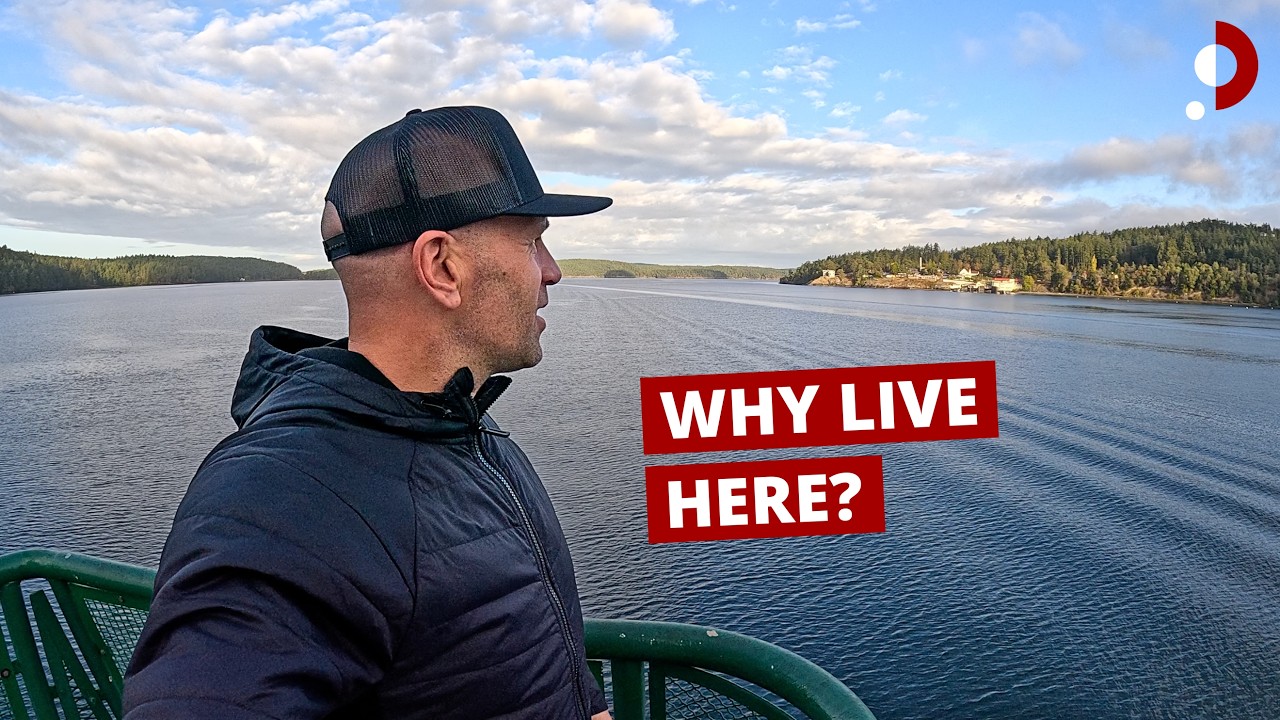
Orcas Island sits inside the San Juan archipelago off the coast of mainland Washington, one of roughly 20 inhabited islands among 172 named ones. Getting there means catching a ferry, and missing the return means losing your spot in line. The island runs on its own clock. The main town of Eastsound is 8 miles from the ferry dock, a drive through meadows, old-growth forest, and farmland that the local land bank has permanently locked out of development. Mount Constitution crowns the island as the highest point of any island in the area, offering a 270-degree sweep of the surrounding water and distant peaks. About 6,000 people live here year-round, though that number swells hard in summer when, as one longtime resident put it, ‘it becomes a different place.’
The community runs on systems that mainlanders rarely build. The island has no emergency room, no urgent care, and no walk-in clinic. The fire station doubles as a walk-in medical stop. A helicopter evacuation off-island can run $15,000 to $30,000, which is why residents are advised to carry a membership with one of three air transport services. Glass recycling is handled by a community-owned crusher that has diverted over 150 tons of glass from a landfill 327 miles away in the south of the state, turning bottles into substrate for landscaping and art. The local exchange, rebuilt after a 2013 fire through community fundraising, functions as a thrift shop at the edge of the transfer station where residents drop off and pick up goods rather than haul them to the mainland.
People who showed up with nothing and bought a house
The people who end up staying on Orcas Island tend to arrive sideways. A carpenter from Santa Monica showed up in 2018, lived in a tent, took on heavy equipment work and odd jobs, and within less than 10 years owned a home. Jimmy, a musician who moved from Southern California decades ago, built his entire property himself using trade work, hosts weekly all-comers jam sessions he calls the Train Wreck, and still has no cell phone. He has a landline. When Santenello asked about the single scene on a small island, Jimmy cleared his throat: ‘Not as bad as the married scene was.’
Affordable housing pressure is real and acknowledged openly. Service workers are actively competing for rentals. One solution that has taken root is a community land trust called Opal, which buys land, builds homes, and offers 99-year land leases so residents can own the structure outright while the land stays permanently affordable. A price ceiling formula controls resale value. The model has let people on working incomes hold ground on an island where roughly 40 percent of homes are seasonal.
Bruce and his wife Tiffany raised two daughters aboard their sailboat Vixen, circumnavigating for 11 years after leaving Victoria in 2004. One daughter was born in New Zealand, the other in Brazil. The family of four lived on about $10,000 a year in places like Indonesia and Madagascar. When they finally came back to Orcas, their house burned down. The community launched a GoFundMe within a day. ‘The Orcas community was amazing,’ Bruce said, standing next to a floor beam still carrying the char.
The talking tree in Eastsound, a tall sequoia with wooden rungs climbing its trunk, was planted when one local teacher was in high school. Kids disappear into its canopy and all you hear from outside is chatter, which is how it got the name.
The talking tree in Eastsound
The sequoia stands in the middle of town, ringed with hand-cut wooden rungs, the bark worn smooth at the handholds from years of climbing.
When the last ferry slot approached and it was time to go, the ferry dock appeared not as an exit but as a kind of seal, a reminder that everything on this island, the music, the glass crusher, the boat car built from a 1967 Volkswagen and a salvaged hull, the seed library at the public school, the scorch mark on Bruce’s floor, stays on the island. You have to come back for more of it, and each time, as one resident at the exchange said plainly, it gets a little harder to leave.
 Wake up to Only Happy News!