Göbekli Tepe was raised 11,500 years ago on a hilltop in southeastern Turkey, more than twice as old as the Great Pyramid of Giza, and it predates writing, cities, and in many places, farming itself. That single fact stops experts cold: who organized the labor, and why? The ancient world left behind no shortage of monumental stonework, but Göbekli Tepe forces a reckoning with what human beings were already capable of doing before most of the story we tell about civilization had even started.
When the stone came before the city
Across the hilltop at Göbekli Tepe, pillars taller than 5 m were quarried from the surrounding limestone and raised into great enclosures. Carved into their surfaces: snakes, foxes, wild boar, vultures, and gazelles, a vivid world of wild animals preserved in stone at a moment when the people carving them had no known system of writing to explain what they meant. For more than a thousand years, those enclosures were built, altered, and replaced. Then, for reasons that have never been satisfactorily answered, some of the great circles were deliberately buried. The civilization that chose to inter its own monuments took whatever explanation it had with it.
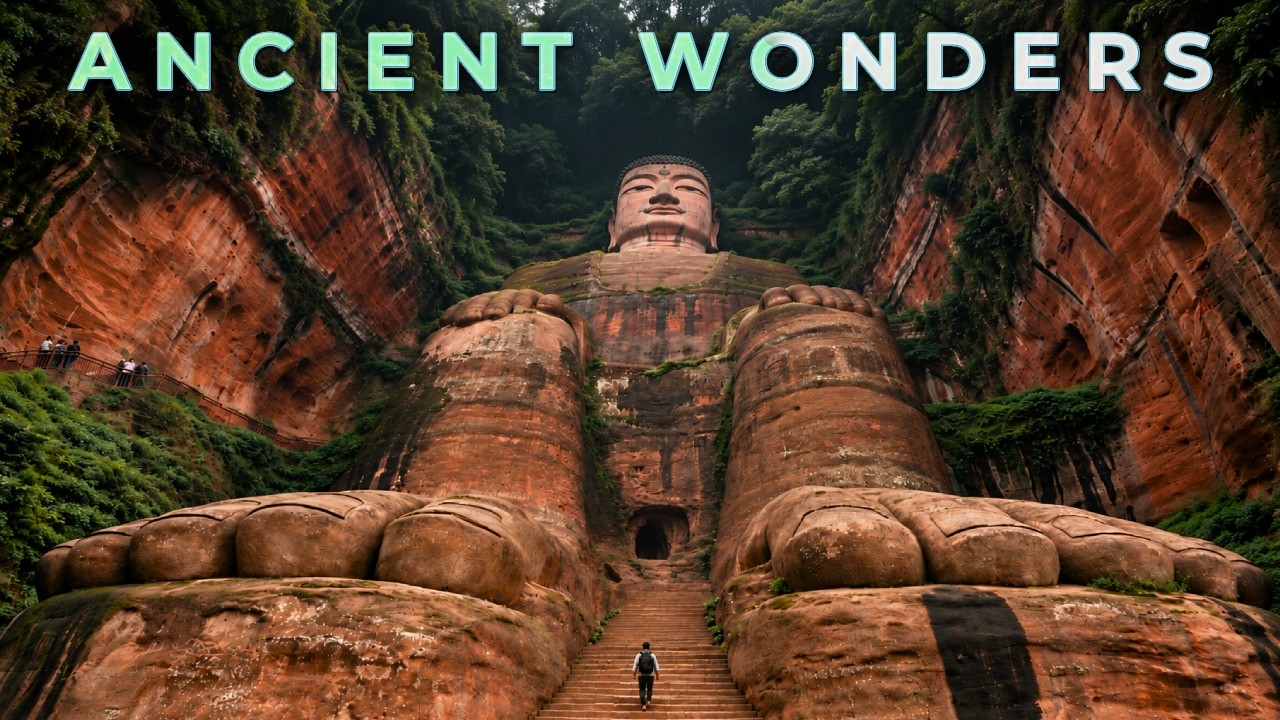
The impulse to build at that scale was not confined to one corner of the ancient world. At Leshan in southwestern China, a monk named Haitong began carving a 71 m Buddha into a cliff in 713 CE, hoping the statue would calm the notoriously dangerous river currents below. He never saw it finished. Work continued for roughly 90 years before the statue was completed in 803 CE. Each ear stretches around 7 m; the middle fingers run more than 8 m long. And the construction may have done exactly what Haitong intended: enormous quantities of stone removed from the cliff were reportedly dumped into the river below, altering the channel and weakening the currents.
In Peru, the Inca engineers at Sacsayhuaman fitted stone blocks exceeding 8 m in height and 100 tons in weight so precisely that the joints in places nearly disappear, with no mortar holding any of it together. At Moray, circular terraces descend into the earth, possibly creating distinct microclimates for testing crops. At Tipón, ancient channels still carry mountain water through the terraces today, centuries after they were first engineered, with no pumps, just a system built around how water moves naturally.
The discoveries that rewrote what was possible
In 1974, farmers near Xi’an in China were digging a well when they broke into something that turned out to be one of the greatest archaeological finds in history: a buried army of around 8,000 life-sized terracotta soldiers, horses, and chariots arranged in military formation, created more than 2,000 years ago for Qin Shi Huang, the first emperor to unify China. The figures appear individual: faces, hairstyles, armor, and expressions vary across the entire army. Originally, they were brightly painted, though the color disappeared rapidly once the figures were exposed to air during excavation. At the center of the complex, the emperor’s burial chamber remains sealed beneath a large mound, left unopened partly because archaeologists fear damaging whatever survives inside. As World Tour put it plainly: ‘if an army this large could disappear without a trace, what other extraordinary remnants of the ancient world are still buried out there, waiting to be found.’
In the Nazca desert of southern Peru, enormous figures and lines stretch across a barren landscape: hummingbirds, monkeys, spiders, whales, and geometric shapes covering kilometers of ground. Some are so large their full design is impossible to read from ground level. In 2024, an AI-assisted survey identified 303 previously unknown geoglyphs in just six months, nearly doubling the known count of Nazca lines. More than 2,000 years after many of those figures were made, the desert is still producing surprises.
A circle of stones nobody has explained
At Stonehenge, the mystery runs deeper than scale. The 6-ton altar stone has now been traced to northeast Scotland, an extraordinary journey of at least 750 km, and reaching the site was only the beginning. The enormous uprights were carefully shaped so the horizontal lintels locked into place using joints more familiar from woodworking than from monumental stone construction. The entire monument was deliberately aligned with the sun toward the midsummer sunrise in one direction and the midwinter sunset in the other. Thousands of tons of stone transported across Britain, shaped, fitted, and aligned with the sky. Exactly what all that effort ultimately meant remains a mystery to this day.
Back on the hilltop in southeastern Turkey, the carved enclosures of Göbekli Tepe sit above a landscape that has long since moved on. The foxes and vultures cut into the limestone look outward from pillars that were buried and then found again thousands of years later. The people who decided to inter them are gone. The reason they did it has never been recovered.
 Wake up to Only Happy News!