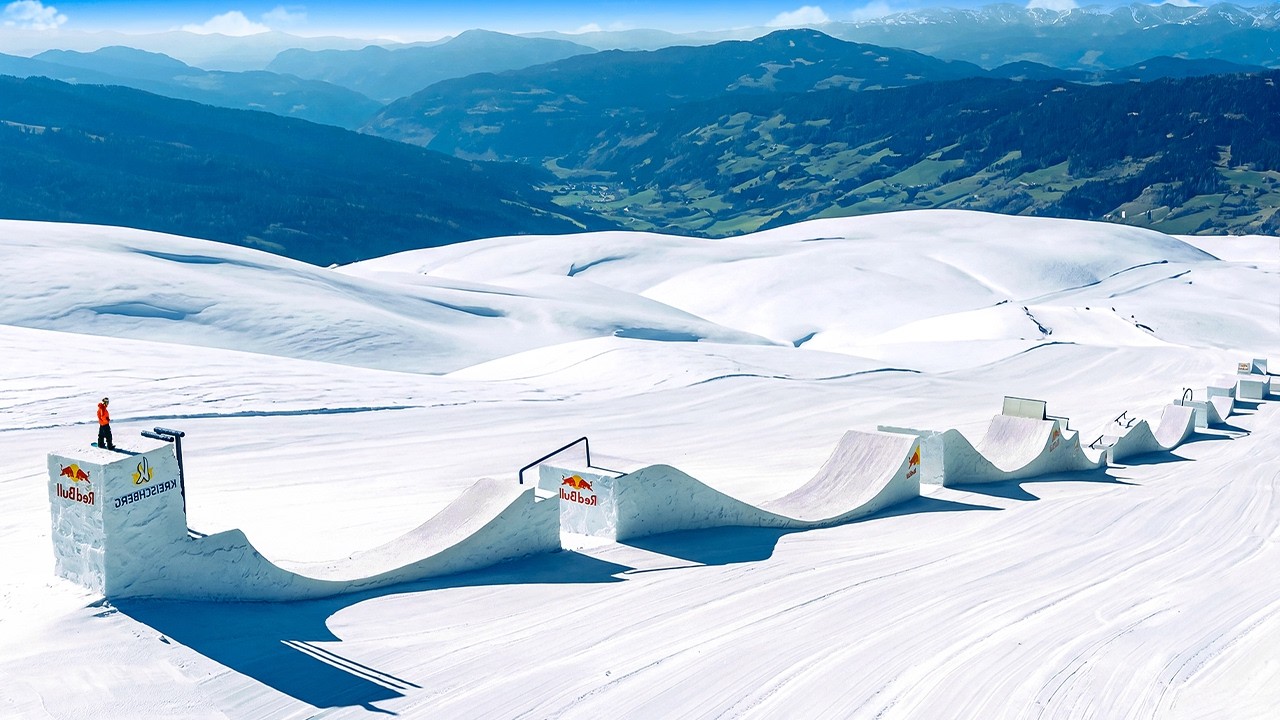
Clemens Millauer stood at the top of a 400-meter slopestyle course unlike anything he had ridden before, staring down a chain of 10 features designed with one rule: no breathing room between them. Every obstacle feeds directly into the next, every mistake sends a rider back up a ladder and over a set of balance beams before they can try again. That physical penalty makes the whole endeavor feel less like a snowboard session and more like a gauntlet, and Clemens built the thing himself.
The idea that turned into a problem
The course came from Clemens’s own vision of a ninja-style slopestyle run, something tight and relentlessly flowy, where every feature connects to the next without a moment to reset. A bomb drop at the top feeds into a channel that leads onto a rail where he planned to throw a trick. After the rail, the course opens into what his crew described as the most consequential section: the double wall ride.
It was originally designed as a single wall ride. Clemens added the second wall himself, and by the time the session was underway, that decision was already being questioned loudly by everyone watching. As one of the builders put it plainly: ‘He would have nailed it already if he didn’t put the second wall ride in.’
The double wall ride became the breaking point. Clemens hit it repeatedly, sometimes carrying the speed and the line almost perfectly, then losing it at the last moment and sliding back down to face the ladder. Each failed attempt meant climbing back up, crossing the balance beams, and dropping in again from the top. He described the feeling of a failed run with unusual precision: ‘You know why I’m so angry? I’m so angry because every time I fail, I know that I need to go back up this ladder and then jump over the balance beams. That’s the worst. Like it was all for nothing in this moment.’
The crew watched, laughed, winced, and shouted. The session settled into the rhythm of a genuine battle, the kind where nobody is sure whether a breakthrough is two attempts away or two hours.
When the whole thing finally clicked
Somewhere deep into the attempts, Clemens found the line. The wall ride held. The rest of the course connected the way it was drawn up. The crew erupted, and one voice cut through the noise with a confession: the backflip built into the course was not Clemens’s addition. ‘He’s going to hate me for that backflip. That was my idea.’
The completed run pulled together every feature, the bomb drop, the rail, the double wall, the backflip, in a single unbroken line. For a course designed to punish any hesitation, that clean run was the only acceptable ending.
The ladder he had to climb one more time
Somewhere in the middle of the session, after one particularly close attempt came apart just past the wall ride, Clemens described reaching the top of the ladder and gripping the rungs with a kind of honest dread. ‘I climbed up the ladder and I was gripped. I was like, oh my god.’ The ladder was not part of the snowboard course. It was just the way back up.
The 400-meter course took one clean, connected run from start to finish to complete. Every one of the 10 features held. The balance beams, in the end, were crossed for the last time.
 Wake up to Only Happy News!