
A young orangutan clings to his mother somewhere high in the Bornean canopy, watching her shift her weight slowly between branches, never once jumping. He has been watching her do this for years, and he will keep watching for years more. Borneo’s rainforest is among the oldest on the planet, and the animals shaped by it carry that age in everything they do. What looks from the outside like a paradise of warmth and endless rain is, beneath the canopy, one of the most demanding places on Earth to stay alive.
When abundance is actually a trap
Borneo straddles the equator and has sat in the tropics for well over 100 million years. Temperature barely shifts. Daylength never changes. Every afternoon, clouds release torrents of rain with the regularity of a clock. By every measure, the conditions for life seem ideal. But the dominant trees, the dipterocarps, a single family with some 300 species, can go as long as ten years without bearing fruit. The same rain that feeds the forest washes nutrients out of the soil on the high peaks, leaving vast stretches of land that can barely support ordinary plants. The result is a landscape where species are not shaped by comfort but by relentless competition for limited resources.
The carnivorous pitcher plants are the clearest illustration of that pressure. On the nutrient-starved peaks, one species lures ants with sweet nectar, then drowns them in a liquid-filled trap formed from a modified leaf tip that inflates over several weeks before opening. Another species, Hemsleyana, has evolved the back wall of its pitcher to perfectly reflect the sonar of a small bat, though it has no interest in eating the bat. What it wants is the bat’s droppings, a source of the nitrogen the soil cannot provide. The bat gets a perfect resting place in return. It is the kind of arrangement that only emerges when every scrap of nutrition is worth engineering a partnership to secure.
The same logic plays out underground. The immense caves carved by centuries of water hold mounds of bat droppings stretching some hundred metres long. Millions of cockroaches live on nothing else, recycling the material completely, including the bodies of the bats themselves. Cave swiftlets nest sixty metres above the cave floor on walls of near-total darkness, and the nests they build from saliva are valuable enough that collectors without safety harnesses climb rattan ladders to reach them, spending entire days in the dark at fatal height. Those nests are the main ingredient in bird’s nest soup, and those from Borneo’s ancient caves are among the most valuable on earth.
The creatures the island made
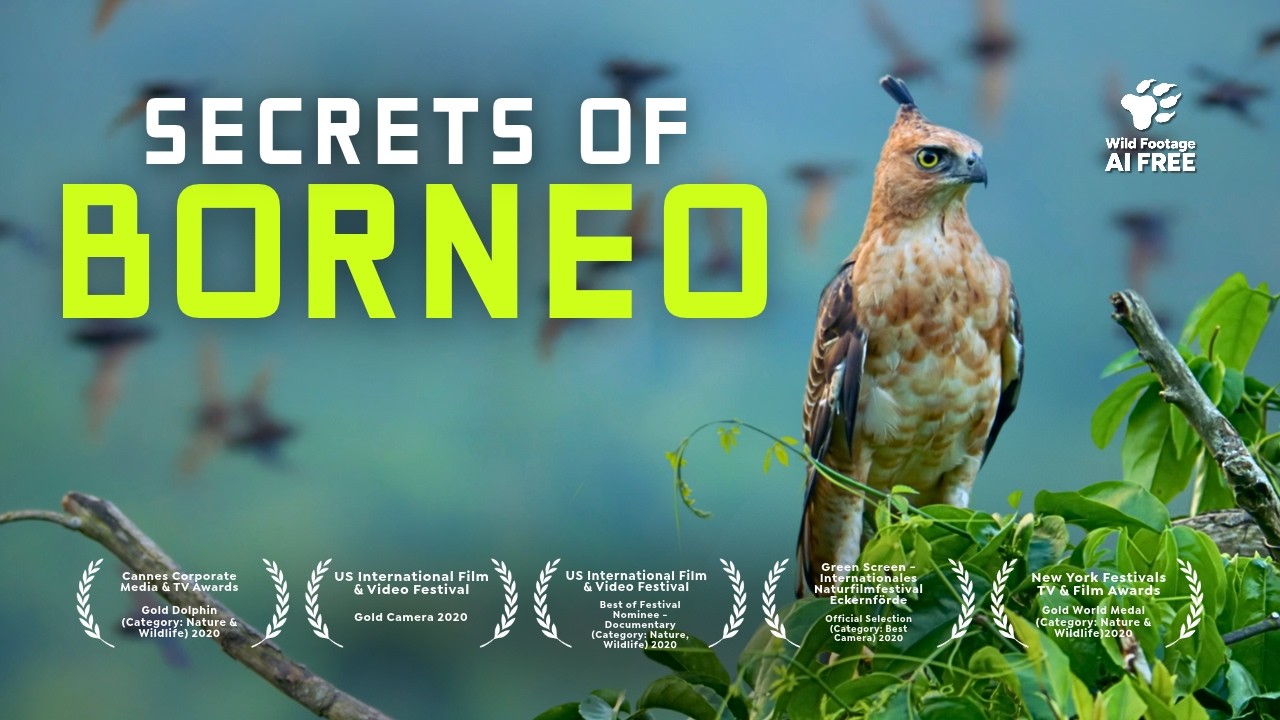
At the cave entrance each evening, a Wallace’s hawk eagle waits for the nightly exodus of hundreds of thousands of wrinkle-lipped bats. On one such evening, a group of pied hornbills, birds built for picking fruit, began attempting to catch bats in flight alongside the eagle. The Terra Mater team captured what they described as a completely new behaviour, never recorded before: fruit-eaters with blood on their bills. The island, it turns out, still produces surprises.
In the mangrove forests where the great rivers reach the sea, proboscis monkeys are the only large animal that cuts it in the daily salt-water influx, digesting tough mangrove leaves with the help of special bacteria and a multi-chambered stomach. They are the only primate known to regurgitate food and re-chew it, the same way a cow does. Inland, the net-casting spider Deinopsis hunts in near-total darkness using eyes among the most light-sensitive in the natural world, holding a small flexible web and casting it onto prey with impeccable aim. In a lake cut off from the ocean for thousands of years, four species of jellyfish descended from trapped marine ancestors have all but lost their sting. Two of those species farm microscopic algae living inside their own cells, migrating each morning toward the surface so the algae can photosynthesize and provide energy in a place with almost nothing to eat.
The young orangutan on the branch above
He has not yet learned to bend branches across gaps the way his mother can. That takes a body weighing at least enough to do the work, and he will not have that until he is around six. For now, she serves as the bridge.
The eight years they will spend together before he moves on is the longest childhood of any wild primate, and it exists for a reason the forest itself designed: so much needs to be learned, so many seasonal cues memorized, so many plant species catalogued for edibility, that there is simply no shortcut. His mother navigates this ancient place with the calm of someone who has spent decades decoding it. One day, so will he.
Right now, he is using her back to cross a gap in the canopy that he cannot yet cross alone.
 Wake up to Only Happy News!