
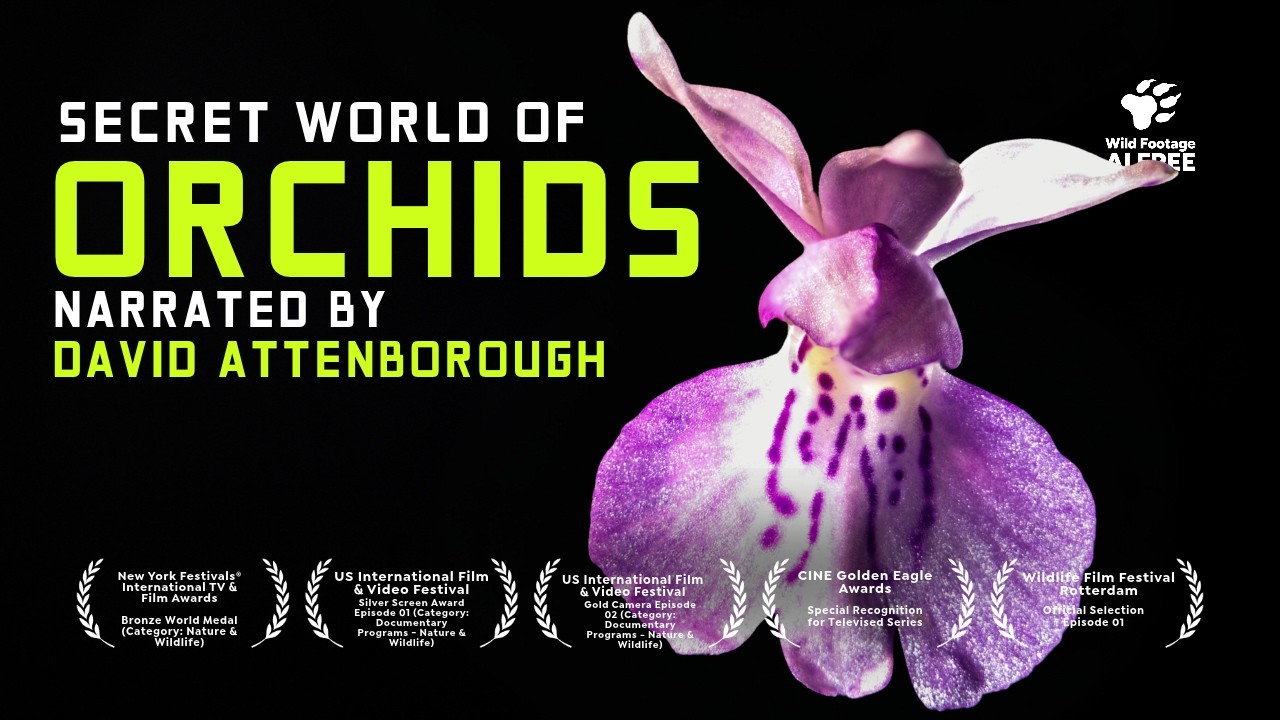
Anthony Lamb has been exploring the rainforests of Mount Kinabalu in Borneo for 50 years, and he is still finding plants that have never been photographed before. At nearly 1,600 meters on the mountain’s slopes, he moves through forest so thick with moss and climbing orchids that some species there have only ever been collected twice in a century of botanical work. This is not a quirk of one remote mountain. It is a window into the most elaborate system of biological deception in the plant kingdom, one that Charles Darwin himself could barely explain and that scientists are still untangling today. Orchids, all 25,000 species of them, roughly one in every 20 plants on Earth, did not get this successful by playing fair.
The trap, the fake, and the promise that never pays out
The lady’s slipper orchids of the Appalachian Mountains offer one of the more structurally honest versions of orchid trickery. A bee enters the swollen, shoe-shaped lip drawn in by bright color, finds the interior too steep and slippery to exit the way it came, and squeezes out through a narrow channel at the base that presses a sticky mass of pollen directly onto its back. The bee is inconvenienced. The orchid is pollinated. At least the bee was genuinely investigating something that looked promising.
The bee orchid goes further. Its lip has evolved to physically resemble a female bee, and it releases a chemical mix close enough to female bee pheromones that eager males attempt to mate with the flower. They depart carrying pollinaria and, as Darwin long suspected, rarely fall for it twice. The green-winged orchid runs a subtler con: it looks enough like a nectar-producing flower that bees investigate it, pick up its pollen while probing for a reward that does not exist, and leave hungry. Scientists recently found that this is not simply an evolutionary shortcut but an active advantage. When nectar was artificially added to the flowers in a controlled experiment, bees lingered so long that they transferred pollen between flowers on the same plant, producing the inbreeding the orchid is trying to avoid. By offering nothing, the green-winged orchid sends its pollinators elsewhere, to another plant of the same species.
Around a third of all orchid species produce no reward whatsoever.
Darwin’s longest wait and a moth with a foot-long tongue
In 1862, Darwin was sent a comet orchid from Madagascar with a nectar spur he measured at over a foot long. He made a prediction that was met with open skepticism: somewhere in Madagascar, there had to be a moth with a tongue long enough to reach the nectar at its tip. It was not until after his death that such a hawk moth was confirmed to exist. Then, just a few years ago, entomologist Phil DeVries staked out a comet orchid at night in a Madagascan forest canopy using infrared cameras. When the moth finally appeared and uncoiled its tongue into the spur, DeVries said simply: ‘Look at the tongue. Look at the tongue’s coming out, man. Amazing.’ Final proof, 143 years after the prediction.
Orchid seeds carry their deception all the way to germination. Too small to contain food supplies, they parasitize underground fungal networks, chemically blocking the fungi from decomposing them while stealing nutrients to fuel early growth. The bird’s nest orchid takes this further still, never developing leaves at all, drawing everything it needs from fungi connected to the roots of surrounding trees for its entire life.
The school greenhouse keeping ghost orchids alive
In Fakahatchee Strand in southern Florida, roughly 2,000 ghost orchids survive for most of the year as nothing more than green roots on a tree trunk. When summer rain arrives, a single extraordinary flower opens in the dim swamp light. All locations are kept secret. Remote cameras in the swamp have caught poachers leaving with armfuls of rare plants.
At Writhlington School in Somerset, students growing over 1,000 orchid species in state-of-the-art greenhouses are part of the response. The school runs its own propagation lab, sells plants to fund conservation trips, and has helped establish the first seed germination lab in southern Laos, a region where wild collection remains a serious problem. One student put it plainly: ‘It’s probably the best plant family to be involved with.’
The nutrient jelly devised for premature infants
At Kew Gardens in London, Margaret Ramsay spent more than a decade developing the growing medium that finally allowed the British lady’s slipper orchid to be raised from seed after the wild population was reduced to a single plant by Victorian collectors. The nutrient jelly that worked was originally formulated by a Swedish pediatric surgeon for intravenous drips, adapted because, as Ramsay explained, it turned out to be ‘equally good for small patients, be they plants or human.’
The lady’s slipper now grows again at carefully guarded sites in northern England. It is, by some accounts, the most photographed plant in the country.
Anthony Lamb, still working the slopes of Mount Kinabalu, says the number of orchid species on and around that one mountain could eventually approach 900, nearly four times the total found across all of Europe. He expects to keep finding them.
 Wake up to Only Happy News!