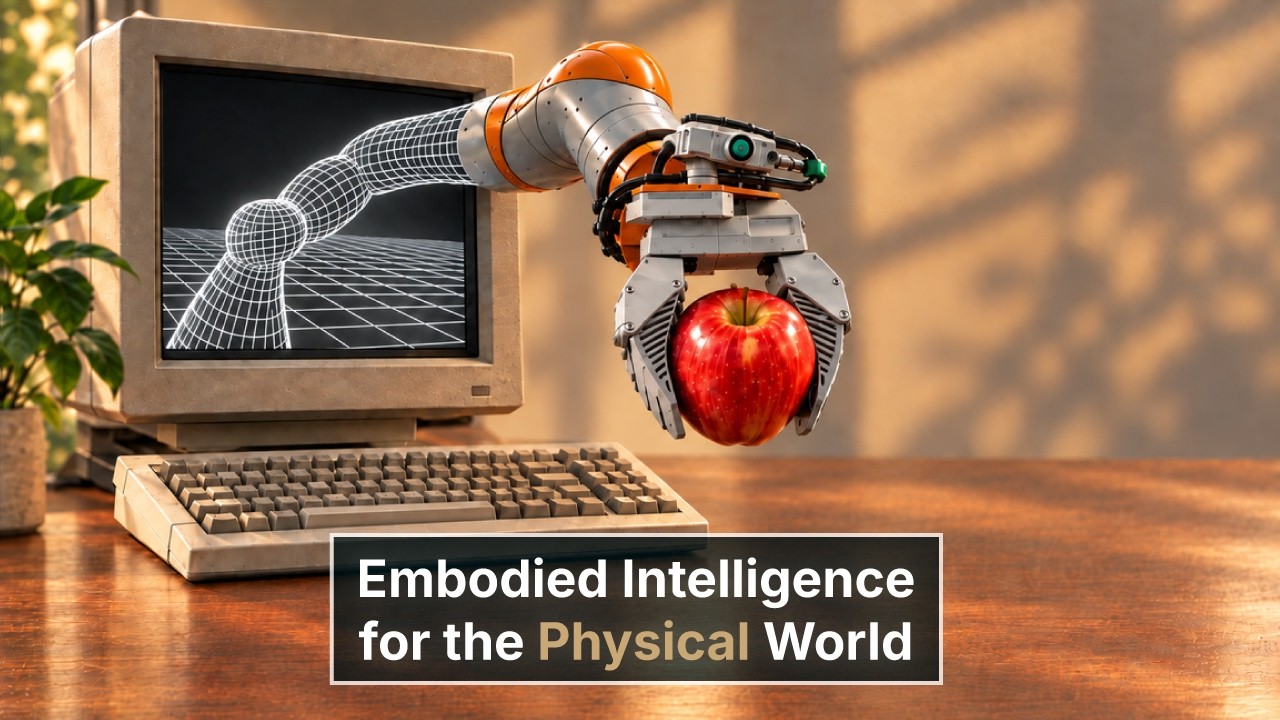
A toddler picks up an object it has never seen before. Within four seconds of turning it, twisting it, and dropping it, the child has already mapped its mass, its balance point, what it will and will not do. No robot on the planet can do that right now. That gap, between a machine performing preprogrammed actions and one that genuinely understands the world, is the central problem driving Physical AI research at MIT CSAIL, where the challenge runs through the entire building, from the fingertips of an experimental robot hand to the floor of the ocean.
Why touching something is harder than thinking about everything
For more than fifty years, engineers have known how to build the body of a robot. The intelligence to run it in the unpredictable real world was another matter entirely. When large language models arrived and consumed nearly everything ever written, it looked like a template for solving robotics. It was not. Language had the whole internet as a training ground. The physical world does not come with one.
The mechanics of why are specific and uncomfortable. Before a robot finger contacts a solid object, the physics calculations are clean and manageable. The instant contact happens, the rules fracture into dozens of micro-transitions: stick, slip, release. Each one has to be understood, not just computed. And unlike text, that data cannot be scraped. It has to be made.
One researcher at MIT CSAIL put the stakes plainly: ‘Physics doesn’t tell me what I should do with that coffee cup. A perfectly good solution would be for the robot to stick its finger right in my coffee and bring it over like this. But I don’t want that.’ Holding a cup of coffee with liquid inside requires something robots currently lack entirely: learned human intuition about what other people find acceptable. There is nothing in the laws of physics that encodes social expectation.
A backflip, counterintuitively, is one of the easier things a robot can learn. It happens in midair, where physics is forgiving. Opening a jug of milk is historically among the hardest.
The chicken-and-egg problem that goes all the way to the ocean floor
The data crisis at the heart of Physical AI has a name at MIT CSAIL: the chicken-and-egg problem of robotics. To get robot data, machines have to be deployed. To deploy them, they have to work. To make them work, you need data. No single path out of that loop is sufficient on its own.
Human video is abundant and teaches objects in motion, but carries no force or torque data. Teleoperation captures those forces, but moves at human speeds. Simulation is fast, but dominated by imprecision. Train a robot on a ceramic mug inside a simulator, then hand it a plastic one of the same shape at a fraction of the weight, and the grip is calibrated for a mug that no longer exists. Researchers call this the sim-to-real gap. The current workaround is deliberate messiness: randomizing weight, friction, and lighting across thousands of simulated versions until the real world registers as just another variation.
Underwater, the problem reaches its outer limit. There is no GPS below the surface. Wi-Fi is useless. Sonar replaces cameras, turbidity replaces lighting, and the labeled datasets that power modern AI simply do not exist. The offshore oil industry still relies on saturation divers living at depth to manipulate valves and make physical connections. The researchers working on underwater Physical AI at MIT CSAIL frame the goal not as replacing those divers but as amplifying their capabilities and improving their safety.
In factories right now, robot arms and human workers already share the same stations. One researcher described the near-term arc directly: ‘The next station is robot, doing almost the same task, right next to you, and you can fix and correct and interact. This will become a norm even in the next one to two years.’
The worker who still does the step no machine has mastered
In a real warehouse running automated manufacturing lines, there is still a person in the middle moving objects from a box to a tray. That handoff, that small dexterous judgment call repeated thousands of times a shift, is precisely what Physical AI has not yet closed.
The full-circle wrap on that observation is not comfortable, and the researchers at MIT CSAIL do not pretend otherwise. Safety standards for humanoid robots are still being written by ANSI and ISO committees, following a slower arc than the technology itself. The deployment, everyone agrees, has to be safe even when the innovation is not required to wait.
For now, that person moving objects from box to tray is still there, doing the step the robot next to them has not learned yet.