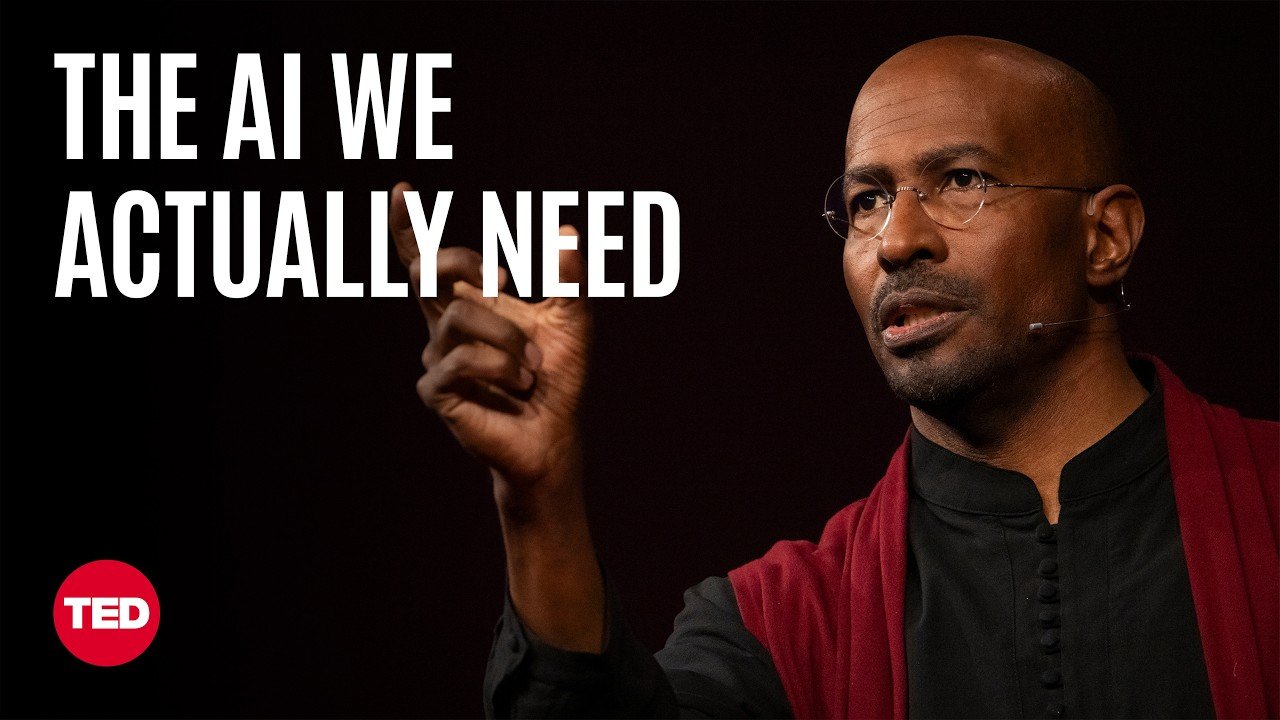
Van Jones walked onto a TED stage and said the quiet part out loud: two of his children still sleep in diapers, and their first crushes may not be a rock star or an athlete. Their first crushes may well be an AI. That single observation cuts to the heart of what Jones calls the adaptation gap, a widening distance between technology moving on an exponential curve and human beings who still evolve on a largely linear one. The question he brought to the room was not whether the new civilization will be powerful. It will be. The question is whether it will be human, and whether it will be civilized.
When abundance only reaches one side of the room
Jones opened with a thought experiment that landed like a verdict. Imagine someone wheels a barrow of diamonds and gold into a room and dumps it entirely on one side. The room is technically richer. The people on the other side are not. They are miserable. Then their child asks: ‘Mommy, Daddy, how come we don’t have what they have?’ Jones named what happens next with precision: ‘You’re not just unhappy. You’re ashamed. You’re humiliated.’ He has worked in some of the toughest prisons in the world, he told the audience, and the one thing you never want to do is take someone who already has nothing and then humiliate them. They become the most dangerous person in that prison, even if they only weigh 100 pounds. The implication was direct: the tech industry is not just risking mass unemployment. It is risking mass humiliation, and the two are not the same problem.
The solution Jones proposed is not decelerating technology. He was blunt about why that approach fails. Having spent considerable time in Washington, D.C., he noted that Congress cannot catch a train moving that fast, and US senators are not, in his words, ‘exactly lickety-split type people.’ The better move, he argued, is to accelerate humanity.
Ancient Intelligence as the missing variable
Jones built his case around what he calls Ancestral Intelligence, or Ancient Intelligence, the accumulated practical and moral wisdom held in communities, families, faith traditions, and grassroots institutions that the tech world tends to treat as legacy noise. He pushed back hard on that dismissal. Those small Black churches, he said, had nothing but praying hands and marching feet, and changed a whole nation. Grandmothers, mosques, prayer circles, Native American ceremonies: these are not obstacles to innovation. They are the correction mechanism for people caught in what Jones called a greed and speed trap.
He challenged the grassroots side too, with equal directness. ‘I think we replaced I have a dream with I have a complaint.’ Dr. King, he reminded the room, was a futurist, not a historian. A dream is about tomorrow. A politics that multiplies enemies rather than friends is not consistent with Ancestral Intelligence, regardless of how legitimate the grievances behind it are.
The concrete examples Jones pointed to involved pairing, not replacing: Andre Peart, formerly incarcerated, teaming with engineers to build a LinkedIn-style platform for people with criminal records, now deploying AI agents to support social workers; Noella Sudbury, a lawyer, using AI to expunge prison records; Phaedra Ellis-Lamkins and Diana Frappier at Promise, building what Jones described as a billion-dollar company to help government become more frugal and more helpful rather than more lethal; and John Hope Bryant launching HOPE AI with a goal of getting a billion people AI-literate in ten years.
A check engine light and a child’s question
Somewhere in that room, Jones described a family whose main enemy is not a rival tech firm but a check engine light. When that light comes on and there is no money to get the car looked at, that is the actual lived opponent. Nobody at the table holds an equity stake. Nobody is on an exponential curve. That family is not waiting for a framework. They are waiting for the math to stop working against them.
Jones closed by asking that the tech world offer a little less greed and speed, and that the grassroots world offer a little less shame and blame, and a little more space and grace. If those two things meet, he argued, what gets built will someday become the Ancestral Intelligence for the children watching all of this unfold right now.
 Wake up to Only Happy News!