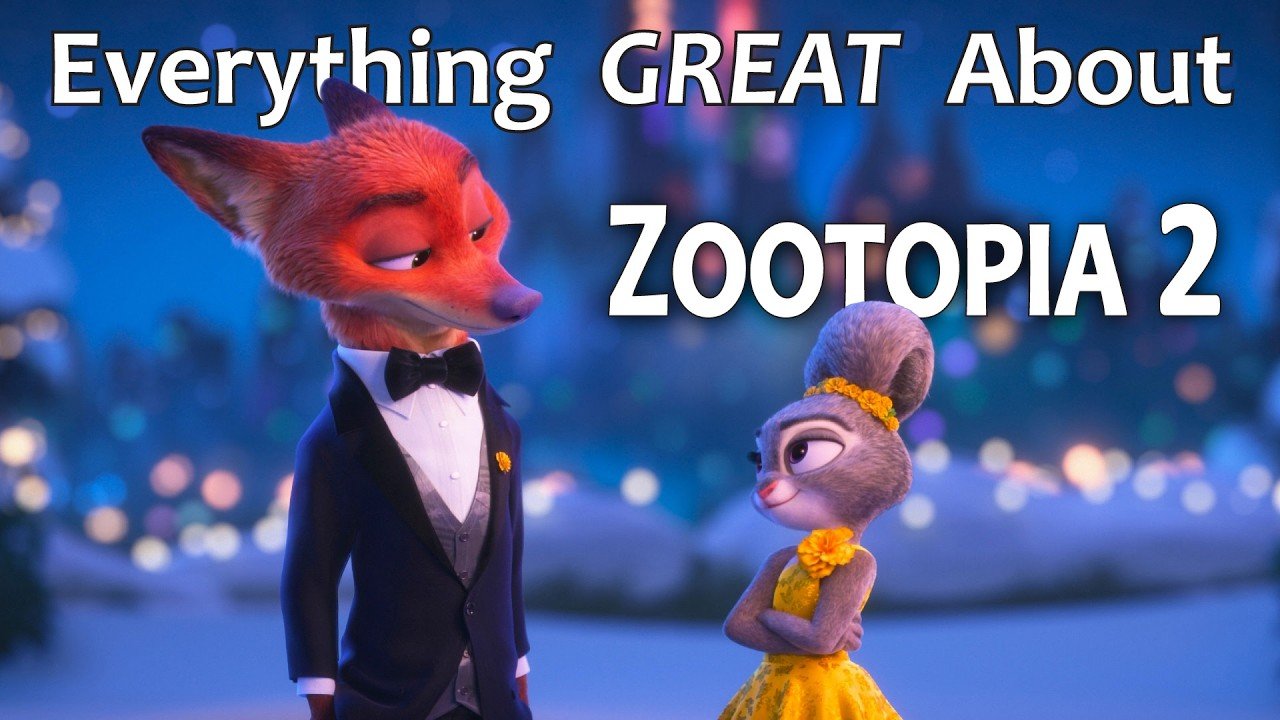
CinemaWins documented a thorough celebration of Zootopia 2, identifying the animated sequel as a film that not only surpasses expectations but delivers one of the most emotionally resonant and socially aware animated experiences in recent memory. The review, packed with specific scene-by-scene analysis, builds a compelling case that Judy Hops and Nick Wilde have returned in a story that earns every laugh, every gut punch, and every heartfelt moment.
Pubert, Gary, and the Characters Who Steal the Film
One of the standout revelations in the CinemaWins analysis is the extraordinary introduction of Pubert, voiced by Andy Samberg. Described as an ‘incredible character intro,’ Pubert arrives as an apparently sincere and endearing figure before executing a villain turn so convincing that CinemaWins noted his own eyebrows ‘hit his hairline’ — a significant admission from a reviewer who professionally anticipates plot twists. Samberg’s cold menace in the film’s final act drew a direct comparison to Judge Claude Frollo, marking Pubert as one of animation’s more surprising antagonists.
Gary, a snake character whose warmth and sincerity anchor much of the film’s emotional core, received equally devoted attention. CinemaWins traced Gary’s arc across multiple scenes, noting how his instinct to move toward Judy’s warmth in a freezing sequence — readable simultaneously as survival instinct and emotional encouragement — represents exactly the kind of layered storytelling that elevates the film. Nibbles was identified as ‘genuinely one of the best characters of the franchise,’ with CinemaWins issuing a direct promise to ‘flip out’ if Nibbles does not appear in a third installment.
The Lynxley Displacement Plot and the Film’s Social Ambition
CinemaWins gave extended analysis to Zootopia 2’s central conflict: the revelation that the Lynxley family orchestrated the erasure of an entire reptile neighborhood, burying Marsh Market in snow to expand Tundra Town. The review called out the film’s willingness to address ‘the displacement of marginalized communities and subsequent demolition of their neighborhoods’ as something unexpected from, in CinemaWins’ words, ‘the Talking Fox and Cute Bunny movie.’ The reptile community’s red-lit gathering space, initially readable as a moody speakeasy, is recontextualized as simply a place where cold-blooded animals can feel warm — a detail CinemaWins identified as both scientifically grounded and emotionally generous.
The review also highlighted a key thematic distinction between Zootopia 2 and its predecessor. Where the original film’s racial allegory faltered by implying that predators ‘used to be dangerous in the past, but they’re not now,’ Zootopia 2 corrects the framework entirely: the story used to disenfranchise reptiles was, as Gary states plainly, ‘a complete and total lie.’ CinemaWins praised this as the film focusing on ‘the very real tragedies and losses of the animals affected’ rather than the villains themselves.
Chief Bogo’s nuanced leadership speech to Judy, Nick’s immediate trust in Judy during the film’s climactic sequence, and the mutual vulnerability exchange between Nick and Judy — in which both characters articulate their fear of loss and their commitment to each other — were each flagged as evidence of writing that respects its audience. The Nick-and-Judy confession scene, in which Nick admits ‘you’re the best thing that ever happened to me’ and Judy reciprocates in kind, drew particular praise for modeling emotional honesty in a format accessible to children and adults simultaneously.
Zootopia 2 joins a relatively short list of animated sequels that deepen rather than dilute their source material. Walt Disney Animation Studios, which produced both films, has used the Zootopia franchise to engage with systemic inequality in ways that mirror academic discussions of housing discrimination and community erasure — themes explored in real-world contexts by institutions including the National Fair Housing Alliance. The film’s willingness to name displacement as a mechanism of power, and to center the experience of those displaced rather than the architects of the system, positions it alongside animated works like WALL-E and Encanto in using the genre’s accessibility as a delivery mechanism for genuinely difficult ideas.
CinemaWins closed the review with a forward-looking note: the assumption that Nick and Judy’s wedding and a bird-littering subplot will anchor Zootopia 3 — a lighthearted prediction that nonetheless signals full confidence that this franchise has earned its future.