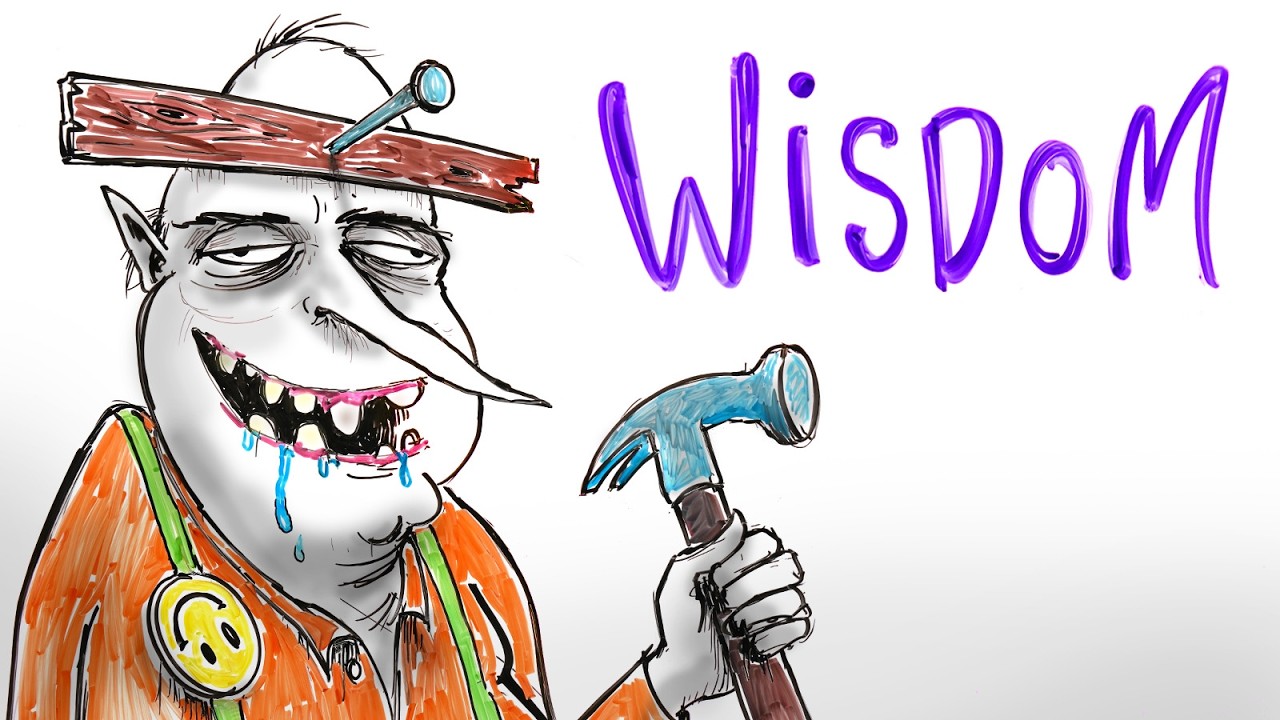
Ten years ago, the artist behind After Skool described himself as bitter, lost, and burning with energy he had nowhere to direct. He was a self-described foolish artist desperately searching for answers. A decade later, on the channel’s tenth birthday, he is still searching, still drawing, and still convinced that curiosity is the whole point. What follows are the lessons that shaped that decade, filtered through philosophy, neuroscience, parenthood, and a deliberately smudgy ink line.
Sleep, mornings, and eating the frog first
The first lesson is unglamorous and non-negotiable: prioritize a good night of sleep. Go to bed at the same time every night, keep the room dark, quiet, and cool, and sleep on your left side for optimal digestion. After waking, get bright light into your eyes immediately and hold off on caffeine for the first 90 minutes, or risk the afternoon crash that follows. From there, do the hardest thing first. Mark Twain’s instruction gets quoted here directly: ‘Eat a live frog first thing in the morning, and the rest of the day will be easy.’ A strenuous morning workout, the After Skool creator found, turns the volume down on all the daily drama that follows. The broader principle extends beyond mornings. If you voluntarily choose to do hard things, the suffering along the way carries meaning. Eating cake and binge-watching television eventually gets hard too, so you might as well choose something worth suffering for.
Finding that something is where the Japanese concept of Ikigai enters. It maps four overlapping circles: what you are good at, what you love doing, what people will pay you to do, and what the world needs. The intersection of all four is the sweet spot. As the creator put it, if you feel empty, you might be a TikTok influencer.
Dopamine, the unconscious, and bumper bowling with your kids
Neuroscience has quietly revised one of its most popular ideas. For a long time, dopamine was understood as the reward chemical, the pleasure that arrives when you get what you want. Current understanding places the pleasure earlier: in the anticipation, in the act of making progress toward something. That reframe matters practically. Focus on progress, not perfection.
Subconscious programming sits beneath all of it. By age three, the brain is roughly 80 percent developed. By seven, the subconscious programs are fully formed. Much of the addictive behavior visible in adults, the creator argues, is an attempt to find an attachment that was missing in those early years. Altering those programs later in life requires either hypnosis or repetition, and almost always involves a shift in environment, a rock-bottom moment, or, as he puts it plainly, a big psychedelic trip. Carl Jung’s framing anchors the point: ‘Until you make the unconscious conscious, it will direct your life, and you will call it fate.’ A new habit takes roughly three weeks to form; after that, the desired behavior happens automatically.
Becoming a father clarified much of this in a way no philosophy could. Looking into his daughter’s eyes for the first time, he says, deeply changed him. He now sees his children as bowling balls and himself as the bumpers, one side discipline, the other encouragement, because too much of either produces fear or recklessness.
The algorithm, the smudge, and what makes us human
The attention economy, he argues, has flattened personality and turned content creators into machines chasing an algorithm treated like an almighty deity. His response has been to draw looser, messier, more honestly. No more straight lines or smooth gradients. He lets the ink dry where it pleases, scribbles, smears, smudges. Bob Ross gets the credit for the operating principle: ‘We don’t make mistakes, we have happy accidents.’
On decisions: never act on the first thought, which is usually reactionary or impulsive. The second or third thought is the conscious telling you what is right. Anything beyond the third is overthinking. Make the choice yourself, take decisive action, and own the outcome. You will either be victorious or you will learn something. Inaction, he says flatly, is a slow death.
Immanuel Kant’s single-sentence distillation of morality stays close: never use other people as a means to an end, only as your end. If he gets his wife a burrito to make her happy, she is the end. Ethical. If he gets her a burrito so she will do him a favor, that is manipulation. The distinction sits at the front of his mind every time he draws.
A decade’s worth of wonder, held loosely
A battered sketchbook sits somewhere in the After Skool workspace, filled with smeared ink lines and happy accidents accumulated over ten years.
Albert Einstein’s two ways to live close the loop: as though nothing is a miracle, or as though everything is one. The After Skool creator has chosen the second, and no experience confirmed that choice more fully than the first moment he looked into his daughter’s eyes. The curiosity that started a decade of hand-drawn animations is still there, still unquenched, still treating every obstacle as a gateway. The best, he insists, is yet to come.