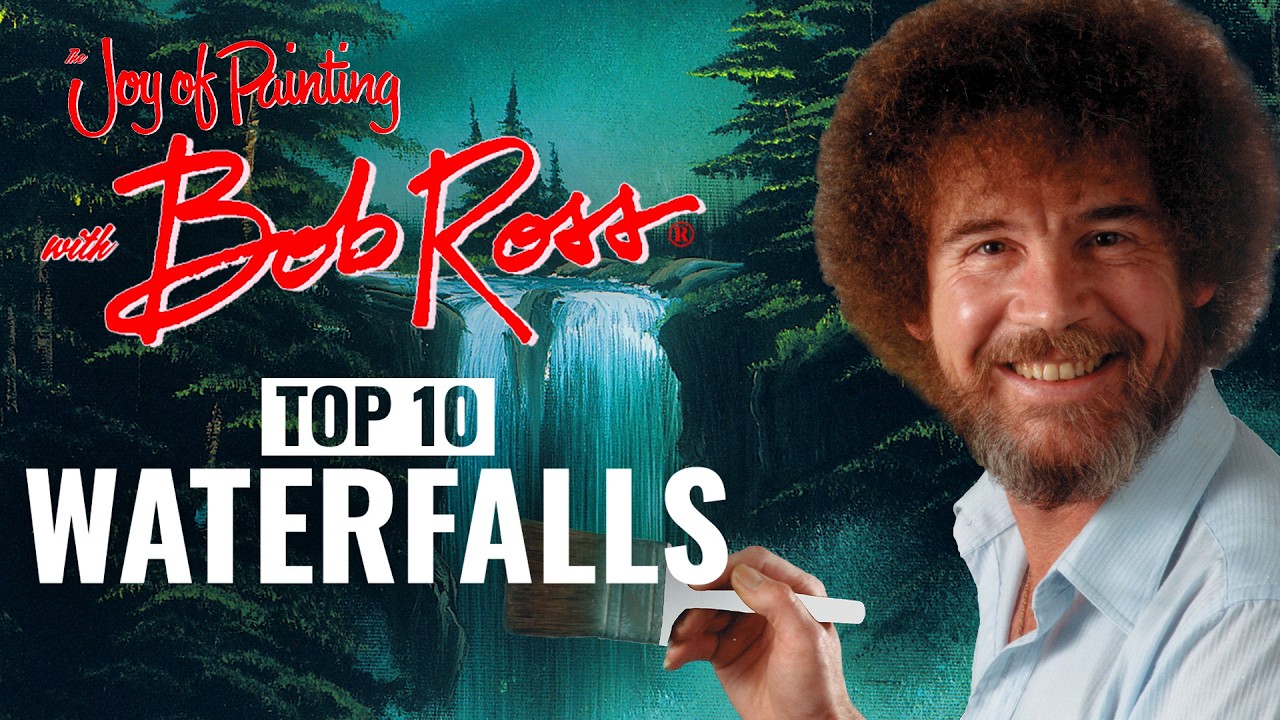
Bob Ross picked up a fan brush loaded with titanium white, touched it to a wet black canvas, and pulled straight down. That single stroke, done fast so the hand would not wobble, became a waterfall. The simple physics of the move matter to anyone who has ever stared at a blank canvas and felt paralyzed: speed and confidence produce the result, not careful deliberation. Across ten separate Joy of Painting waterfall episodes collected here, Ross returned again and again to that same physical problem, each time solving it a little differently.
Why the black canvas changes everything
The foundation of nearly every waterfall in this collection is black gesso, covered with a thin coat of liquid clear, then glazed with a transparent color such as phthalo blue mixed with sap green. Ross called this the hardest part of the whole painting, not because the technique is difficult but because it has to be done before the demonstration begins, and it requires complete drying time. Once that base is in place, titanium white placed anywhere on the canvas seems to glow from within. A small amount of white tapped at the top of the frame with a two-inch brush, using little crisscross strokes, produced a light source that pulled the eye immediately toward the waterfall zone below it.
The water itself followed a consistent physical logic regardless of the episode. Still water is always flat, so brush strokes had to go straight across or they would create the illusion of water running uphill. Falling water, by contrast, needed a stroke that went horizontal first and then dropped: the fan brush would come across and then bend downward in one fast motion. At the base, the same fan brush loaded with liquid clear and titanium white was spun, wiggled, and pushed upward to create foam and mist. Ross was explicit that the fan brush had to actually spin against the canvas: ‘Just spin it. Wiggle it. Push it. Get crazy with a brush. This is where you take out all your frustrations.’
Rocks, trees, and the things that hold water in
A waterfall with nothing containing it, Ross pointed out repeatedly, will simply run off the canvas. Rocks were placed using a palette knife loaded with Van Dyke brown and dark sienna, the knife barely touching the surface so the colors would skip and bounce rather than fill in flatly. Highlights on the tops of stones came from a small roll of mixed brown and white held on the very edge of the knife. Trees and foliage were built outward from the waterfall in layers, each layer separated from the one behind it by a thin band of mist produced by tapping a clean dry brush at the base of the tree shapes and lifting upward.
In one episode Ross took a break from the canvas entirely to share footage from a private painting class he held in Nashville, where country music legend Hank Snow joined him alongside Grand Ole Opry announcer Grant Turner and behind-the-scenes figure Fred Perta. Snow, who painted alongside Ross for two days, held up a hand covered in paint at the end of the session. ‘The other one’s worse,’ Ross told the camera.
By the final episode in the collection, Ross noted that the Joy of Painting had produced close to 340 shows. He credited the audience directly: ‘It is absolutely your fault. You have invited us into your homes. You made us feel like part of your family.’
A fan brush still loaded with phthalo blue
On a shelf somewhere, a fan brush holds the dried residue of phthalo blue and titanium white from the last stroke of the last waterfall in this collection, still bent slightly at the tip from being pushed upward against a canvas to make foam.
The black gesso was always dry before the cameras came on. The rest, as Ross put it more than once, was easy.