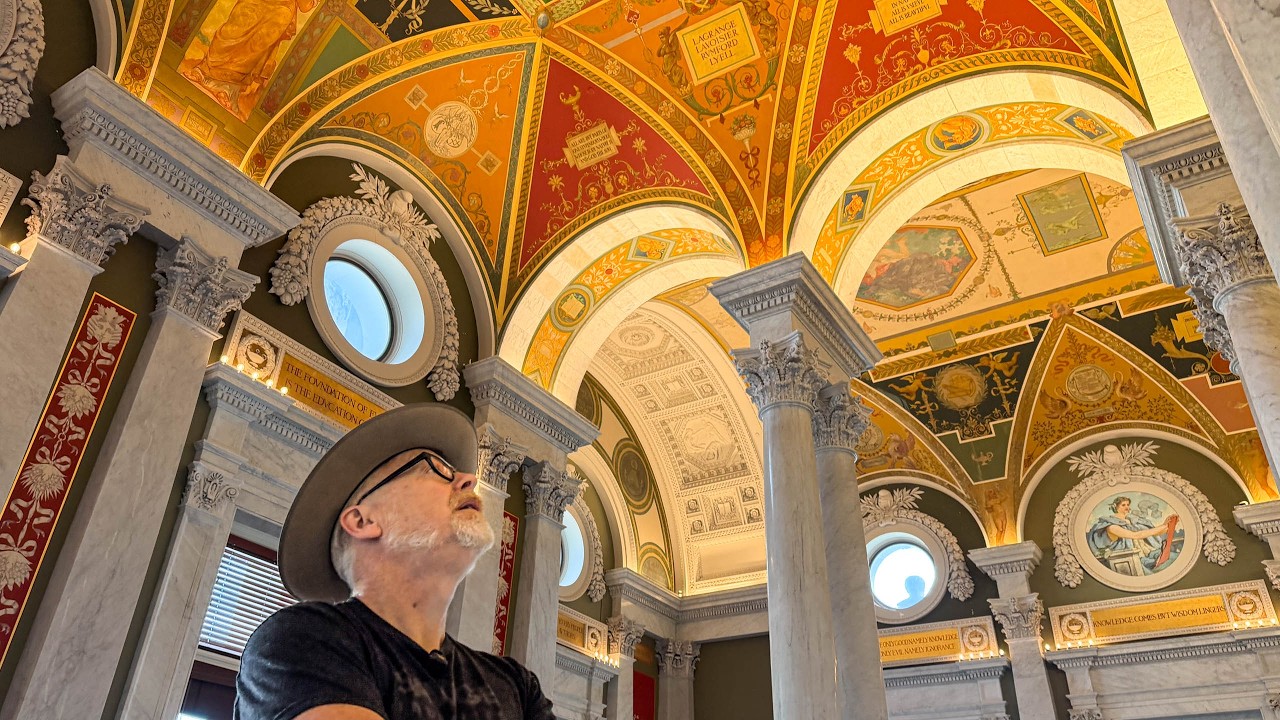
The Gutenberg Bible sits in the Great Hall of the Library of Congress, printed on vellum animal skin, climate-controlled, humidity-controlled, and open to anyone who walks through the door. That last part is what stops most visitors cold. The Library of Congress is not a restricted archive for scholars or government officials. It is a palace built for the American people, and on any given weekday, thousands of them file past one of only three known complete Gutenberg Bibles in existence before lunchtime.
Adam Savage arrived at the Thomas Jefferson Building early enough to beat the crowds, joining Ryan Ramsey for a private look before the doors opened to the public. The building sits between the United States Capitol and the Supreme Court, and the first thing Savage noted, before the history and before the numbers, was the architecture. ‘I’ve rarely been in a place that felt so much like a church to knowledge,’ he said. Ramsey did not disagree. The Congress that commissioned the building over a century ago had a deliberate point to make: in Europe they build palaces to princes and kings, and here the Americans wanted to build one to knowledge instead.
A reading room under a 160-foot dome
The main reading room is the building’s centerpiece, a Beaux-Arts space completed in 1897, ringed in marble, with allegorical figures representing fields of human study carved into every surface. Above it all, a soaring 160-foot dome holds a painted portrait called the ‘portrait of human understanding,’ visible only from the reading room floor. The figure at its center is lifting the veil of ignorance from her face. Researchers working below it are, the building suggests, doing the same thing. The collection they can reach from those desks runs to 184 million items: roughly 40 million books and printed materials and another 140 million items spanning maps, photographs, manuscripts, moving image, and recorded sound.
Not everything in that collection has been digitized. The physical card catalog, a floor-to-ceiling bank of wooden drawers, still holds about 22 million cards that librarians use every day. Ramsey confirmed the scanning is ongoing, which means a significant portion of what the Library holds is still not searchable anywhere online.
Franklin’s edit and Lincoln’s field copy
The Declaration’s Promise exhibit, mounted in celebration of America’s 250th birthday, pulls items from the permanent collection into one continuous argument: that the country itself is a work in progress. Thomas Jefferson’s rough draft of the Declaration of Independence is there, and so are the marginal edits by John Adams and Benjamin Franklin. Franklin’s most consequential change is visible in the ink: Jefferson originally wrote ‘we hold these truths to be sacred and undeniable,’ and Franklin struck that and suggested ‘self-evident’ instead.
A few steps away sits the Nicolay copy of the Gettysburg Address, named after Lincoln’s secretary. It is Lincoln’s field copy of the speech he delivered six months after the Battle of Gettysburg at the consecration of the Soldiers’ Cemetery. Lincoln was not the keynote speaker that day, which is why the address is brief.
The Gutenberg Bible, printed in 1455 in Mainz, Germany, closes the tour. The Library of Congress holds one of the three known complete editions printed on vellum. The British Library holds another, and the Bibliotheque Nationale in Paris holds the third. The Library rotates which page is on display, not to highlight particular passages but to protect the spine and binding from calcifying in a fixed position.
The card catalog drawer marked ‘Industrial Hygiene Lithuania’
Savage paused at the physical card catalog long enough to read a few consecutive drawer labels out loud: Industrial Hygiene Lithuania, Industrial Hygiene Nicaragua, Industrial Hygiene Rome, Industrial Hygiene Russia. The specificity of a card catalog built over more than a century has a texture that no search engine replicates.
By the time the public doors opened, the Great Hall was filling quickly. The Gutenberg Bible, Ramsey noted, would have thousands of people standing in front of it within the hour. The vellum pages turned slowly on their own schedule, indifferent to the crowd.
 Wake up to Only Happy News!