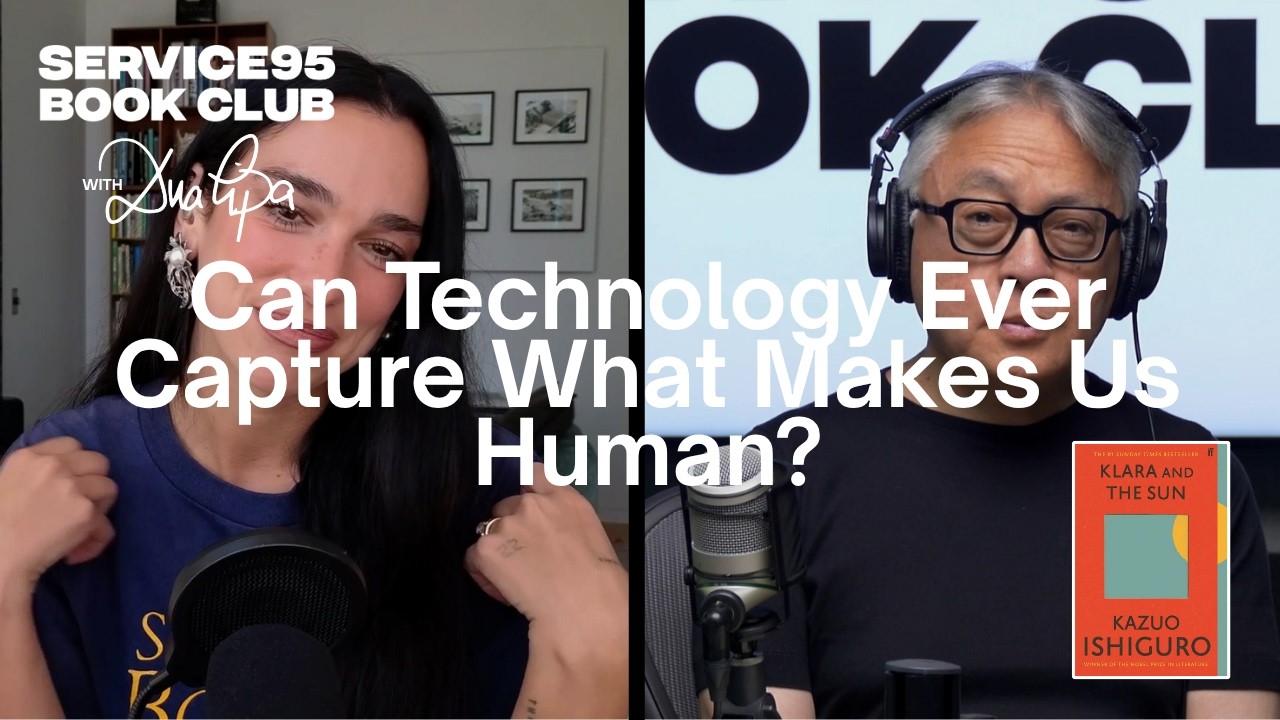
Kazuo Ishiguro is sitting across from Dua Lipa, and she has just told him he is one of her most-read authors alongside George Saunders. He gasps. It is a small, genuine sound, the kind that belongs to a person who still cannot quite believe his work finds its way into other people’s lives. What follows is a conversation about loneliness, the fragility of what we call love, and a quiet fear about the near future that most people are not yet talking about. For anyone who has ever read a book and felt permanently changed by it, this exchange between two artists working at the height of their powers is worth every minute.
Ishiguro begins by situating his novel Klara and the Sun in the world he was imagining when he wrote it. Klara is a robot girl, an artificial friend sold to a teenager named Josie in a society where adolescent loneliness has become so structural that buying a companion is as routine as buying a doll. The story is narrated entirely by Klara, whose perspective starts as narrow as a shop window and slowly expands as she learns what human life actually costs.
The fear that crept up while nobody was looking
Ishiguro is direct about what unsettled him most while writing the book. ‘The book that isn’t really worried so much about the issues around AI that people are discussing at the moment,’ he says. ‘I am more worried about the issues around genetic engineering and genetic technology.’ In the world of the novel, wealthy parents can pay to have their children ‘lifted,’ a procedure that sharpens intelligence and physical capability. Josie has been through it. So had her older sister Sal, who did not survive. What Ishiguro feared, and still fears, is not a robot takeover but something quieter: a savage meritocracy in which rich families simply purchase biological advantage for their children, making the gap between the lifted and the unlifted as absolute as any gap that has ever existed between human beings. He acknowledges the contradiction in himself frankly, noting that for all his liberal views about how society should run, as a father he would do every dirty trick to further his daughter’s chances.
The penalty shootout and the room with infinite rooms
The most unexpected image Ishiguro reaches for when describing human loneliness is a World Cup penalty shootout. He describes watching a professional footballer detach from his team, walk to the spot, and suddenly stand completely alone in front of the entire history of the sport. Communities form, crowds chant, teams play brilliantly together, and then something shifts and it is just one person on their own. That moment, he says, feels like a perfect analogy for the way human beings live.
The novel pushes the question further by asking whether anything essential about a human being resists being mapped. Dr. Capaldi, a character who makes portraits of sick children, argues that nothing does. Ishiguro counters him through a passage between Klara and Josie’s father, who tells her that the human heart is like a house with many rooms, and that every time you enter one room, you find more rooms within rooms within rooms. Klara’s reply is characteristically undaunted: ‘I don’t know, but I could give it a go.’
Lipa then shares something from her own work in progress: listening back to the album she is currently writing, she realized that what she thought were love songs are actually relationship songs, full of the darker, more complicated textures underneath the euphoria. Ishiguro tells her he means it when he says her songs are distinguished in exactly that respect. ‘They are relationship songs,’ he says, ‘and whether they are love songs, well, they are kind of love songs because we are in that terrain.’
A Klara and the Sun film directed by Taika Waititi and starring Jenna Ortega as Klara is out this month. Ishiguro says he has no desire to adapt his own books and compares a good film adaptation to a cover version of a song: you want the Radiohead version of it, not a replica of the original recording.
His next book, due in March 2027, is a period thriller he describes as completely devoid of anything deep. His publisher suggested he illustrate it himself as a signal that this is a lighter kind of publication. He spent the weeks just before Christmas teaching himself perspective and how to draw hands, then produced four illustrations he cheerfully admits are probably not very good.
The Tom Waits song that cracked open a buttoned-up English butler
Listening to Tom Waits’s ‘Ruby’s Arms’ in the late 1980s, Ishiguro realized his nearly finished draft of The Remains of the Day was missing something. The song is a simple scene of a soldier sneaking out while his girl sleeps, but there is a moment when Waits, in the toughest, most weathered voice imaginable, sings that his heart is breaking. That combination of total emotional armor and a single moment where it cracks just once struck Ishiguro as exactly what his repressed English butler narrator needed. He went back through the manuscript, found the right place toward the end, and put it there.
The four illustrations from the upcoming thriller, completed after an intensive self-teaching sprint, sitting somewhere between passable and charming, still waiting to be seen.