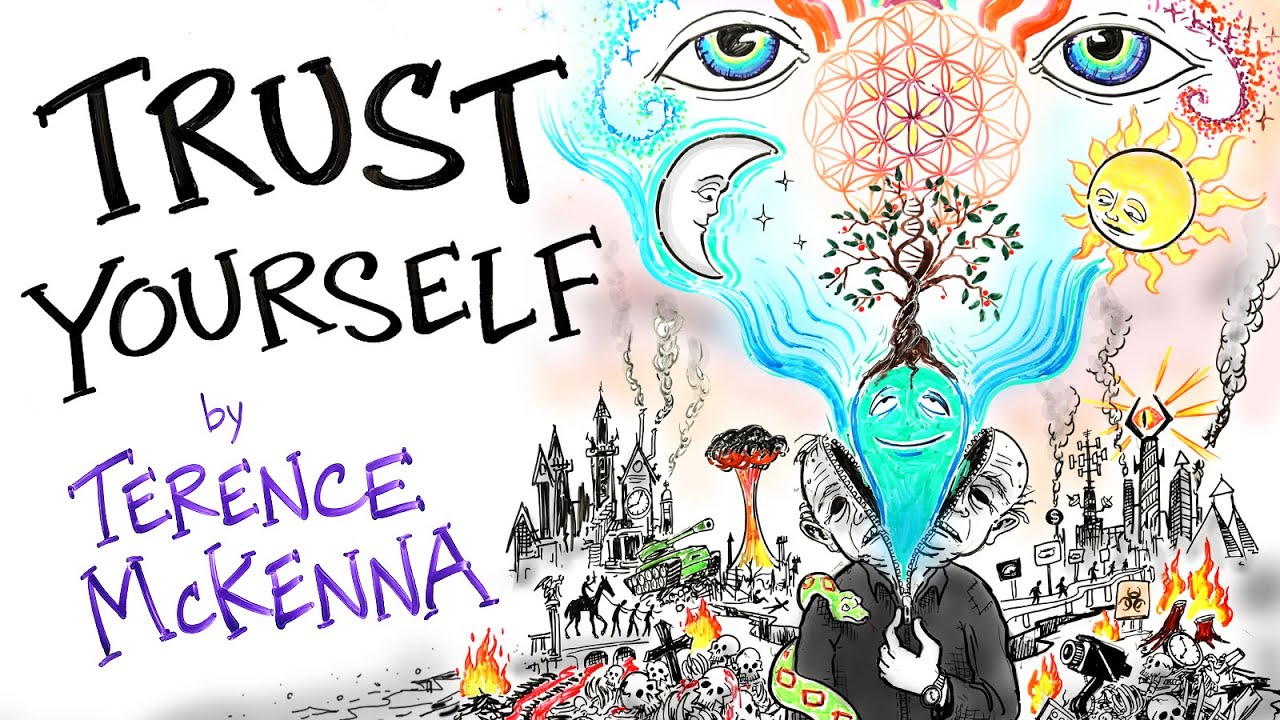
Terence McKenna did not ease into the argument. Standing before an audience, the writer and ethnobotanist made his opening move by citing the oldest reported act of disobedience in Western literature: someone in Eden ate the fruit, got expelled, and the punishment has been used as a management tool ever since. The stakes he described were not personal or spiritual. They were political, biological, and, in his framing, planetary. And the medicine for what ails the species, he insisted, begins with a single, uncomfortable discipline: trusting yourself.
The one thing every institution agrees you should not do
McKenna’s core accusation is that authority, in every form it takes, is organized around the goal of control rather than the goal of truth. He drew no distinction between governments, religious institutions, and philosophical movements. Marxism, Catholicism, objectivism: he called them all ‘rubbish,’ variants of what he named ‘shell games worked out by priestly castes of people to keep things under control.’ His argument was not that each tradition contains nothing of value but that the posture of deference itself is the trap. The moment a person clusters around the feet of a self-proclaimed authority, he argued, they have already surrendered the only thing that makes knowledge real: the testimony of their own experience.
He pointed to the history of political liberation as evidence that the logic of emancipation has a natural next stop. The freeing of slaves, the extension of suffrage to women, the abolition of public punishment: each required someone to refuse a rule that the prevailing institution called non-negotiable. McKenna’s position was that the same logic applies to the interior life. ‘We are not interested in being intellectually, spiritually, emotionally manipulated by the state,’ he said flatly. The frontier he was describing was not a political platform. It was the boundary where a person’s direct experience ends and where someone else’s story about that experience begins.
Where he said the real teachers live
Against institutions, McKenna offered a specific alternative: ‘If you want a teacher, try a waterfall, or a mushroom, or a mountain wilderness, or a storm-pounded seashore.’ The psychedelic experience occupied a particular place in his thinking, not as recreation but as the mechanism most threatening to what he called ‘the dominator culture.’ His reasoning was precise: a mind returned to its own perceptual authority is a mind no longer volunteering its best years to an institution’s agenda. ‘It makes the individual complete within himself or herself,’ he said, ‘and this completion of the individual is extremely destructive to the plan of the dominators.’
The practicality underneath the rhetoric was blunt. Stop waiting for a vanguard or a cadre of intellectual elites to organize the change. Walk away from the machinery, he said. Claim your identity, your vision, your intuition, and then act from it cleanly, without regret.
The image McKenna kept returning to
At one point he described pianos wearing pants, a literal Victorian practice of covering furniture legs to avoid suggesting the human body, as a marker of how deep repression can reach before a culture notices it is even happening.
The whole performance, the argument, the analogies, the controlled fury, was built toward one practical instruction: stand up on your hind legs and howl. He left it to the listener to decide what that looks like on a Tuesday morning.