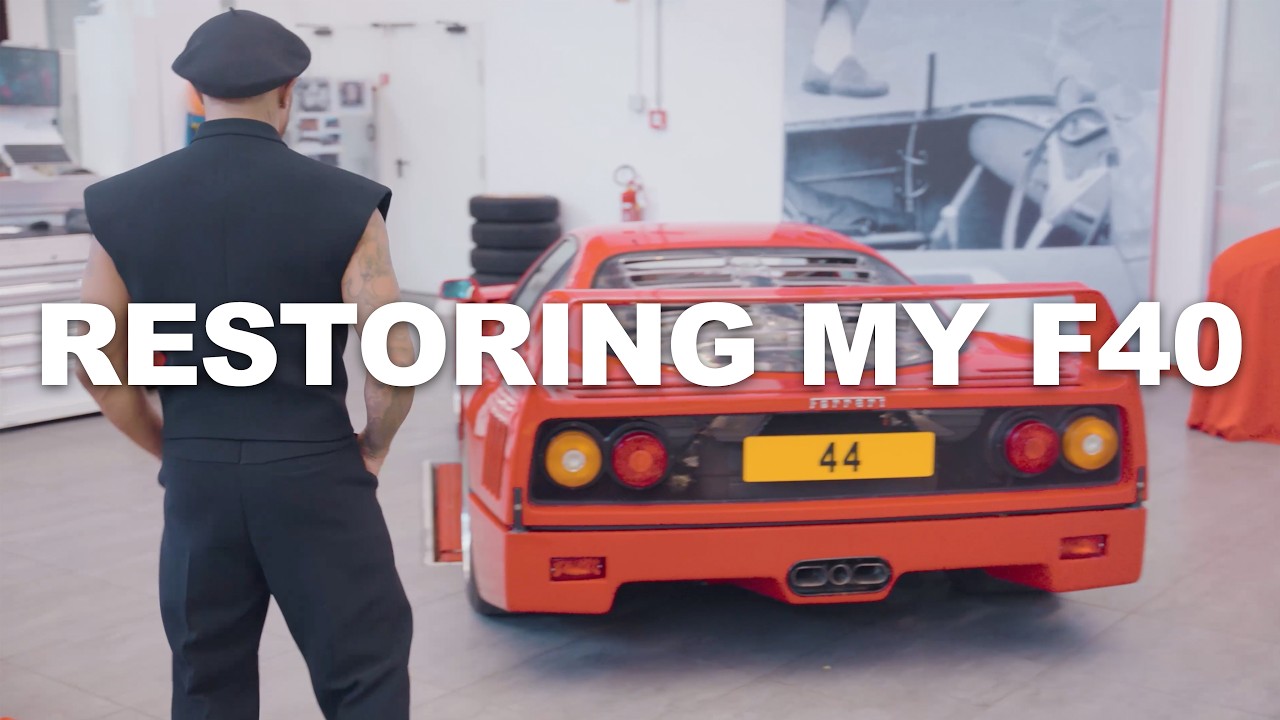
Lewis Hamilton walked up to a freshly restored Ferrari F40 at the Ferrari factory and stopped cold. The car looked brand new, the exhaust gleamed, and stamped on the engine block was the number 44, his own racing number, on a car bought in 1991 before Hamilton was old enough to read. That collision of coincidence and childhood dream is what this restoration was always quietly building toward, even if nobody knew it until the day before the unveiling.
Sixty-nine kilometers and then a garage door closed
The F40 Hamilton acquired had one of the most specific and quietly melancholy ownership histories imaginable. A buyer picked it up in 1991, drove it exactly 69 kilometers, parked it, and never started it again. For 36 years it sat. When Hamilton’s team found it, the interior still held dead flies that had been there for decades, fossils of the car’s dormant life. Hamilton described the original owner with genuine empathy: ‘You just think of like the smile on the guy when the guy picked it up, like how he felt, and he’s driving it home, and then never touching it again.’ The mileage is so low that Hamilton acknowledged he cannot really add to it in any meaningful way. A kilometer or two, perhaps, but this is not a car he plans to use as transport. The number is part of what the car is.
The decision about what to do with it pulled him in two directions for some time. He considered leaving it exactly as found, dust and fossils and all. He also considered a full restoration, with a specific vision attached: have Ferrari make it look completely new, have it delivered to Monza, arrive in a carefully chosen outfit, and step out at the circuit where the F40 belongs. That dream won.
The number nobody expected to find
The restoration was already emotionally loaded before anyone opened the engine bay. Hamilton had joined Ferrari, shot his first team content alongside this car, and spent months searching for a low-mileage example with a real story. When the car came to the factory, it carried all of that weight. Then, the day before the formal unveiling, someone checked the engine number and discovered it ended in 44. Hamilton had not known. The team had not known. ‘We literally were totally blanked out by that,’ one of the people present said. Hamilton stood over the gleaming engine bay and simply said: ‘Wow. 44.’
The restored car started cleanly. Hamilton moved it forward and immediately noted the turning circle with something close to disbelief. The exhaust note filled the space. ‘For me, this is the most beautiful car,’ he said, and the laugher around him suggested nobody was inclined to argue.
The dead flies in the cabin
Before the red paint was buffed back to a mirror finish and before the engine turned over for the first time in nearly four decades, someone peered into the interior and found the flies. Tiny, desiccated, and somewhere between artifact and evidence, they marked exactly how long the car had waited. The question hung in the air for a moment: keep it dirty, leave the record intact. The answer was no.
The F40 sat for 36 years on 69 kilometers, came to rest at Ferrari with a number on its engine that its new owner has carried on his car for his entire Formula 1 career, and rolled out of the factory looking, as Hamilton put it, brand new. The fossils are gone. The number stayed.