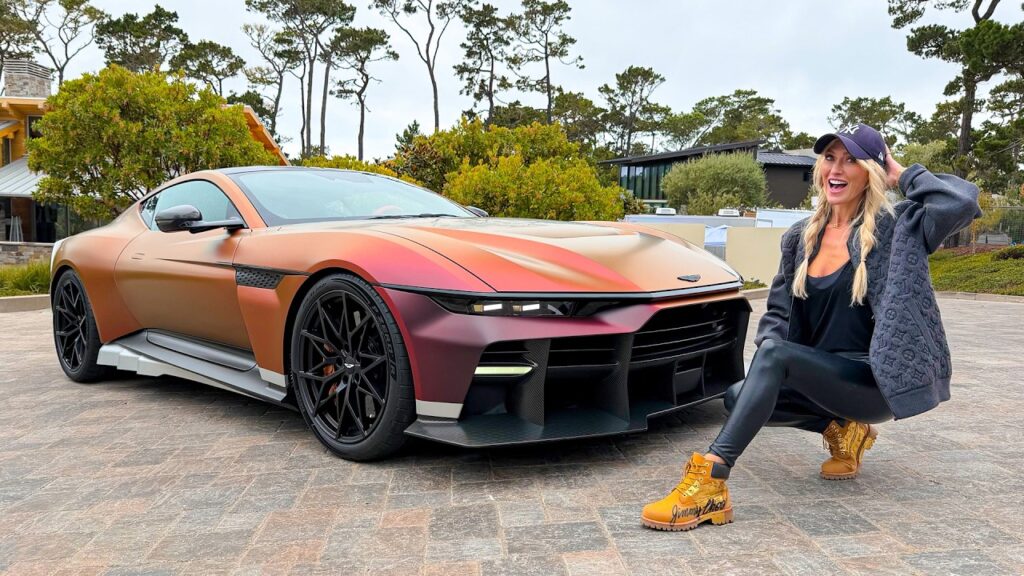
Alex, the Australian-born automotive creator known globally as Supercar Blondie, was sitting in the back of a van somewhere in Los Angeles when the question landed with full weight: a US company had offered her a hundred million dollars for everything she had built, and she had said no. The stakes are not abstract. She had built the most-watched Facebook page in the world, accumulated over 120 million followers across platforms, and turned a radio journalist’s press-car perk into a global media brand with more than 100 employees. What she chose to protect when she turned down that offer says everything about how she built it in the first place.
She grew up in Australia, moved to Dubai 18 years ago, and found herself laughed out of both a radio station and the Geneva Motor Show before a single car manufacturer would let her point a camera at their product. The radio show gave her journalist credentials. The credentials gave her access to press cars. The press cars gave her content. What she did with it was something the industry had never seen.
The car world that told her to go away
When she went full-time in 2017, social media as a career was, in her words, ‘still very unheard of.’ The radio station gave her a six-month runway in the form of a farewell snicker. At her first Geneva Motor Show in 2018, she walked up to the Bugatti stand and asked to film the car. They said no. She walked to the Ferrari stand. No again. The manufacturers knew who she was and had decided she was not serious because she did not talk about torque curves or engine displacement. She talked about how a car looked, how it felt, what gadgets it had. That was not automotive journalism. That was, as far as the industry was concerned, nothing.
Except it was talking to the 99 percent of people who love cars without being able to identify a Ferrari SF90 under a cover. That audience had never been addressed directly. They had been laughed away from car shows for not knowing engine specs. She was one of them, and she kept filming. After about three years, some of her short-form videos were reaching 400 and 500 million views. The manufacturers noticed. The Bugatti stand that had turned her away suddenly had room for her. She described the shift plainly: ‘The car manufacturers were like, oops.’
Her biggest platform, Facebook, with 63 million followers, became the engine of the business in ways that still sound improbable. In 2021, a single short portrait video earned her almost $500,000 in one day and added 6 million new followers. She had been making around $30,000 a day up to that point, which she now describes, with some affection, as ‘the good old days.’ The formula was deliberate: minimal dialogue, maximum visual, nothing tethered to one language, so the content could move freely into Brazil, China, Europe, and the US without friction.
When building the empire nearly broke the person inside it
The burnout came for her the way it comes for most people who cannot see it arriving: gradually and then completely. She was working 20-hour days for four years straight, traveling 300 days a year to chase one-of-one concept cars in obscure locations, and personally appearing in every piece of content her brand produced. She hired a presenter, then more presenters, then producers, editors, and journalists for an editorial website modeled partly on what she had observed working for media groups focused on shareable content. She launched an auction platform called SVX Cars, seeded it with $150 million worth of consigned vehicles including a sold Lamborghini Veneno, and then ran into the wall she had not anticipated: the marketing infrastructure needed to move a $5 million car is not the same as the reach needed to go viral.
The auction platform eventually closed, caught between an under-built launch strategy and the personal devastation of her marriage ending. She spent nine months recovering: three months in France, four months in Thailand, sustained therapy. She is direct about what the therapy taught her about the relentless online criticism, the sexist comments, the threats, the years of daily attacks on her knowledge, her appearance, and her right to be in the industry at all. Understanding the psychology behind the cruelty, she said, was what finally made it stop landing.
She is now planning to move her channels to the United States, accepting that the tax bill will be significant, because she believes the American market will grow her brand faster than the tax will cost her. She is also working on an AI version of herself for the channel, though she is not satisfied yet. ‘It’s missing the je ne sais quoi,’ she said. ‘It’s missing that human spirit you can see in someone’s eyes.’
The van she sat in, and the offer she walked away from
The hundred-million-dollar offer came from a US company, structured as a payment over several years with an upfront sum she found insufficient. Her reasoning was exact: the upfront amount was less than what she believed she could earn in a single year. ‘It’s not enough money for me to give away everything I have built because I can make that amount of money in here,’ she said, meaning inside the business she was already running. She also notes, without much nostalgia, that the social media landscape shifted sharply in the years that followed the offer, and the deal’s performance-linked structure would likely have paid out less than the headline figure anyway.
She turned it down. She hired a CEO based out of San Francisco for the auction business. She bought and customized a Rolls-Royce Spectre that came to roughly $700,000 after modifications, including work by Mansori done in exchange for promotion. She is looking for someone strong enough to help her structure the next phase of the business and match the scale of opportunities coming at her from every direction.
A barber shop in Thailand who already knew her name
During the months in Thailand when she had cut her hair short and gone incognito, she walked into a barber’s shop for the first time in her life. The barber looked up and immediately recognized her through the changed look and the unfamiliar setting.
She sat down in the chair anyway.
The van doors in Los Angeles are still open, the next destination not yet announced, the business plans still being structured. She is ready for all of it now in a way she was not one year ago, and she is not especially quiet about the difference.