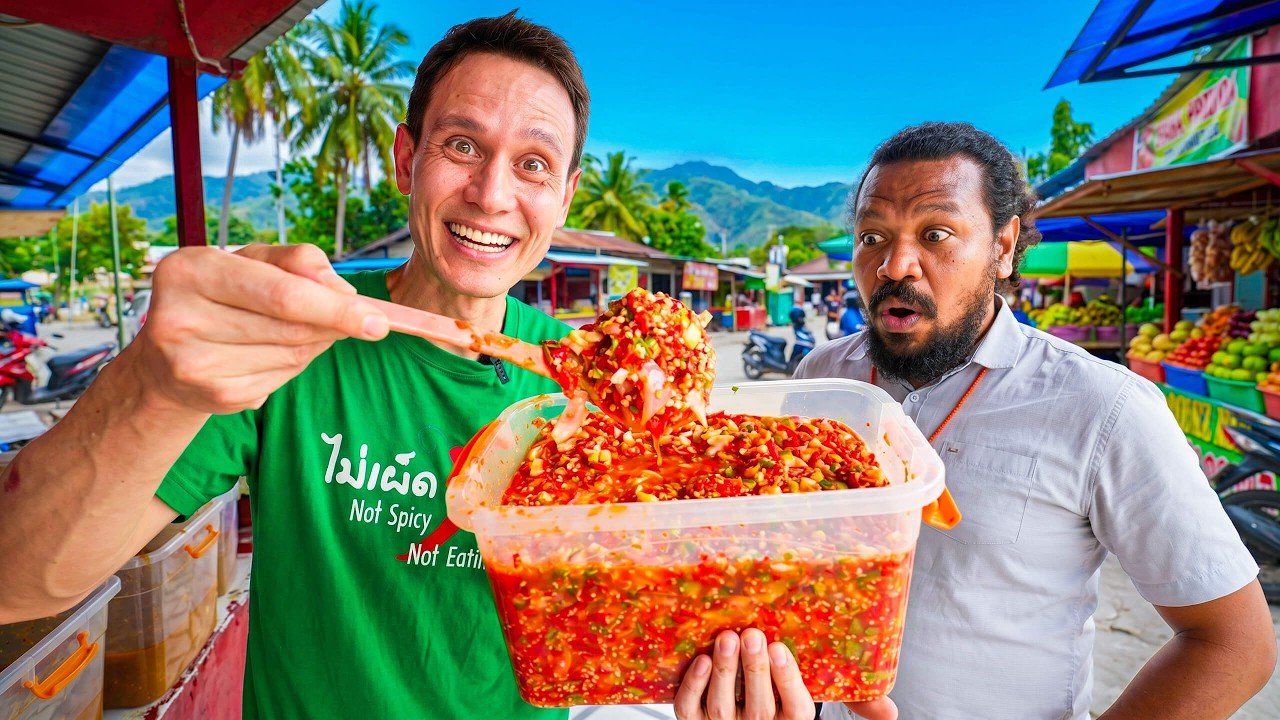
Caesar unwrapped the palm leaf parcel slowly, like unpacking something sacred, and the yellow-tinged rice inside crumbled apart in dense, coconut-fragrant layers. For Mark Wiens, standing at a seafood shack on the waterfront outside Dili, this was the moment the entire trip clicked into place. Timor-Leste, one of the least visited countries in Asia, with a population of roughly one and a half million people, has a food culture that almost nobody outside its borders has ever tasted. That changes, one bite at a time, starting now.
The family stall selling 400 meals a day out of their living room
The first stop landed Wiens and his local guide Caesar at a home-cooking operation that blurred the line between kitchen and front yard entirely. The family sells 400 to 500 meals a day, including takeaways, from the same building where they sleep. A crowd of people stood outside as always, drawn by grilled chicken, beef curry, and the dish that would define the entire day: imanas, a chili sauce built from crushed whole chilies, herbs, and lime chopped skin and all, not just juiced. Caesar put it plainly about Timorese chili: ‘I have traveled the world but I found chili in Timor is very different. I promise you different chili.’
A full plate at this stall costs one dollar. It arrives loaded with stir-fried water cress salad, fijuada, the bean soup with kidney beans and macaroni that traces its roots to Portuguese and Brazilian influence, beef curry, and grilled chicken marinated in coconut milk and turmeric then finished over coals and ladled with a sweet peanut sauce. The fijuada carried its own unexpected history: Caesar explained that in Timor-Leste, the dish evolved into a largely vegetarian preparation because families could not afford meat every day, and during the resistance period it fed fighters because beans expand with water and carry protein and energy. Every component on the plate arrived alongside a green salad. As Caesar explained, in Timor something green is always a must.
Fish on a stick, saboco, and the dish you have to eat to say you’ve arrived
A 45-minute drive along coastline that Caesar compared, without much exaggeration, to arriving in Hawaii by boat, brought them to a row of beachfront stalls where everything on display had been half-cooked and marinated, waiting for the final grill-to-order finish. Octopus came off tender with turmeric and chili. Squid arrived so dense and meaty that Wiens called it the most sausage-like squid he had ever eaten. But the centerpiece was saboco, a national dish so embedded in Dili’s identity that a song once warned visitors: if you come to Dili and do not eat this, you have not truly arrived.
Saboco is fish, either mackerel or flying fish, marinated in salt, pepper, chili, and tamarind leaves, then wrapped in palm leaves and cooked until the smoke and the leaf aroma both sink into the flesh. The tamarind leaves are edible and carry a gentle sourness that lifts the natural oil of the fish without overwhelming it. Alongside it came ketupat, rice compressed and boiled inside coconut leaves until it becomes almost bread-dense, served with fish laid across the top and a heavy scoop of imanas. Caesar described it as what ancient people would have eaten: fish straight from the sea, grilled on a stick, eaten with chili. The group ran low on imanas twice and asked for a refill both times.
A wild boar with piglets, palm fruit from the roadside, and the city’s Chinese quarter at night
On the drive back toward Dili, a wild boar family crossed the road, piglets in tow. Minutes later, the group pulled over at a roadside palmyra palm plantation where children were selling the palm fruit directly from the trees, splitting them open to reveal a natural jelly with the texture of lychee and a flavor somewhere between coconut water and fresh melon. Caesar noted that during the resistance, fighters relied on the fruit as a field food source, and that the palmyra palm wastes nothing: leaves become roofing, construction material, cooking wrappers for ketupat, and woven baskets.
Back in the capital, the final stretch took in Timorese-Chinese cooking at a restaurant where the Indonesian influence arrived openly in the form of tempeh smashed with chili, tamarind-sauce pork satay, and ayam geprek, a fried chicken dish that the cook pounds flat after frying, plastering chili into every broken fiber all the way to the bone. Caesar’s lips were burning. Wiens was sweating through the conversation. The imanas kept coming in new variations at every stop.
The bowl of bako Caesar doctored with a double-spray of sauces
At a small food court near the end of the night, Caesar picked up a bowl of bako, Indonesian-Chinese noodle soup with meatballs, and before Wiens had finished arranging his chopsticks, produced a simultaneous two-handed squeeze of sweet soy sauce and tomato sauce directly into the broth in one practiced motion. He offered no warning and no explanation.
Timor-Leste became independent in 2002 after 24 years of Indonesian occupation and a brutal aftermath following the 1999 referendum. Indonesian restaurants returned to Dili within two years of independence, and Caesar’s read on that speed was characteristically direct: ‘If you don’t forgive the Indonesian, then you won’t enjoy the food.’ The bako, the satay, the tempeh, and the matabak pancake folded with peanuts all sit inside that fact, absorbed into a table where nobody was keeping score by the end of the night.
 Wake up to Only Happy News!