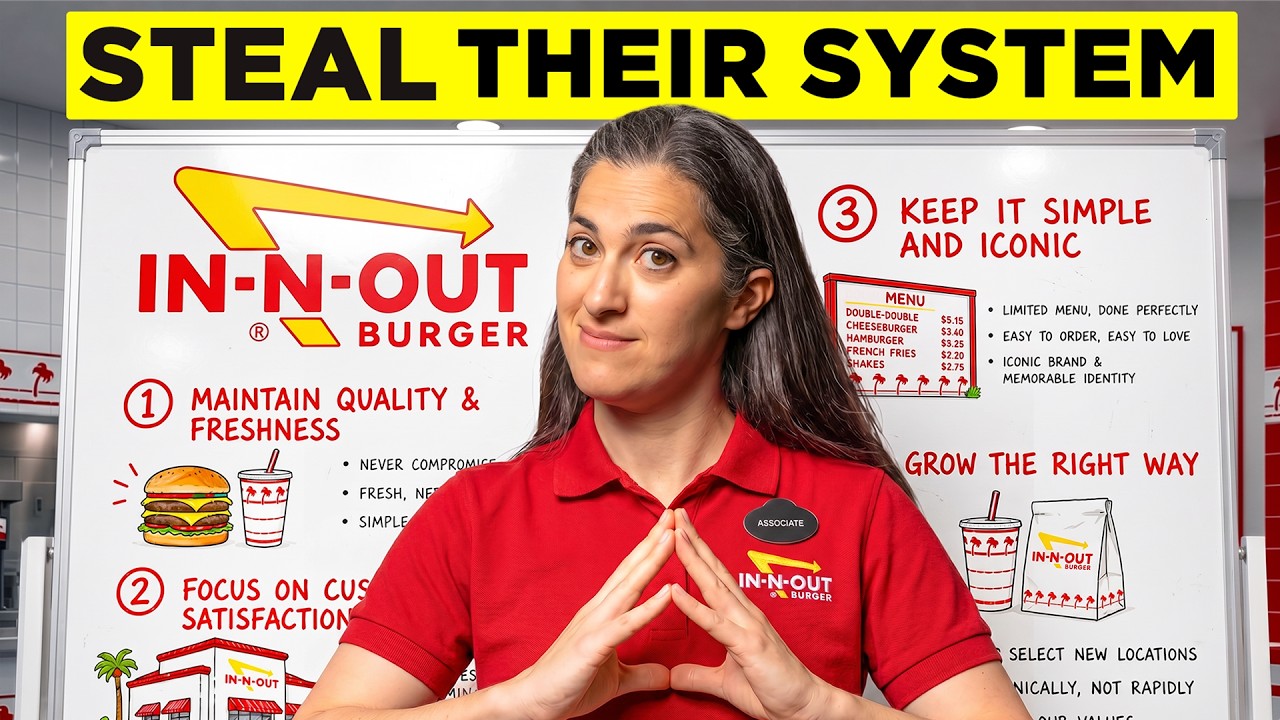
Angus Stanfield was standing in a San Antonio kitchen, staring at a pepperoni pizza that looked greasier than last week’s batch, with no explanation from the supplier and no real way to fix it. That kind of invisible inconsistency, the kind a restaurant owner can feel but cannot trace, is exactly what In-N-Out Burger engineered out of its entire operation. Stanfield, who co-owns Matangas Pizzeria with her husband Matt and runs eight locations doing over $7 million a year, has spent years studying how the world’s top restaurants actually work. What she found inside In-N-Out’s operation is a system so tightly constructed that its constraints are its competitive advantages.
A four-item menu that runs like a machine
In-N-Out’s founder Harry Snyder built the first two-way drive-thru speaker in his garage in 1948, replacing the carhop model where servers walked orders out to idling cars. That same instinct for eliminating friction defined everything that followed. The menu has not changed in 75 years: burger, cheeseburger, double double, and fries. Four items. That is it.
The kitchen runs on what In-N-Out calls a pod system. Each pod contains a grill, a board, and a fryer, and every pod is configured identically. One pod handles a slow shift; a second fires up during a rush. Team members learn every station in sequence, and they cannot move to the next one until they have proven mastery of the current one. Pay is tied directly to the number of stations a person can run well, not to how long they have been on the job or what their job title is. Nobody touches the grill until they have earned it.
Because the menu is so narrow, In-N-Out cuts potatoes fresh in-store for every order. It also identified its own production bottleneck, the grill, and solved it by making the patties thinner: six patties per pound of meat, cooking faster, with no drop in quality.
Stanfield is direct about the lesson for independent owners: ‘The restaurants that win are the ones that do fewer things better than anyone else, not the ones that do a lot of things just okay.’
Why paying managers $160,000 a year actually saves money
At a moment when many states set starting wages at $20 an hour, In-N-Out pays its average manager around $160,000 a year, including bonuses tied to hitting targets. That figure sounds expensive until it sits next to the industry’s annual turnover rate of 150 percent. In-N-Out’s turnover rate runs around 20 percent per year. The average In-N-Out manager stays for 14 years.
Every manager is developed from within, someone who started on the grill or the counter and worked through every station. By the time they are running a location, they know the operation from the ground up. They file financial reports daily, track inventory and waste down to a dropped patty or a lost bun, and calculate labor percentage against targeted sales. They do it knowing that unannounced inspectors can walk in at any time, not to catch violations, but to verify that standards hold when no one is watching.
A single In-N-Out location averages around $100,000 in weekly sales, which works out to over 7,000 burgers a week and more than $5 million per location annually. That volume demands precision, and precision demands people who stay long enough to actually get good.
The supply chain nobody else bothered to build
Most chains buy through outside distributors, accepting the recipe drift and quality variation that comes with that arrangement. In-N-Out owns its butchers, its bakery, and its delivery trucks. Every ingredient moves through a supply chain the company controls entirely. That removes the middleman margin and, more importantly, removes the invisible inconsistency that Stanfield describes in her own pepperoni supply.
The scarcity strategy amplifies all of it. In-N-Out operates in only a few states despite being founded in 1948 and having the capital to expand. When a new location opened in Scottsdale, Arizona, people drove for hours and camped overnight for the grand opening, then posted about it across social media at no cost to the company. In-N-Out’s secret menu items, like animal-style fries with grilled onions and extra spread, cost pennies in additional ingredients but carry a $2 add-on charge. They require no new ingredients, no added kitchen complexity, and generate higher margins while making the customer feel like an insider.
The manager who has done every job
Stanfield closes with one question she thinks every single-location owner should answer honestly before opening a second location: do you have a manager who has done every job in the restaurant and can hold company standards high without you there every day?
An apron hung by the back door of a busy In-N-Out, clean and pressed flat against the hook.
Stanfield has watched the grease levels fluctuate in her own kitchens for years, still not entirely sure what changes upstream. In-N-Out solved that problem by refusing to let anything exist upstream that it did not own outright, and then it built the people to run it the same way every single day.