A woman lost her marriage, her business, and her eyesight to a stress-driven thyroid condition called Graves disease, and it was only after she decided to stop believing in her past more than her future that her vision returned and her thyroid hormones began moving back into balance. Her case, described by Dr. Joe Dispenza, is not an outlier. It is, according to his framework, the predictable consequence of a nervous system running on emergency fuel for years on end. The science of how that happens, and how to reverse it, is the core of this presentation drawn from the Gaia series ‘Rewired.’
Why your body treats your boss like a predator
Dispenza opens with a distinction that reframes modern anxiety entirely. The stress response evolved for short-term physical threats: a zebra outrunning a lion, a deer evading a pack of coyotes. Thirty minutes after the threat passes, the body switches off the emergency system, rests, and repairs. The problem is that the human neocortex, the thinking brain, cannot tell the difference between a lion and a difficult co-worker. ‘What if it isn’t T-rex outside the cave?’ Dispenza asks. ‘What if it’s your mother-in-law? What if it’s traffic?’
When the fight-or-flight system stays on, the body keeps mobilizing energy outward, toward the perceived threat in the environment, and leaves nothing for growth and repair inside. Cortisol and adrenaline suppress the immune system, push genetic buttons that create disease, and over time condition the brain to crave the very problems that produce those chemicals. ‘We become so conditioned to these chemicals that, like a drug addict, we need the bad job, we need the poor relationship, we need a difficult situation in our life to keep getting that rush of adrenaline.’ That is not a metaphor. Dispenza treats it as a measurable neurochemical dependency, and he reports that 70 percent of people are living in this survival state most of the time.
The nocebo effect, the mind’s capacity to induce illness through stressful thought alone, sits at the center of this argument. Doctors already exploit the mechanism in reverse: stress hormones are administered to organ transplant patients specifically because they suppress the immune system. Every sustained stressful thought, Dispenza argues, is biochemically doing the same thing.
What the 117-person study actually measured
To test whether the direction can be reversed, Dispenza’s team ran a four-day study with 117 participants, measuring cortisol and immunoglobulin A (IgA), the body’s primary defense against bacteria and viruses. Participants were asked to spend ten minutes a day trading survival emotions, including anger, fear, and aggression, for what Dispenza calls elevated emotions: gratitude, appreciation, kindness, and love. After three and a half days, IgA levels rose by roughly 50 percent as a collective, and cortisol dropped by about 16.25 percent. The immune system, freed from the suppressive grip of stress hormones, upregulated substantially in under four days.
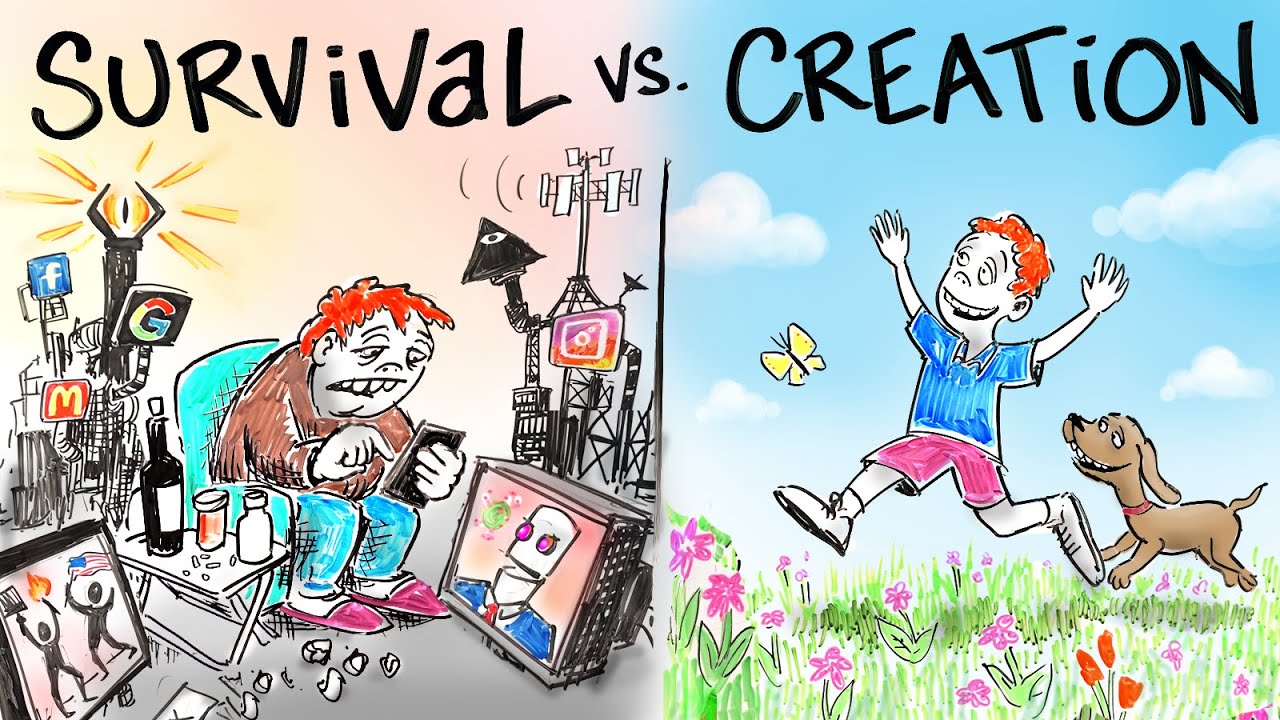
The contrast Dispenza draws between ‘living in survival’ and ‘living in creation’ is built on this physiology. Survival is characterized by narrow, object-focused attention, emotional contraction, tissue breakdown (catabolism), incoherent brain and heart states, and a compulsion to control known outcomes. Creation is the inverse: broadened, open awareness, elevated heartfelt emotions, tissue repair (anabolism), brain-heart coherence, and a willingness to treat the unknown as an adventure rather than a threat.
The Graves disease patient embodies the full arc. She identified the pattern, changed the story she was telling herself, and her autonomic nervous system returned to doing what it is designed to do: create order and balance.
The woman who decided to believe in her future
She had double vision and almost no energy. The condition had taken years to build, fueled by mismanaged emotional reactions that, day after day, pushed her genetic buttons in the wrong direction.
Her vision is now described as perfect.
Dispenza does not offer that detail as a miracle. He offers it as a data point about what becomes possible when the brain and body are no longer running in emergency mode.