At the center of Raphael’s celebrated School of Athens, painted for Pope Julius II in the early 16th century, two figures command the composition: Plato, pointing upward toward ideal forms, and beside him his student Aristotle, arm extended toward the viewer, insisting that truth lives in the world itself. That single gesture captures a life’s work. Medieval Christians, confronted with a philosopher who had written authoritatively on logic, ethics, biology, politics, poetics, rhetoric, and cosmology, did not bother with his name. They called him simply ‘The Philosopher.’ This is the story of how a physician’s son from the provincial edges of the Greek world became the most prolific thinker in human history.
From a Macedonian courtyard to Plato’s Academy
Aristotle was born in 384 BC in Stagira, a city in the ancient kingdom of Macedon in what is now northeastern Greece. His father Nicomachus served as physician to King Amyntas III of Macedon and belonged to the Asclepiadae, a guild of physicians who claimed descent from Asclepius, the Greek god of medicine. That medical household shaped everything. In accordance with the guild’s tradition, the young Aristotle received medical training from his father, and those early lessons in close observation of the natural world never left him.
After his parents died when he was in his early teens, his upbringing passed to a relative named Proxenus. In around 367 BC, at 17, Aristotle traveled to Athens to study at Plato’s Academy. The institution had been founded in the 380s BC on part of Plato’s private estate, once a sacred olive grove dedicated to Athena, and it carried elite formal membership. Plato was away in Sicily when Aristotle arrived, so the two men only met properly once Plato returned. Scholar Georgios Anagnostopoulos observes that Aristotle’s earliest writings from the Academy are closely aligned with Plato’s philosophical approach, and Diogenes Laertius described him as Plato’s most ‘genuine’ student.
Aristotle would spend two decades at the Academy. During that time he developed his foundational work on logic, later compiled by his followers into six treatises known collectively as the Organon, or Instrument. The most celebrated contribution was the syllogism, the structured deductive argument in which a thinker draws certain conclusions from properly categorized premises. The textbook example distills it: ‘All men are mortal. Socrates is a man. Therefore, Socrates is mortal.’ Aristotle also pioneered the use of letters of the alphabet to express these relationships universally: Some A is B, therefore Some B is A.
Cracking eggs every morning in the name of science
Around the time of Plato’s death in 347 BC, Aristotle left Athens for Asia Minor, invited by Hermias of Atarneus, a former student of the Academy and an ally of King Philip II of Macedon. Hermias established research facilities for Aristotle and his Academy colleague Xenocrates at Assos, in what is now northwestern Turkey, where the Doric columns of the Temple of Athena still overlook the Aegean Sea and the nearby island of Lesbos. It was the independent research opportunity Aristotle had been waiting for.
His method there was unambiguous. To document the development of chicks, he took an egg from under a brooding hen every single day, cracked it open, and recorded the state of the embryo. He could not guarantee that each egg would develop at exactly the same rate, but the discipline of the process illustrates exactly how he worked: patient accumulation of observed data before any theoretical conclusion. He recorded his findings across several books, including the History of Animals, describing the forms, functions, and habits of creatures from insects to whales. Some conclusions would later be refuted, among them his belief that certain insects arose from non-living matter, a view that fed the theory of spontaneous generation and remained widely accepted until the 19th century. But the foundational method, observe, collect, categorize, write up, proved durable. More than two thousand years later, Charles Darwin would draw on the same connections between the form and function of animals to develop his theory of evolution.
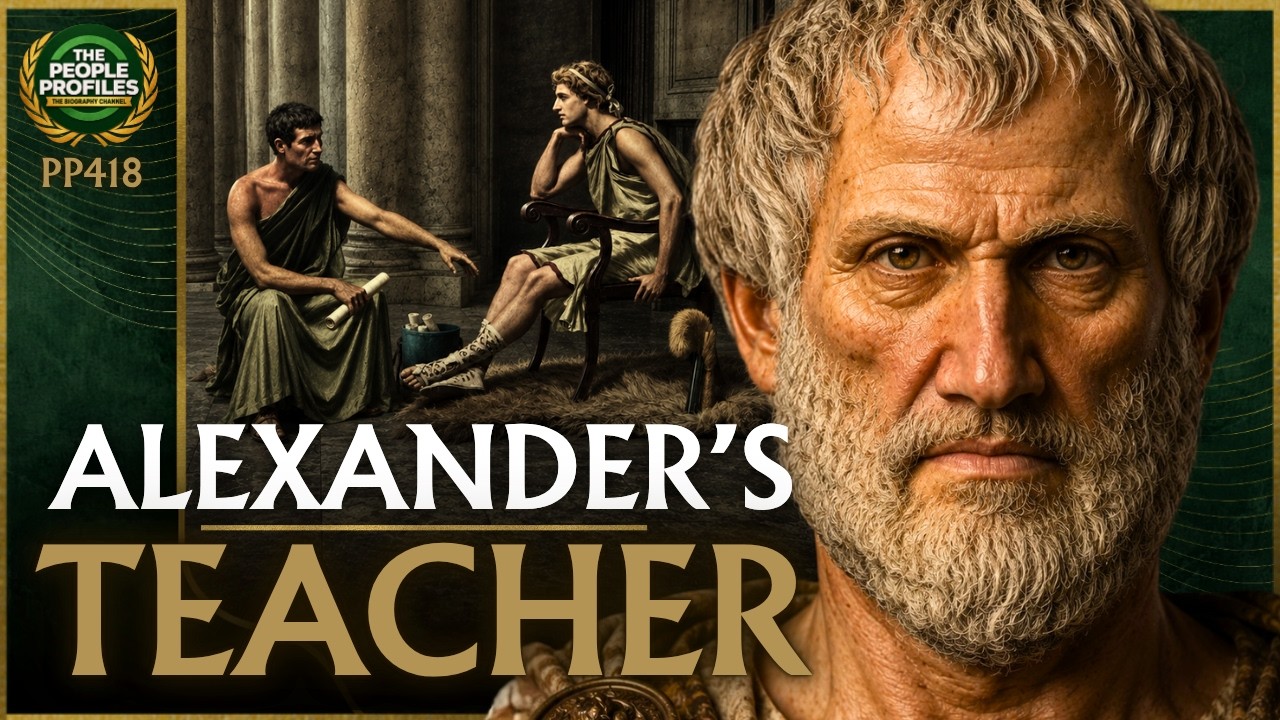
It was at Assos and then on Lesbos, where he was joined by the botanist Theophrastus, that Aristotle also began seriously developing his political thinking. King Philip II recalled him to Pella in the late 340s BC to serve as tutor to his teenage son Alexander. The lessons took place at a private school for Macedonian noble children at Mieza, a royal estate near Pella. Alexander studied alongside companions including Hephaestion, Ptolemy, and Cassander. Aristotle taught for only two or three years before Alexander, at 15, was already serving as his father’s deputy commander on campaign.
The Aristotelian scholar Jonathan Barnes wrote of Aristotle’s legacy in terms that have not aged: ‘He bestrode antiquity like an intellectual colossus. No man before him had contributed so much to learning. No man after him might aspire to rival his achievements.’ Alexander would go on to conquer the Persian Empire and campaign as far as India, accumulating the military glory Aristotle’s ethics explicitly warned against. For Aristotle, the telos, the end goal, of a human life was eudaimonia, a term usually translated as happiness but better rendered as flourishing, and he was clear that flourishing was achieved through intellectual pursuit, not conquest.
Aristotle returned to Athens in 335 BC and founded his own school, the Lyceum, located outside the city walls near a sanctuary of the god Apollo Lyceus. Unlike the Academy, it was open to the public and also served as a gymnasium. The Roman geographer Strabo credited Aristotle as the first person to assemble a systematic collection of books, an approach that would inspire the creation of the Library of Alexandria. Diogenes Laertius lists 143 works attributed to Aristotle amounting to 445,270 lines in total, though scholars note that some were falsely attributed and others have been lost entirely.
After Alexander’s death in 323 BC, anti-Macedonian sentiment surged in Athens. The inscription at Delphi honoring Aristotle and his great-nephew Callisthenes for their painstaking compilation of the victors list of the Pythian Games was smashed and thrown into a well. Archaeologists recovered it more than two millennia later. Aristotle withdrew to Chalcis, where his maternal relatives lived, and died there in 322 BC at the age of 62.
The tablet at the bottom of the well
The broken inscription from Delphi, recovered after more than two thousand years in a well, honoring Aristotle and Callisthenes for cataloging the victors of the Pythian Games, has not been replaced.
Aristotle’s will, preserved by Diogenes Laertius, instructed his nephew Nicanor to care for his mistress Herpyllis and to free his slaves after they reached a certain age. It ends with directions on where to place statues he had commissioned of his mother and close friends, and with arrangements to sponsor statues of Zeus and Athena for the temple in his native Stagira. The boy from the periphery of the Greek world had not forgotten where he started.