Fruda stood at the top of a half-finished staircase in the Norwegian forest, grinning at the table folded neatly beneath it, and announced to anyone within earshot: ‘Vi er fad.’ Complete. For treehouse builder Pete Nelson, that moment captured something bigger than one build finishing on time. It was proof that two craftsmen from opposite sides of the globe could share methods, materials, and a single creative vision without losing either voice. The treehouses gathered here push that idea further still, from the eucalyptus decks of an African game reserve to a recycled-steel arch spanning a wildfire-scorched gulch in Texas, each one redefining what it means to live briefly among the branches.
Where the lake meets the loft
The Norway build was Pete’s first international project, a collaboration with Fruda that began with a language barrier and ended with a fire in the hearth and a brass whistle on the deck for hailing passing steamboats across Lake Miosa. Fruda fitted cabinet panels salvaged from a house estimated to be more than 200 years old. Pete added a Dutch-door sleeping nook: open the top half to crawl into the double bed, open the bottom half to reach the water heater underneath. Fish nets strung between pine railing posts pulled the interior visually toward the water outside. On Constitution Day, Pete rented a Norwegian tuxedo and Fruda counted down the reveal in Norwegian. The clients, nearly moved to tears, called it ‘a little birdhouse for people’ and one of them took a nap in the loft before anyone had to ask.
At Lion Sands Game Reserve in Africa, the Kingston Treehouse rises nearly 40 feet above a boulder-strewn hillside on eucalyptus posts, clearing the forest canopy entirely. Its railings and decks are built from a hardwood called balao, so dense it has a reputation for blunting saw blades. A king-size bed with mosquito netting and an open-air dining area sit above the bush, accessed by a drawbridge that guests raise at night. One pair of guests discovered exactly why: a leopard walked the sandy trail below and held its flashlight beam for a long moment before disappearing.
Steel arches, brewery taps, and a crow’s nest with water cannons
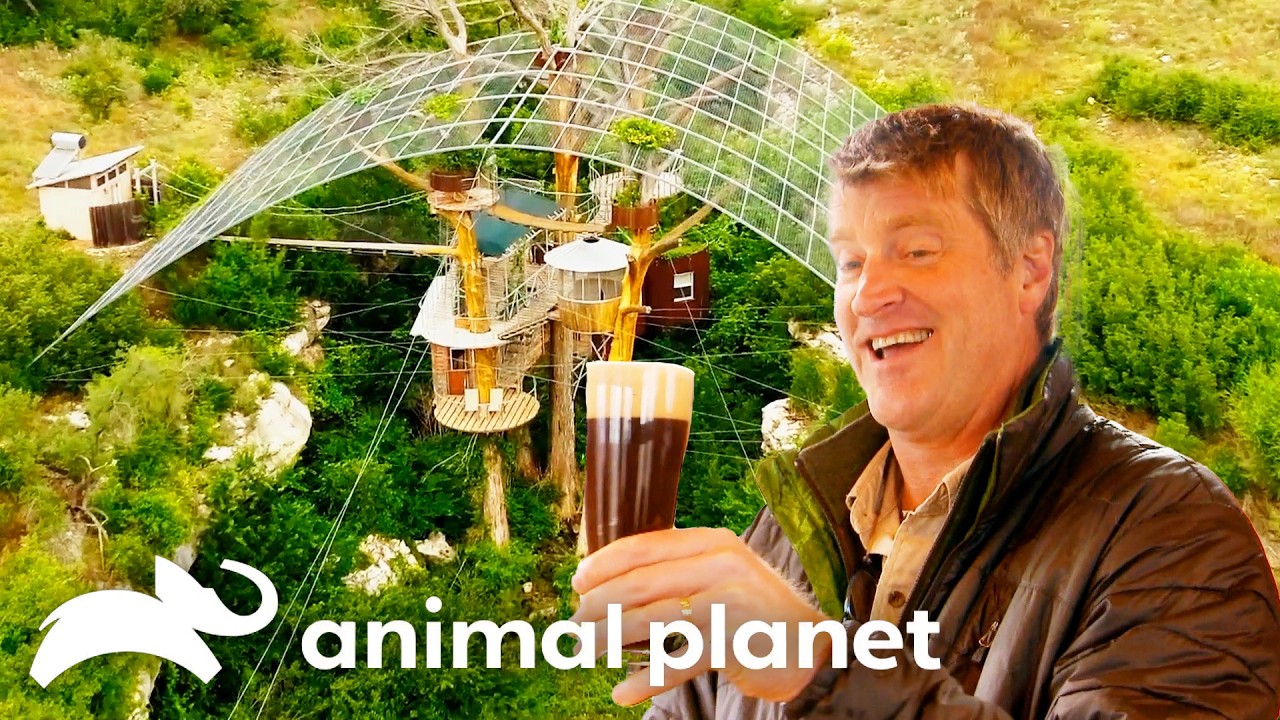
In a wooded valley at a Texas family ranch called Cypress Valley, designer Will Bhar erected a freestyle structure that stretches a steel arch 135 feet across a gulch, the cables above strung to regenerate a canopy through the scorched remnants of cypress trees killed in the 2011 wildfires around Spicewood and Bastrop. A butterfly hatchery sits in a barrel near the top, waiting for enough vine shade to begin hatching. The bedroom walls are lined with old recycled cider cask material, cut and collaged where the supply ran short. The whole complex sits roughly 55 feet up. Will put it plainly: ‘Tree houses are so unique because every tree is different. They can grow and evolve and continually become new.’
In the woods of western Massachusetts, Ramble Wild takes the treehouse idea and strips away the walls entirely, replacing them with 60 compression-locked platforms in a grove of eastern hemlocks, connected by high wires, zip lines, rope ladders, and a suspended expert trail that only one in ten visitors completes. Program director Luke Bloom explained that the platforms grip each tree with four bolts in a compression lock rather than any fixed hardware, so the bolts can be backed off as the tree grows.
For Bobby’s Texas man cave, the crew hauled a custom-built all-in-one smoker, grill, and pizza oven weighing more than 600 pounds onto the deck by forklift. The crow’s nest above came equipped with water cannons. The finished treehouse clocked in at close to 1,000 square feet.
The treehouse brew house, built for the Mooneys, went further still: a 30-gallon brewing system carried up by hand, a live-edge pine bar top milled at a local Amish sawmill, and a carved wooden sign reading Treehouse Brewing Company anchored above the tap handles. The first beer poured in the building was poured the day the clients saw it finished.
The bar top waiting to be filled
A live-edge pine plank, two inches thick, resting across three half-barrel bases in the Mooney treehouse brew house. Sanded flat in the middle, rough along the natural edge where the log was first split.
At Woodland Farm in western Massachusetts, a treehouse rests in two white oaks each more than a hundred years old, built entirely from timber felled by storms on the property and milled on-site, with stairs and windows reclaimed from old buildings. Below it, the largest herd of North American bison east of the Mississippi roams a thousand acres of land. The steamboat whistle on Lake Miosa is still there on the Norwegian deck, too, ready for the next guest who wants to send a greeting across the water.