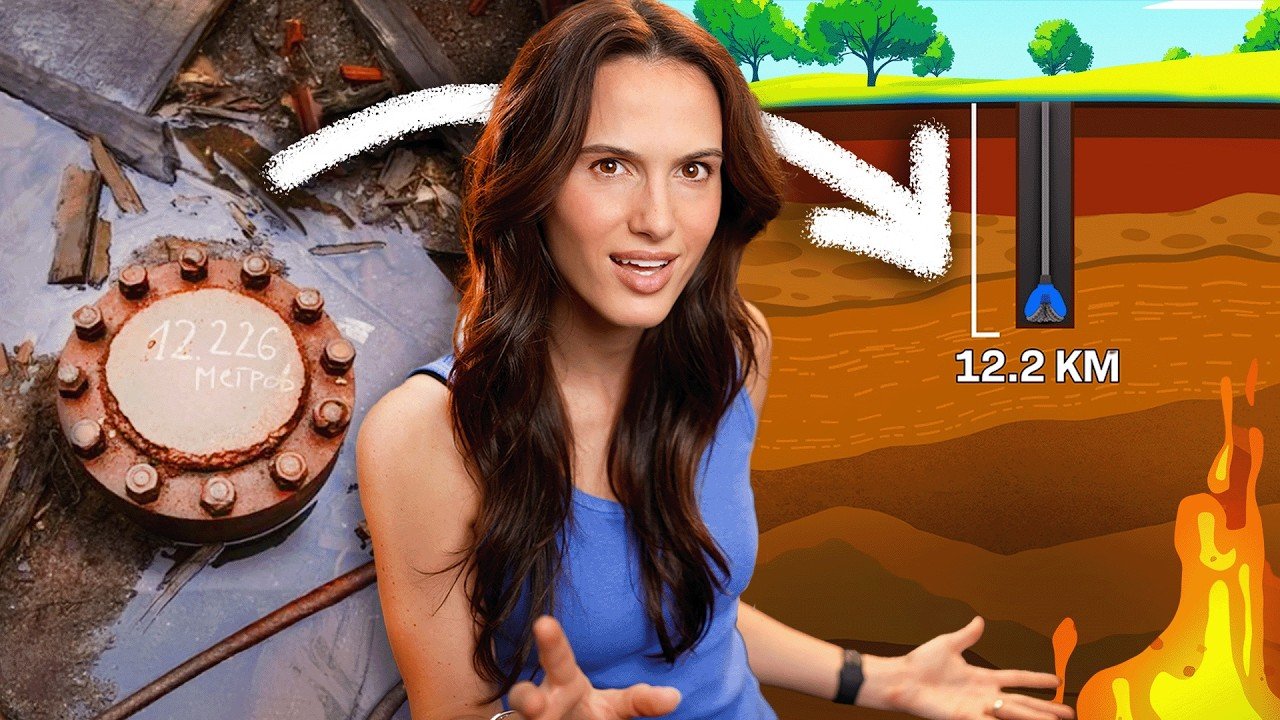
The Kola Superdeep Borehole sits in northwestern Russia, a sealed metal cap covering a hole thinner than a human hand yet deeper than the deepest point in any ocean. Soviet scientists spent 20 years driving that borehole to 12.2 km, inventing new drilling methods as they went, only to watch each new attempt at going deeper collapse on itself. And that extraordinary effort reached just 0.2% of the way to Earth’s center. What lies in the remaining 99.8% has shaped the planet’s geology, its magnetic field, and all life on its surface, and much of it is still genuinely unknown.
The journey down begins more gently than expected. At around 50 meters, the temperature starts to climb. Every kilometer through the crust adds roughly 25 degrees Celsius, and the crust itself on land rarely exceeds 40 km deep, a distance shorter than a marathon. Along the way, the route passes research laboratories carved into deep rock for dark matter and neutrino physics, a vast nuclear command bunker built by China, and the deepest cave ever discovered. The Kola scientists, working by remote equipment in conditions that would have crushed and incinerated any unprotected person long before, pulled out fossils of organisms dating back 2 billion years and found water far deeper than anyone had predicted.
One of the scientists who worked on the project described the borehole, in a direct exchange, as ‘a moonshot which will never be repeated or surpassed,’ and explained that the team ‘tried several times to get down past the maximum depth that they had reached but each time the new hole tended to collapse.’
Where solid rock turns into slow-moving goo
Between 30 and 50 km down, the rock changes character. The crust gives way to the mantle, and as temperatures climb past 1,300 degrees Celsius, something physically strange happens: the rock exceeds its own melting point but remains solid because the pressure is so enormous. The material becomes gooey, behaving more like hot plastic than stone. Giant convection currents carry this material from the bottom of the mantle toward the top over millions of years, transporting enormous amounts of heat toward the surface.
Knowing any of this from the surface required a different kind of detective work. Dr. Megan Newcombe, a geologist and volcanologist at the University of Maryland, put it plainly: ‘We can’t get there so we have to put together all of these indirect pieces of evidence to work out what’s going on down there.’ The primary tool is earthquakes. Seismic events send two distinct wave types downward: P waves, which travel through both liquids and solids, and S waves, which can only move through solids. An S wave shadow on the far side of the planet revealed something that changed everything. A liquid layer was blocking the waves. That liquid layer is now called the outer core.
A barcode at the bottom of the ocean
The outer core is a churning soup of metals at roughly 4,400 degrees Celsius. Its constant movement generates the electric currents that produce Earth’s magnetic field, the shield that prevents cosmic radiation from stripping the surface of life. That field occasionally reverses entirely, with the north and south poles swapping positions. The record of every reversal is preserved in the ocean floor. As Dr. Newcombe explained, basalt erupted along mid-ocean ridges freezes with a record of the magnetic field at that moment, and as the plates spread apart, ‘we can read them off like a barcode.’ The last full reversal was around 780,000 years ago. When the next one arrives is not yet known.
At the very center, 6,400 km from the surface and under pressure 3.6 million times greater than at the surface, sits a solid metal ball almost as hot as the surface of the Sun. Its solidity was itself a discovery: scientists assumed everything in the core was molten until seismic waves near the center started bending and reflecting in ways that only made sense if something solid was sitting inside the liquid outer core. More recently, data has shown the inner core rotating at a rate that speeds up and slows down on a roughly 70-year cycle, independently of the planet above it.
Whether there is an inner inner core, with iron atoms packed differently at the very center, is a question scientists are still debating. The data hints at it. The consensus has not arrived.
The sealed cap over the Kola borehole
The metal cover bolted over the Kola Superdeep Borehole sits in place on the surface, marking the deepest cut humans have ever made into their own planet. The rock below it collapsed every time anyone tried to go further.
Somewhere beneath that cap, convection currents that have been moving for billions of years are still pushing heat slowly upward, a magnetic field is still being generated by churning metal, and a solid iron ball is spinning at its own quiet pace, indifferent to everything happening above it.
 Wake up to Only Happy News!