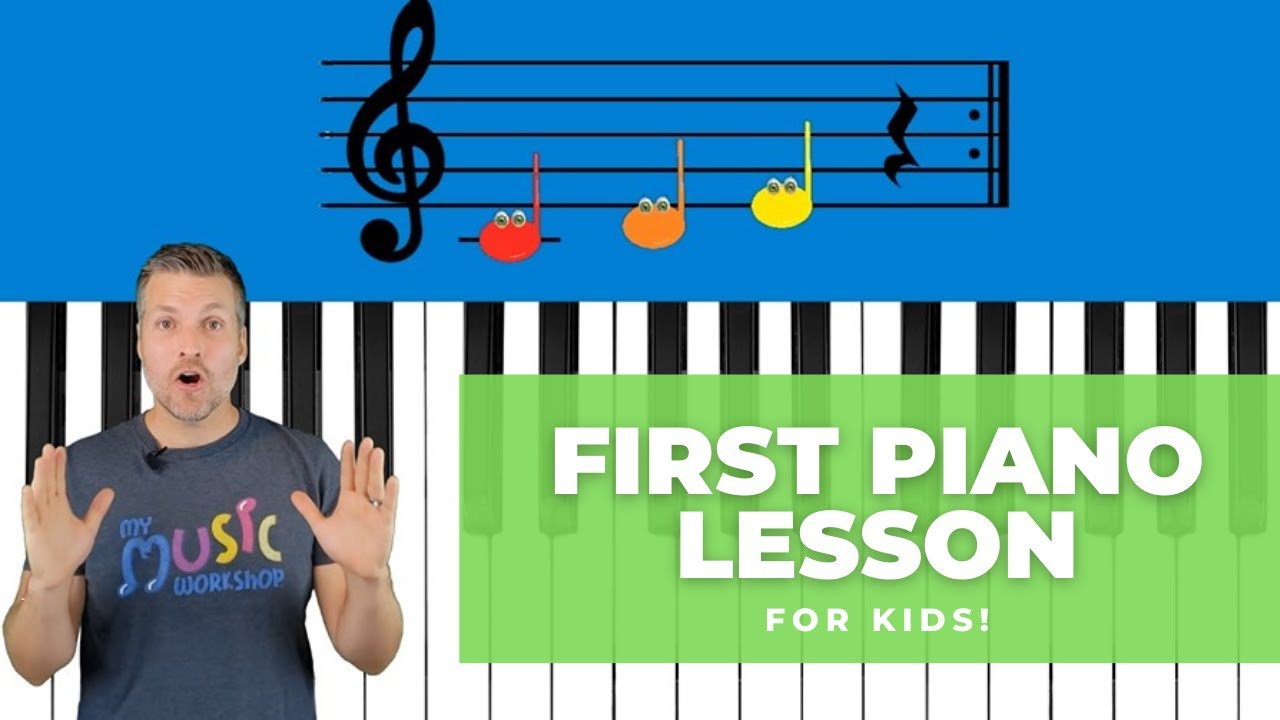
Before a single note is played, the teacher makes one thing clear: the piano already knows how to explain itself. The black keys are grouped in threes and twos, repeating across the entire keyboard in a patient, endlessly visible pattern, and that pattern is the first secret a beginner needs to unlock every white key by name. For any child who has ever pressed a piano key and wondered what it actually meant, this lesson answers the question in a single friendly session, using a dog’s face to do it.
The doggy ears that hold the whole alphabet together
The entry point is the two black keys. Grouped in pairs, they sit on the keyboard like floppy ears on either side of a single white key, and the white key in the middle is the dog’s face. Dog starts with D, so that middle key is D. From there, C sits just to the left and E just to the right, and a child has their first three named notes before they have touched a single one. The three-two-three-two pattern of black keys, the teacher explains, repeats all the way across the instrument, so once a student can spot the doggy ears anywhere on the keyboard, they can find D, and from D they can find everything else.
Acoustic pianos get a quick mechanical tour as well. Lift the lid and strings are visible inside, and when a key is pressed, a small hammer strikes those strings to produce the sound. The keyboard, its electric cousin, works differently: it needs to be plugged in, can have its volume adjusted, and can mimic dozens of other instruments. Both belong to the same family, but the acoustic piano is presented as the physical, self-contained original.
Right hand, three fingers, and a pattern worth repeating eight times
The playing portion of the lesson assigns each finger a number: thumb is one, pointer is two, middle finger is three, ring is four, pinky is five. Fingers one, two, and three press C, D, and E in sequence, followed by a one-count rest that looks, as the teacher puts it, like a lightning bolt on the printed page. Three quarter notes, then a quarter rest: C, D, E, rest. That unit repeats eight times in a row, which is enough repetition for the feel of the pattern to move from the eye to the hand.
The sheet music reading element is layered in gently. Each note sits slightly higher on the staff than the last because each pitch is slightly higher than the last, a visual logic that mirrors the physical layout of the keys. Repeat signs bracket the whole thing, a callback to an earlier lesson about a magic tunnel that sends the music back to the beginning.
As the teacher put it plainly near the close: ‘learning an instrument takes practice and you’ve got to keep practicing to get better.’
The keyboard sitting open with three keys waiting
On the keyboard, three adjacent white keys sit exposed below the paired black keys: C to the left, D in the middle, E to the right.
The doggy ears are still there. The pattern has not changed. The fingers just have to find it.