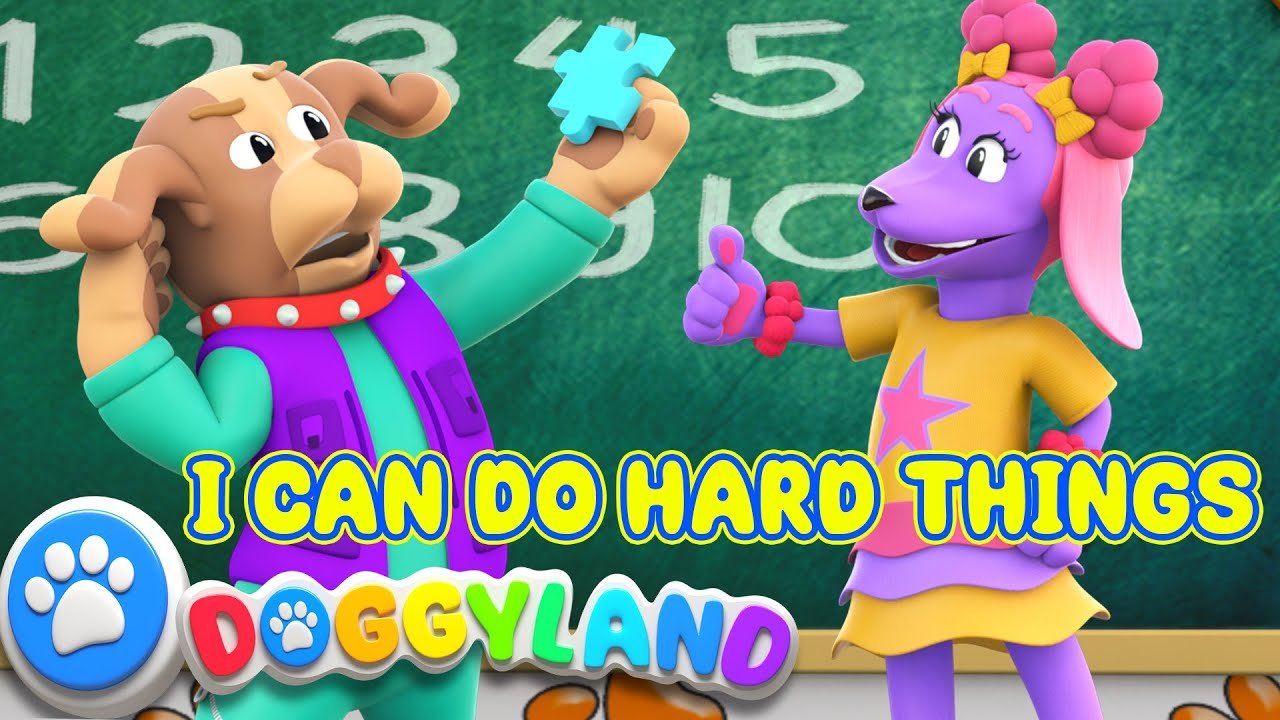
Billy is staring at a puzzle he cannot finish, the clicking and shuffling of pieces going nowhere, frustration quietly building. In Doggyland, that small stuck moment is exactly where a song steps in. Because the gap between ‘this is too hard’ and ‘I can keep going’ is one of the earliest and most important gaps a child ever has to cross, and the right words at the right moment can bridge it.
A puzzle that won’t cooperate and a song that shows up anyway
When Billy admits he thinks the puzzle is too hard, nobody tells him it is easy. Nobody solves it for him. Instead, the song arrives: ‘I can do hard things, you can do them too, nothing’s too hard for a kid like you to do.’ The distinction matters. The lyric does not promise the puzzle will be simple. It promises that hard things are survivable, and that the kid on the other side of the difficulty is still a star.
The song cycles through its message with the kind of repetition young children need to actually absorb an idea, not as filler, but as reinforcement. ‘Just keep going, it’s all right, you will get it, it won’t be long.’ Each line lands short and clean. Then the chorus shifts from ‘I’ to ‘we,’ from solo encouragement to shared effort: ‘We can do hard things.’ That small pronoun move turns a pep talk into a partnership.
Why the shift from ‘you’ to ‘we’ is the whole point
The song’s structure follows Billy’s emotional arc rather than skipping past it. First it names the feeling without dismissing it: ‘If it’s hard, it’s okay.’ Then it redirects: ‘Just keep going.’ Then it affirms without overclaiming: ‘You will get it, you can do it, don’t forget it.’ By the time the chorus lands the line ‘even if it’s hard, believe and you’ll go far,’ it has earned it, because it spent the whole song sitting with the difficulty first.
The Doggyland team put the philosophy plainly inside the lyric itself: ‘Nothing’s too hard for a kid like you to do.’ That line does not say hard things are secretly easy. It says kids are bigger than the hard things.
Billy and the puzzle
The puzzle is still sitting there when the song ends. Its pieces have not rearranged themselves.
Billy has been told, in the most direct terms a children’s song can manage, that he is a star and that the hard thing in front of him is not the end of the story. What happens next is his to figure out.
 Wake up to Only Happy News!