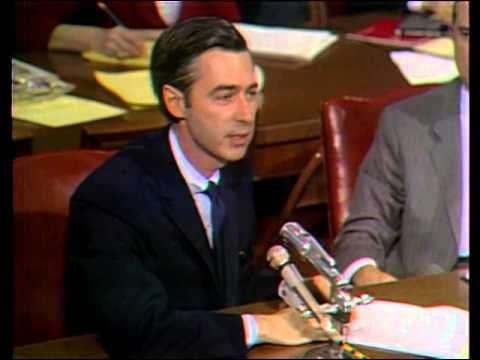
Senator John Pastore had not planned on getting goosebumps. The Rhode Island Democrat was known across Washington as one of the toughest questioners on the Senate Commerce Committee, and in 1969 he was presiding over hearings that would determine whether public television would receive $20 million in federal funding or walk away with nothing. When Fred Rogers stepped up to the microphone that day, he had a ten-page philosophical statement in his pocket that he decided, on the spot, not to read. What happened next would become one of the most quietly remarkable moments in the history of American broadcasting.
A $30 budget and a question about what children deserve
Rogers opened not with argument but with autobiography. His first children’s program on WQED had launched 15 years earlier on a budget of $30. By the time he sat before the Senate committee, that figure had grown to $6,000 per episode, a number that sounds substantial until he placed it in context: six thousand dollars, he explained, pays for less than two minutes of cartoons. Two minutes of what he called ‘bombardment.’ He told the senators he had spent six years working in child development, not making television in the conventional sense, but trying to understand what he called the inner drama of childhood. His program addressed getting a haircut. Feelings about brothers and sisters. The kind of anger that rises in ordinary family situations. Pastore, still testing him, asked how long the program ran and whether the committee could see a copy. Rogers answered plainly: a half hour, every day, and he would be grateful for them to watch any episode they chose.
The song that landed the argument no speech could make
When Rogers asked if he could share the words to one of his songs, Pastore said yes, and what followed was not a performance in any theatrical sense. Rogers recited ‘What Do You Do with the Mad That You Feel’ directly into the Senate record, explaining that the first line had come straight from a child he worked with in small puppet sessions. The lyrics walked through punching a bag, pounding clay, rounding up friends for a game of tag, and then arrived at the idea Rogers considered most important: the good feeling of being able to stop. ‘I can stop when I want to, can stop when I wish, can stop, stop, stop anytime,’ he recited. ‘And what a good feeling to feel like this, and know that the feeling is really mine.’ He closed with a line about a girl becoming someday a lady and a boy becoming someday a man.
Pastore sat quietly for a moment. Then he said what no one in the room expected from him: ‘I think it’s wonderful. Looks like you just earned the $20 million.’
The room broke into applause. Rogers thanked the senator not only for the funding decision but, in his precise phrasing, ‘for your interest in our kind of communication.’ He had walked into the hearing trusting, as he told Pastore at the outset, that the senator would read his written statement. Pastore never needed to.
The senator who admitted to two days of goosebumps
At one point during the exchange, before the song had even finished, Pastore interrupted to say he was ‘supposed to be a pretty tough guy’ and that it was the first time he had had goosebumps for the last two days. Rogers responded without missing a beat, telling him he was grateful not only for the goosebumps but for his interest.
Fred Rogers closed every program the same way, a fact he mentioned to the committee without any fanfare: ‘You’ve made this day a special day by just your being you. There’s no person in the whole world like you, and I like you just the way you are.’ He said it to senators the same way he said it to children.
 Wake up to Only Happy News!