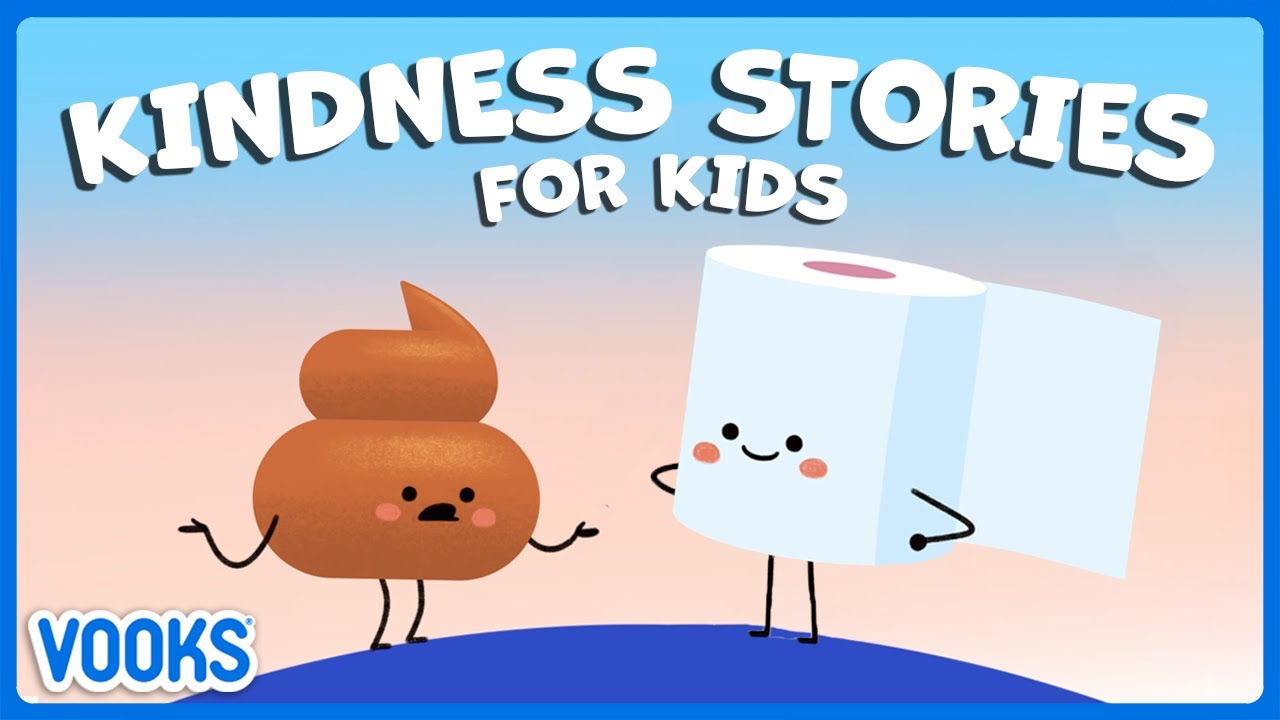
A tiny piece of poo named Blue wanders through nests too small, caves too big, sand too hot, and snow too cold before a friendly voice calls out: ‘Hi little poo, you’re a long way from the potty, huh.’ That opening line, delivered with total sincerity, is the emotional key to what Vooks has assembled here: sixteen read-aloud storybooks for children, each built around a different flavor of kindness, courage, or belonging. The collection moves from picture books about self-acceptance and friendship to stories grounded in real history, and the tone never condescends to its audience.
The stories run long enough to matter and short enough to keep a young listener locked in. Blue finds his shiny home at last. Little I, who lost his dot on the last day of alphabet school, discovers his father saved it on his pillow, then decides he is ready to face the world as a capital letter. Earth, feeling ordinary beside Mercury’s speed and Venus’s heat, receives a surprise celebration from the other planets: ‘You’re covered in flowing water, and most importantly you’re full of life.’ These are not morals bolted onto plots. They are the plots.
Horse, Unicorn, and the friendship nobody expected
The standout comic entry pairs a radiant unicorn who eats pink cupcakes for every meal and makes rainbows against a horse who sits ‘grumpy, blah blah blah.’ The animals adore unicorn. Bird lines her nest with his long, beautiful hair. Horse, watching from outside the group, says flatly: ‘No. I don’t like you.’ But what he means, the narrator explains quietly, is ‘I wish I were you.’ When two men creep into the paddock at night and tie unicorn in ropes, the only animal fast enough and strong enough to stop them is horse. Six great chomps of horse’s large teeth later, unicorn is free. What follows is not a grand reconciliation speech. Horse and unicorn simply start sharing: sometimes horse eats cupcakes, sometimes unicorn eats hay. ‘That’s better than anything,’ the story concludes. ‘Even pink cupcakes.’
Real people who changed the rules
The collection shifts register entirely for a chapter on historical figures. William Wilberforce, Harriet Tubman, Abraham Lincoln, Susan B. Anthony, Mahatma Gandhi, Rosa Parks, Martin Luther King Jr., and Malala Yousafzai each receive a single illustrated spread. The framing is direct and unflinching for young readers: Rosa Parks was told to give up her seat to a man with light skin. ‘Nope,’ Rosa said. She went to jail. After 381 days, the leaders changed the rules. Malala, the book notes, became the youngest person to receive the Nobel Peace Prize in 2014, at age 17. The language is plain. The facts are the drama.
Jadav Payeng’s story, told as ‘The Boy Who Grew a Forest,’ runs longer and carries the collection’s deepest environmental weight. A boy on an eroding river island in India receives 20 bamboo saplings from village elders and begins planting alone, lugging heavy buckets from the river, building a watering system, carrying cow dung, earthworms, termites, and red ants that bit him on the journey to their new home. Decades later, the forest has grown to more than 40 acres and is alive with one-horned rhinos, gibbons, migratory birds, and elephants. The forest is named after him: Malai, for Jadav Malai Payeng.
The mayfly story ‘May’ captures the rarest tone in children’s literature: genuine stakes without manufactured peril. May, born on the bank of a river with perhaps one day to live, nearly becomes a meal for a trout. Hours later, she finds that same trout tangled in fishing line, his color still shimmering in the light, rainbow stripes in every hue. She works the knot loose. The river carries him away. A splash, a flash of tail, and two words drift back on the wind: ‘thank you.’
One knot, one afternoon, one day
May’s small wings worked the line until the knot, so tight her progress was slow, finally let go. The river carried trout away. She watched, unsure whether he would be okay, until the surface broke and a tail waved good night.
Mikey, the four-year-old torn between his Cantonese grandmother’s Chinese food tradition and his Italian grandmother’s pasta loyalty, lands on fried rice with marinara sauce for his birthday party. His friends’ faces light up. The whole party shouts: ‘Different is good.’ The collection ends, as it begins, with a child simply trying to figure out where they fit. The answer, every story suggests in its own way, is exactly where they are.