
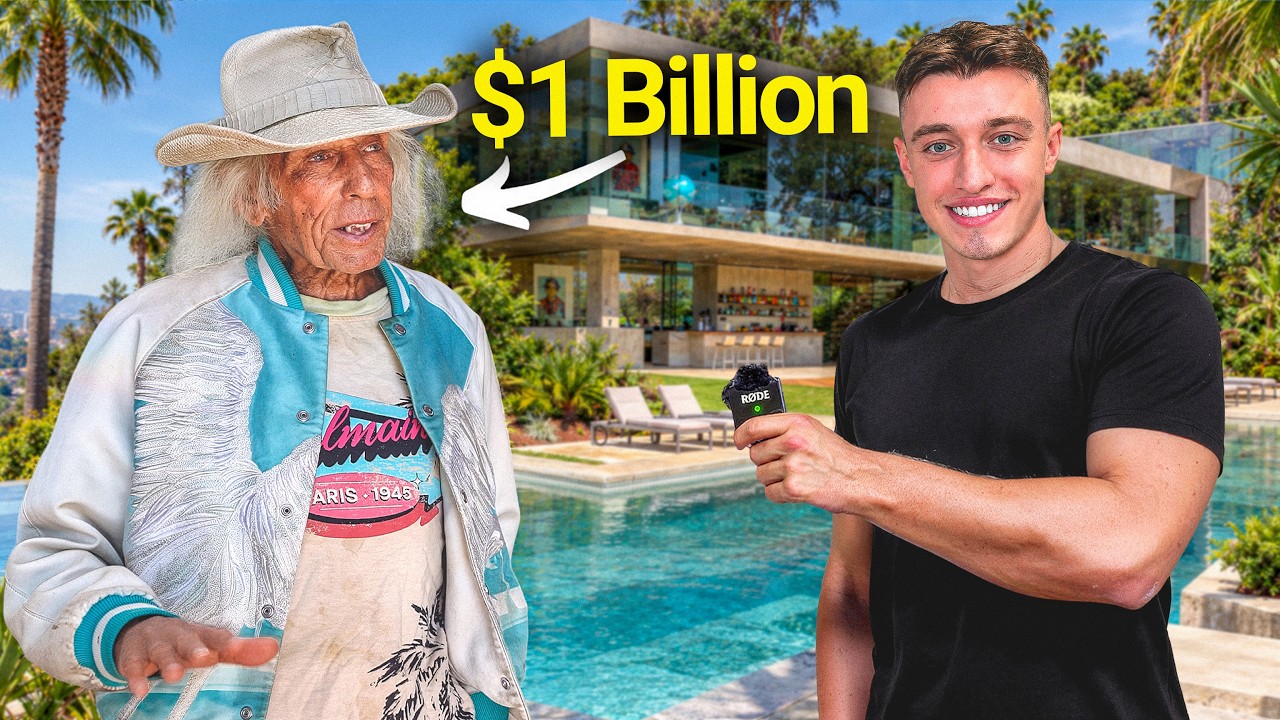
James Goldstein has lived in Beverly Hills for 60 years, and the driveway alone tells you something is different here. Stretching through a hillside estate with a tennis court marked ‘Club James’ tucked into the back, the property sits above a panoramic sweep of Los Angeles that Goldstein designed his entire residence around. Most people accumulate wealth and then wonder what to do with their time. The people inside this zip code, home to some of the most expensive real estate in America, seem to have answered that question their own way, and a single afternoon of cold approaches on Rodeo Drive and inside a nearby business conference pulled back enough of the curtain to make the pattern visible.
The creator behind School of Hard Knocks flew across the country with one question for every person he could get to stop: how did you get rich?
The cable guy who borrowed seven million dollars and proved two adults wrong
Mark Nathansson was 12 years old when he overheard his father and his father’s best friend agree that he was a nice kid who talked too much and would never amount to much. He was a mediocre student by his own description, and he stayed that way until graduate school, when something shifted and he started earning straight A’s. What changed before that, though, was a single conviction: he wanted to go somewhere nobody else was going.
When most of his graduate school peers lined up for jobs at the major television networks, Nathansson looked the other direction. Cable television covered 5% of American households at the time. He borrowed seven million dollars from a bank and started buying cable systems, doubling the size of his company every year for eight years. By the time he sold, cable had reached 75% of the country and the sale came in at over three billion dollars.
Asked on the street in Beverly Hills for his single greatest piece of financial advice, Nathansson did not talk about hustle or mindset. He talked about debt. ‘Watch the debt,’ he said. ‘If you have too much debt and the markets go against you, you can lose control of the company.’ He also taught entrepreneurship at UCLA and told his students the same thing he told the camera: you do not have to go where everyone else wants to go. Think outside the box, be creative, focus, and the path opens.
He also said he made a point of getting to know the janitor by name, because the people dealing directly with customers were more important to the business than the CEO.
Cash, curiosity, and an upside-down pyramid
At a large business conference just outside Beverly Hills, Marcus Lemonis came off stage and agreed to sixty seconds. He made nine hundred million dollars in profit in a single year through the RV business before acquiring Bed Bath and Beyond, and his take on wealth was blunter than most.
‘Have cash at all times,’ he said. ‘Because when there’s an opportunity that you want to strike, you better have the money.’ He pushed back hard on the idea that cash is useless: ‘Whoever said that cash is trash doesn’t have any cash.’ His philosophy runs on an inverted structure where employees sit at the top of the pyramid and leadership exists to serve them, not the other way around. Pay them well, treat them with respect, give them their own path to prosperity, and the customer happiness follows automatically.
A book publishing veteran who peaked at eleven million dollars in his best single year offered a different kind of answer. He pulled out a physical notepad and pen from his pocket and held it up. Writing things down by hand, he said, is the detail that most people skip because they are staring at a phone or an iPad. ‘When you whip out a pen and paper, people kind of get freaked out by that,’ he said. ‘Success is the little things. It’s the detail.’
The 1961 Rolls-Royce that became a million-dollar investment
Back in the hills, Goldstein walked his guests through a bedroom with a view over all of Los Angeles, a living room where ‘The Big Lebowski’ was filmed, and a garage holding a single car: a 1961 Rolls-Royce he bought for 122,000 dollars and has driven for sixty years. The car is now worth one million dollars.
At 86, Goldstein built his wealth through California real estate, buying his current property at a price he described as one of the greatest deals in the history of Beverly Hills after two years of searching and a thirty-second decision. He attends NBA games courtside and has done so more than 5,000 times by his count.
Asked whether money buys happiness, he paused. ‘It can. Not always.’ What mattered to him, he said, was independence: the ability to do what he wants, when he wants to do it.
The view that never gets old
The bedroom window at Goldstein’s estate frames the entire Los Angeles basin, city lights spreading out below the hillside in every direction. He designed the whole residence around that sight line, and when he checks into hotels anywhere in the world, his first instruction is always the same: highest floor, best view available.