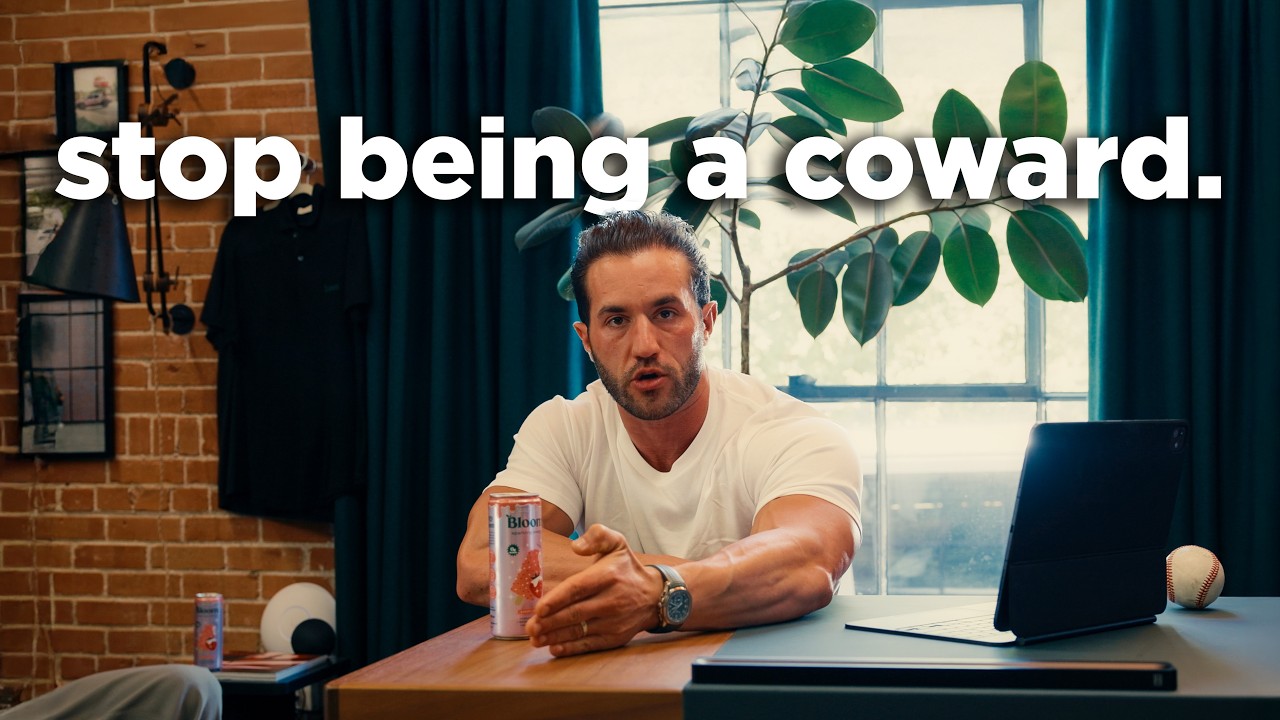
Greg Lav was two and a half months out from 2027, standing on a stage in front of a room of up-and-coming entrepreneurs, when someone in the audience asked him what would happen if Bloom’s publicly visible can-count started to slow down. The question stopped him cold, not because it was hard to answer, but because it exposed something he kept hearing in DMs, at expos, and on Tuesday-night phone calls with people who reached out looking for a straight answer. Nine times out of ten, he told his business partner Leo afterward, the real problem is the same: people are just scared. And that fear, he argued, is the most expensive thing in the world.
The cost nobody talks about until it’s too late
The fear Greg keeps running into is not the rational kind. It is not the fear of losing money or working long hours. It is the fear of what a specific handful of people might think. He pushed his audience to actually write down the names of every person they were afraid of judging them, and he described what usually happens when people do: three of the names turn out to be kids from high school they have not spoken to in years, and the rest are people whose lives look nothing like the life the writer actually wants. ‘You’re going to let Janice from Kansas stop you from going after your dreams?’ he said to the room, in a line that apparently landed hard enough that it became the through line of the whole conversation.
The actual worst case, in his telling, is not a business slowing down. Bloom started as a pre-workout company, then moved into protein powder, then greens, then 300 products later launched Bloom Energy. The 299 products that did not fully land were never quiet failures. They were public. Retailers said no. Pitches to Target, Walmart, Costco, and Amazon produced more rejections than approvals at every stage of the company’s growth. What kept the company moving was never the absence of nos. It was the decision to treat each no as confirmation that the calls were actually being made.
Reframing the feeling that makes people quit
Leo drew the comparison to dieting. The first time someone cuts calories, hunger feels like something going wrong. By the second or third time, hunger becomes a signal that the deficit is working, and the sensation flips from negative to positive. Sales works the same way. Greg described building email lists of 500 to 1,000 people, clicking send, feeling a pit in his stomach every time, and then watching that pit gradually transform as the pattern repeated: 50 calls, maybe one client, and the steady accumulation of proof that the system worked. He also referenced a line he heard attributed to Alex Hormozi, who reportedly started sales sessions by telling his team to go out and collect nos, treating the rejection count as the real measure of effort rather than the thing to be ashamed of.
Greg also pointed to something more personal. He used to take anti-anxiety medication before store pitches and before speaking in public. The shift came not from a single breakthrough but from filling his days with smaller uncomfortable things, changing his morning routine, adjusting his diet, starting to post on social media despite finding it genuinely cringe at the start. His early content, he said, was ‘super lame’, and he leaves it up deliberately. Anyone who judged him for it either has no stake in his goals or is living a life he has no interest in copying.
The version of yourself that can handle what you want
The practical advice he landed on was specific. Write down the fears. Write down the names. Laugh at them. Then audit the people around you, and if necessary, move. He and Leo drove eighteen hours from Westchester, New York to Boulder, Colorado, knew no one there, and worked side by side for a year and a half while building Bloom. They had no social life in Boulder because they were not there for one.
As Greg put it near the end of the conversation: ‘Either you cure the fear or the opportunity goes away. Either the fear goes away or the opportunity does.’
The trophy case nobody can empty
Leo pointed out something about Bloom’s publicly visible can count that changed the frame entirely. The number can only go up or stop. It cannot go backward. Every can, every pitch, every rejected product, every Juicy Orange flavor pulled from a Walmart shelf, those are all already in the count. No one comes into your house and takes the trophies out of the case.
Greg closed the conversation the same way he started it: two and a half months out from 2027, sitting in a room with Leo and JJ behind the camera, arguing that being a nobody with nothing to lose is not a disadvantage. It is the cleanest possible starting position, and the arena doors are wide open.
 Wake up to Only Happy News!