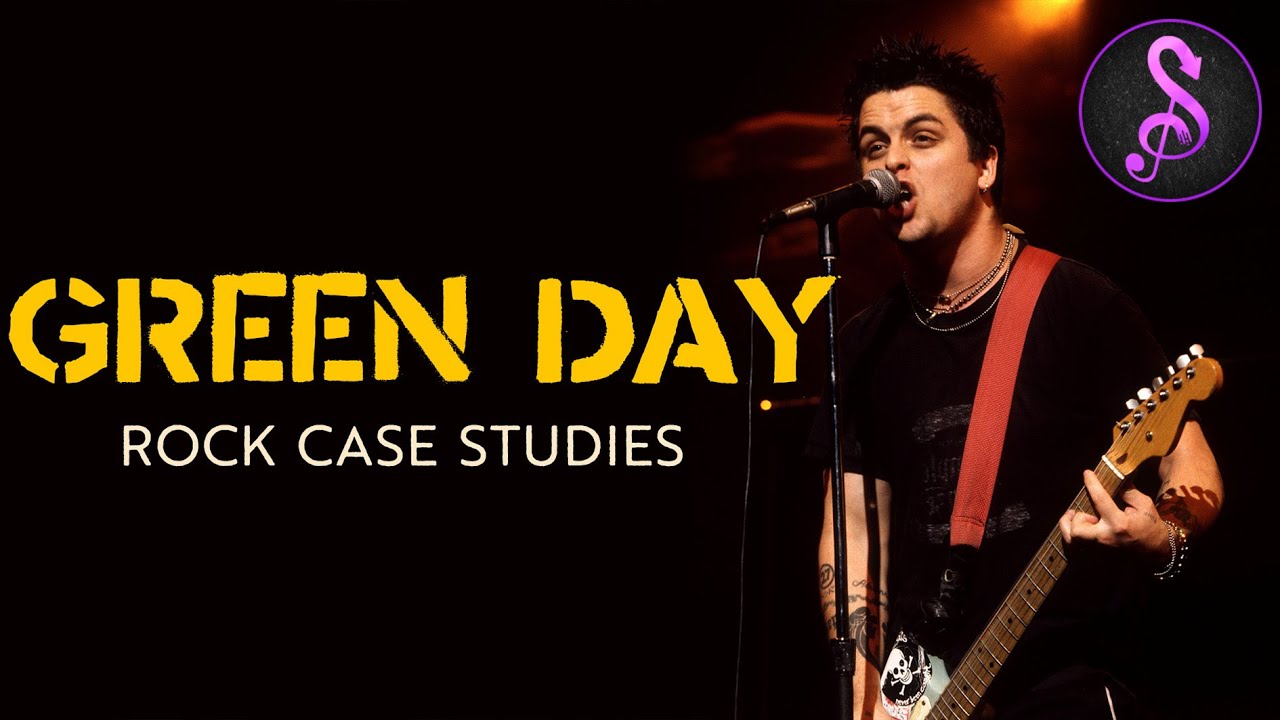
Billie Joe Armstrong was still a teenager when he and bassist Mike Dirnt first drifted up from a town called Rodeo to San Francisco, looking for anyone who would put them on a stage. What followed was not a lucky break but a five-year slog of writing, recording, and touring that would eventually rewrite the rules of what a punk band could become. Green Day‘s story is, at its core, a masterclass in refusing to stand still, and in the stubborn belief that a great song belongs to anyone with even an ounce of rebellion in them.
The band’s roots ran through the Gilman Street scene, an all-ages venue in the Bay Area that became, in the late 1980s, a rare common ground for punks who barely spoke to each other. Crusties, hardcore kids, pop punkers, and everything in between arrived at an uneasy truce around 1987, 1988, and 1989, and out of that friction came a grassroots energy that shaped Green Day’s earliest instincts. They played wherever they were let in, because their audience was too young to get into anywhere that served a drink.
The album that changed everything on a Walkman at 30,000 feet
The turning point came on a plane back to Berkeley. The producer who had worked with the band took a cassette of what would become Kerplunk, slid it into a Walkman as the aircraft began to taxi, and heard the first chords of ‘2,000 Light Years Away’ kick in. ‘It was a scary feeling,’ he recalled, ‘because I suddenly realized this is something way bigger than I’d ever bargained for.’ Kerplunk was the record that began circulating in the UK, nudging the band into an international underground, and it contained an early version of ‘Welcome to Paradise,’ a song written about the semi-squatted Oakland warehouse the band moved into at roughly 18, a neighborhood where shootings and robberies were routine.
Dookie, their 1994 major-label debut, arrived at exactly the right moment. Grunge was running out of steam, the old hard rock acts were fading, and a generation of younger listeners was looking for something that felt like theirs. Every single track on Dookie functioned as its own small anthem. ‘Longview’ announced the band with a rolling elastic bassline that took its time and was in no hurry to end. ‘Basket Case’ ended up on MTV for weeks, with wide eyes and a chorus that stuck immediately. Then came Woodstock, where mud covered the stage, fights broke out between the band and panicking security guards, Mike Dirnt was tackled by a guard who mistook him for a kid from the crowd, and Green Day walked away as the band everyone was talking about.
From ‘Good Riddance’ to American Idiot, nearly 18 years in
Nimrod in 1997 produced the moment that surprised almost everyone: ‘Good Riddance,’ a sparse acoustic song with strings, filmed with Billie Joe sitting on a bed in an empty room. For the first time, a wider audience could see a classic singer-songwriter sitting inside the punk band. Warning followed in the early 2000s, selling less than anything before it, and two compilation releases made some observers wonder whether the career had peaked.
It had not. When the band came in to record American Idiot, the approach was different from any previous session. They stayed until they felt it was finished, with no artificial time constraint. The record sold somewhere between 10 and 15 million copies. One collaborator put the band’s engine plainly: ‘If somebody has an idea, get off your cart and get inside and let’s do this. Doesn’t matter who says that, if somebody says that, they all just run in.’
The studio owner recalled the ‘Boulevard of Broken Dreams’ being played on a drive through Alameda the morning after it was recorded overnight, and being unable to shake it loose from his head all day.
A cassette and a runway
The Walkman on the Berkeley-bound flight sits in the story as one of those small, almost accidental moments that marks an irreversible threshold. The mastering engineer handed over a cassette of Kerplunk, the plane began to roll, and two chords in, someone understood that the scale of what they were holding had changed.
American Idiot arrived decades later carrying a similar weight, placed alongside, by at least one voice in the room, Paul’s Boutique and Songs in the Key of Life as albums of genuine and lasting consequence.