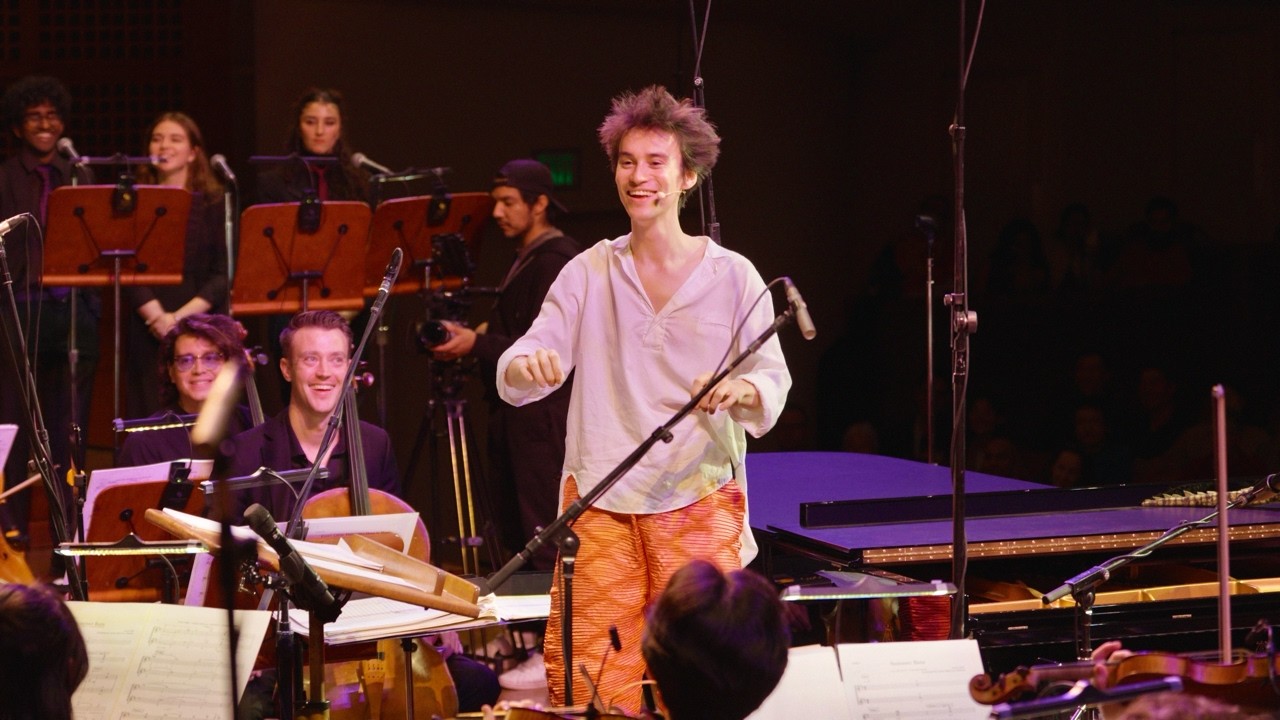
Jacob Collier walked to the front of the stage in San Francisco, faced a full orchestra, and told them something that made the hall go quiet: none of them had any idea what was about to happen. No sheet music had been distributed. No rehearsal had taken place. No song had been announced. Collier had a rough sense of where things might go, but by his own admission, not really all that much. What followed was one of the most quietly astonishing acts of live musical construction an audience is likely to witness, a full orchestral arrangement assembled in real time, instrument section by instrument section, in front of a packed crowd.
Building the verse one section at a time
Collier started with the strings, calling out individual notes by name. High F from one section. C from another. B flat from the far side. He shaped a floating, open harmony before moving to the harp, feeding it a short repeating figure: F, B flat, C, B flat, F, C, B flat. The celeste got a simple ostinato of Fs. The glockenspiel was coached on its volume in real time, nudged louder, then quieter, until it landed exactly where Collier wanted it.
Once the upper register was set, he turned to the low end. The basses were given a pizzicato B flat figure, which he described as even better than he was hoping. The cellos split into two groups of three, one playing a rising figure, the other playing the same sequence inverted. Violas filled the middle with a held D. Then came the moment that locked the whole verse into motion: when the basses dropped to their lowest note, a G, every other player transposed their part down by a tone and back up again. Collier counted them through the shift and the whole thing moved together on the first attempt.
Brass, percussion, and the reveal nobody saw coming
The chorus required muscle. Collier pulled in the tuba first, assigning it three notes across four bars: E flat for four beats, then G for two, then F for two. The bass trombone got the same rhythm a fifth higher. The remaining trombones added inner voices. Four horns split into pairs on B flat and F, running straight through every chord change. Trumpets took the top of the harmony, with the first trumpet holding a high F and the others filling out the triad below, with one note instructed to move down on alternate bars.
When the brass ran it together, Collier told them it could be three times louder. Then he turned to the percussion, working out a snare roll into a simultaneous bass drum and cymbal hit. The timpani rolled on B flat before landing on E flat and following the tuba line at full, uncapped volume, as Collier put it.
Woodwinds came last. Bassoons on a low C, clarinets trilling between E flat and F, oboes on a low B flat, flute holding G, and piccolo on an E flat above. Almost every woodwind player was asked to trill. The bassoons were told, deadpan, that they simply did not deserve a trill.
When a group of singers in the hall reminded him they existed, Collier told them he could not give them a part yet without giving the game away. Moments later, with every section locked in, he sat at the piano, counted the strings in, and began to sing. The song was Coldplay’s ‘Yellow’, which then dissolved into ‘Every Breath You Take’ by The Police, the two melodies braided together as the full orchestra played on behind him, having never heard the plan until they were already inside it.
The piccolo player who held an E flat above the staff
Somewhere in the middle of assembling the woodwind voices, Collier pointed to the piccolo player, sang the pitch he wanted, and waited. The note came back exactly right on the first try.
By the time the final chorus arrived, the hall was singing the same line back at Collier, watch the stars, watch the stars, a phrase that had started as a single voice at a piano and ended as something belonging to everyone in the room, built from nothing in under an hour.