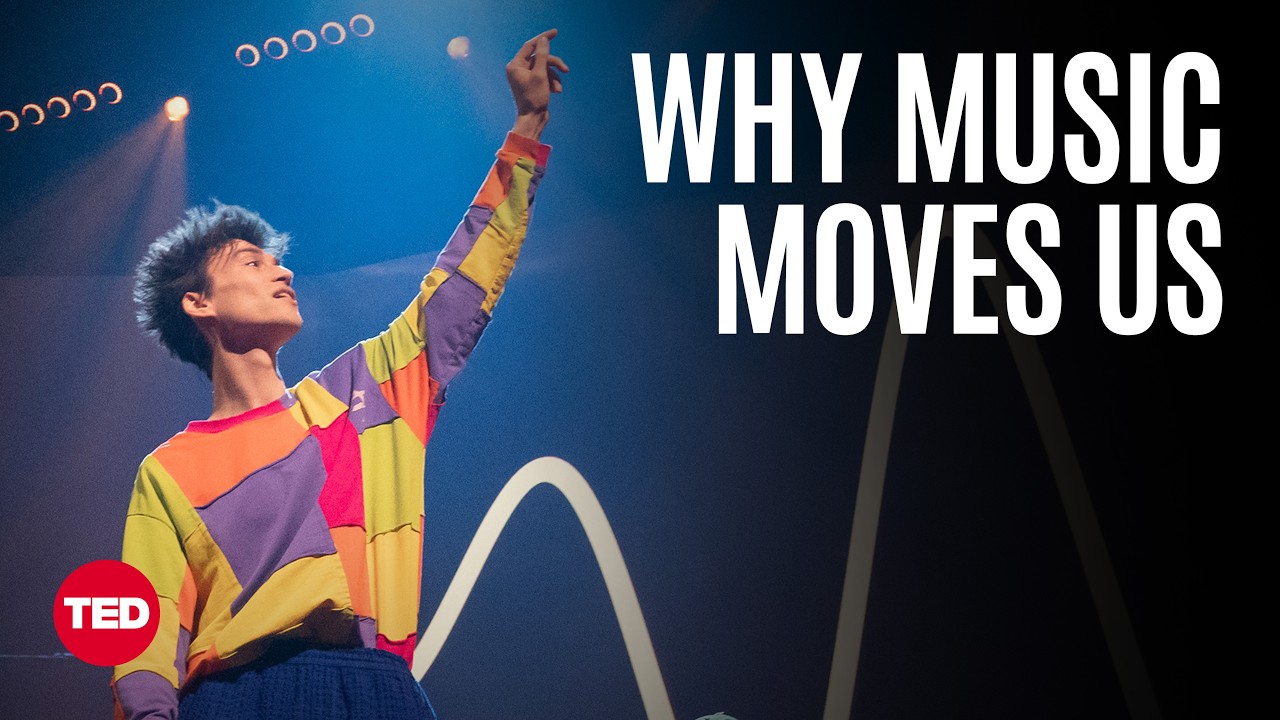
Jacob Collier sat down at a piano on a TED stage and opened with a complete, unaccompanied performance of ‘What a Wonderful World,’ and by the time the last chord dissolved, the room was already his. What followed was not a lecture about music theory. It was something closer to a guided rediscovery, a reminder that the language of music lives inside every person in the room, waiting to be named. The name Collier gave it was simple, a little silly, and immediately unforgettable: the wiggle.
Why a wiggly line beats a straight one every time
Collier opened his case with a contrast most people feel but rarely articulate. A straight line, he explained, is rigid and brittle, like a Roman road or the hand of a clock. The wiggle is soft, fluid, constantly in motion, and stronger for it. ‘There are no straight lines in nature,’ he said, quoting Alan Watts, and music, at its core, is just wiggling air.
From there he broke the wiggle down into three forms. The first is melody, the line that travels from one place to another and tells a story as it goes. He demonstrated using Louis Armstrong’s own phrasing: the way ‘I see trees of green’ rises and reaches, the way ‘the bright blessed day, the dark sacred night’ traces the arc of the sun going down. A good melody, Collier argued, does not merely describe a thing. It moves like the thing.
The second wiggle is rhythm, and here Collier went physical. He sang a flat, metronomic version of the lyric to show what the song sounds like without it, then shifted into Armstrong’s actual delivery, a bouncing, syncopated groove that immediately had people in the audience moving. Rhythm, he said, is about the body as much as it is about time. It gives the melody something to be in conversation with, and it carves out space, proportion, and form.
The wiggle that changes the color of a note without touching it
The third wiggle, harmony, is Collier’s personal favorite, and he made a convincing case for why. Harmony, he said, is the wiggles between the wiggles. By shifting the chord underneath a held melody note, he demonstrated live how a single sustained pitch can feel warm, then dark, then lightened, then saddened, without the note itself moving a single semitone. ‘Did you feel the wiggle?’ he asked the room after landing on a chord that transformed the color of the note entirely. The answer was written on people’s faces.
He put it plainly: ‘With a chord, I can squint, I can reassure, I can enchant, I can purify, I can terrify.’
The moment the audience became the instrument
Collier closed by returning to the piano and beginning ‘What a Wonderful World’ a second time. Without instruction, without a prompt beyond the music itself, the audience began to sing. The hall filled with voices finding their own notes, their own rhythm, their own place in the chord. The performance ended not with Collier playing alone, but with the room singing together, which had been the point all along.
Somewhere in the final bars, Collier’s philosophy snapped into focus: being in harmony does not mean everyone sings the same note at the same time. It means embracing the dissonance and following the thread home.