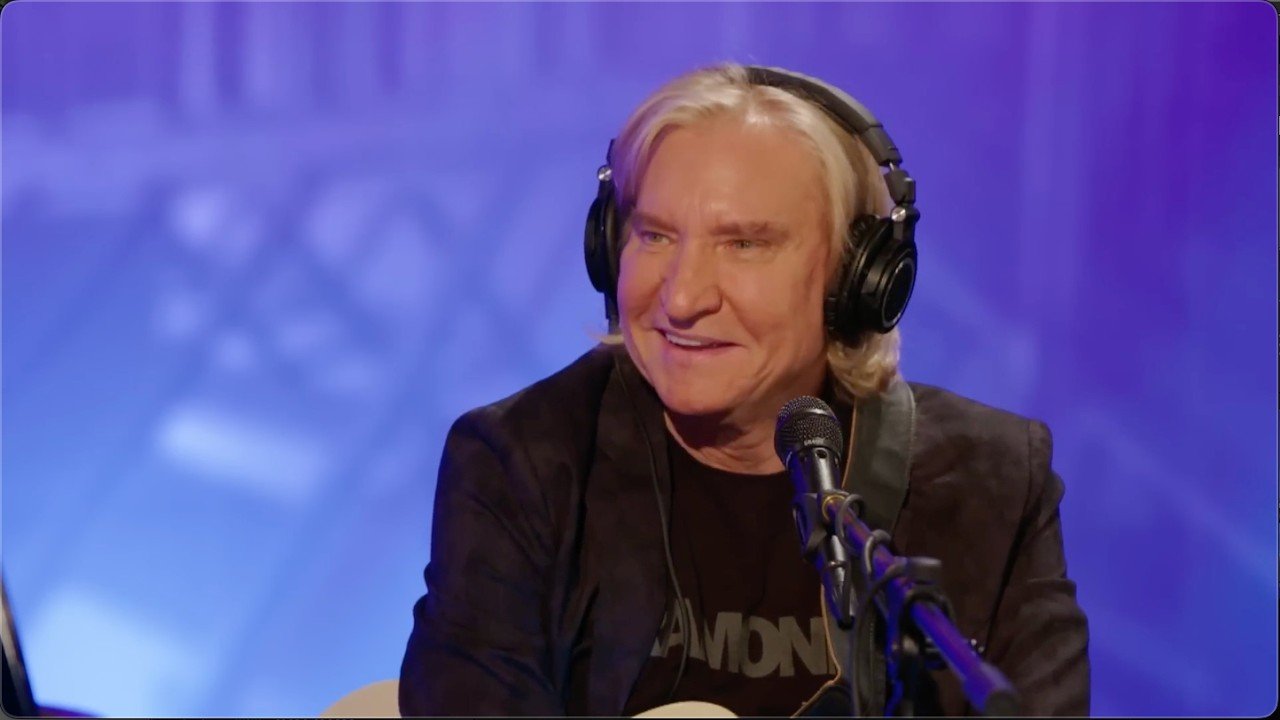
Joe Walsh sat down and played the opening bars of ‘Rocky Mountain Way’ before the conversation even got going, the guitar cutting through the room before a word was spoken. That image captures something essential about the man: the music arrives first, and the explanation follows. For anyone who has ever wondered how one of rock’s most distinctive guitarists ended up inside the biggest-selling band in American history, Walsh finally put it simply enough to print.
They didn’t have a closer
The path into the Eagles was not a straight line. Walsh had already left James Gang behind and started a new band called Barnstorm, relocating to Colorado and recording his second solo album there with producer Bill Szymczyk. That partnership with Szymczyk turned out to be the quiet hinge on which everything turned. When Don Henley and Glenn Frey decided they needed to move away from the country-rock sound that had defined the Eagles’ early years, they asked Walsh who should produce the next record. He didn’t hesitate. He told them Bill Szymczyk, and when they asked him to make the call personally, he did. Szymczyk’s first response, according to Walsh, was blunt: ‘Why in the world would I do that?’ Walsh told him to trust him.
Bernie Leadon, the guitarist Walsh eventually replaced, was by Walsh’s own description a purist, a bluegrass and acoustic player who had no interest in the harder, R&B-leaning direction Henley and Frey wanted to take the band. Leadon made his position clear and walked. By that point, Walsh and the Eagles already shared a manager in Irving Azoff, shared Szymczyk as a producer, and had spent a summer on the same bill alongside Elton John, Chaka Khan, and the Beach Boys as separate acts. The personal familiarity was already there. The fit, once Leadon stepped away, was obvious.
Walsh described the decision without any mythology attached to it: ‘They didn’t have a closer, Paul. That’s all. That’s why they got me. For the ninth inning.’
How ‘Life in the Fast Lane’ started as a warm-up exercise
The songwriting dynamic Walsh described is less romantic than listeners might imagine and more practical than almost any other account of how a classic rock song gets made. The riff at the center of ‘Life in the Fast Lane’ began as a coordination drill Walsh ran through before shows, a left-hand and right-hand exercise he would play faster and faster to get his fingers ready. Glenn Frey walked into his dressing room mid-warm-up and, in Walsh’s telling, immediately demanded to know what it was. Walsh said he didn’t know, that it was just something he played to loosen up. Frey told him it was an Eagles song.
From there the track was assembled in pieces. Walsh developed the guitar work, Don Felder contributed as well, Frey built a demo and arranged it, and then Don Henley took the track away and came back with the lyrics. The three names on the writing credit reflect three genuinely separate contributions, not a single room session.
A dressing room, a lick, and Glenn Frey
Somewhere in a backstage dressing room that summer of shared touring, a guitarist ran through a warm-up exercise he had played hundreds of times before, at no particular tempo, for no audience at all.
Whatever that riff sounded like the first thousand times, the thousand-and-first time Glenn Frey walked through the door.
 Wake up to Only Happy News!