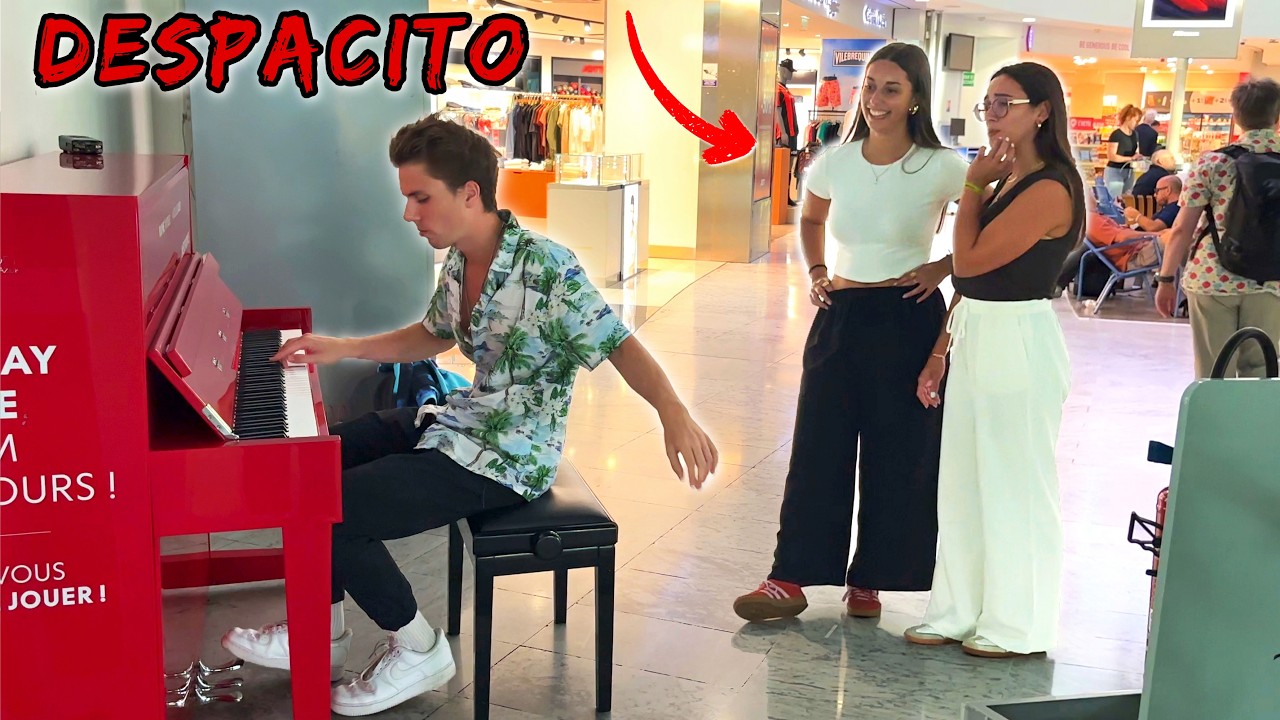
The piano at Nizza Airport was not there to be ignored. Peter Buka sat down at the public instrument and began a performance of Despacito that turned a busy departure hall into something closer to a concert venue. Airports are designed for movement, for the anxious shuffle of bags and boarding passes, but for a few minutes in Nizza, movement stopped.
When a departure lounge becomes a listening room
Public pianos in transit spaces carry a particular kind of democratic promise. Anyone can sit down, and most people walk past them without a second thought. When someone sits down with genuine intention, the acoustics of a hard-floored terminal do something unexpected: they carry. Buka‘s rendition of Despacito filled the space the way the song itself was built to fill space, with warmth and rhythm that needed no amplification to reach the back rows of waiting travelers.
The crowd that was not planning to stay
Passengers in transit are, by definition, somewhere between two places. They have gates to reach and schedules to respect. Yet the performance at Nizza drew the kind of attention that overrides those calculations, the involuntary pause where a person stops mid-stride and simply listens. That pause, repeated across a crowd of strangers who share nothing except a departure terminal, is one of the rarer things travel produces.
The piano, left as it was found
The public instrument at Nizza Airport, standing in the middle of a terminal built for efficiency, still sits exactly where Buka found it.
Airports are not built for lingering, but a piano in a departure hall is a quiet argument that they should be, and Nizza made that argument well the day Peter Buka decided to sit down.