
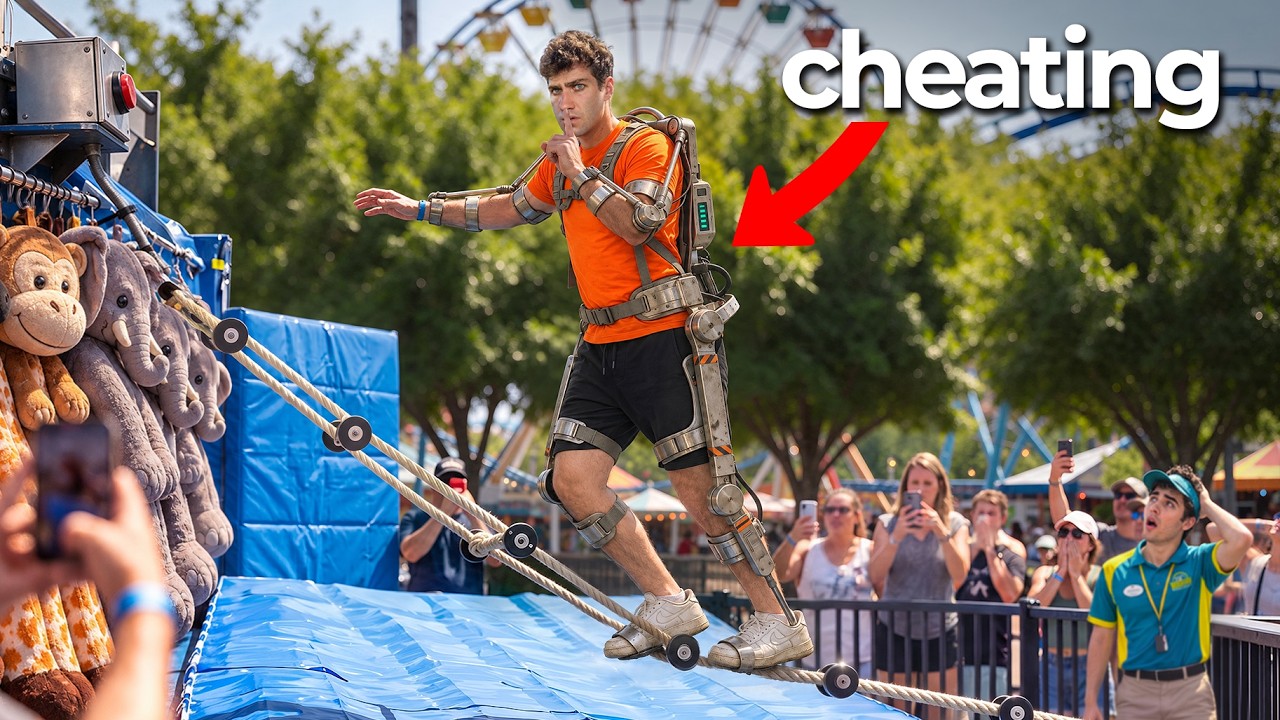
Eric from Airrack walked up to a Cat Rack booth at an amusement park, launched three balls with the confidence of someone who had absolutely no business doing so, and hit nothing. That failure, repeated enough times, became a plan. If the games were rigged by design, the only logical response was to bring experts whose entire identities were built around beating them, and to give those experts actual cheats. What followed was a 12-hour attempt to strip every single prize from every single game in one park, all of it going to kids in need.
The original goal came with some baggage. Eric had tried to win 500 prizes for charity once before and fell well short. This was the redemption run, and he had enlisted what he called ‘the Batman and Robin of throwing games.’ John and Jonah arrived at Cat Rack, where three accurate throws earns a large prize, and immediately made the booth look like a malfunctioning prize dispenser. Jonah hit 18 targets in a row on his first attempt, then 20, then kept going. The two of them cleared all 194 small prizes before lunch. Jonah was methodical about why the game is designed to be hard: the green fuzz around each target makes it look larger than it actually is, and the targets tilt toward the player, requiring more force and precision than most people realize.
A US Army marksman, a trick-shot record holder, and a deflated basketball
At the Shooting Gallery, the average player in a 60-second round managed around 30 targets. Max, a US Army Marksman Unit veteran, Guinness World Record holder, and seven-time speed shooting world champion, arrived and immediately started running the board. His first attempt clocked 5,775 points. The existing park record was 6,300. His cheat was a red dot sight, the same one he uses in actual competition, which keeps the eye on the target rather than forcing constant re-alignment. By identifying the six highest-value targets on the machine and shooting only those in rotation, he eventually posted a score of 9,999, the absolute maximum the machine could display, the first time that had ever been recorded in the park’s history.
At basketball, TJ came in with an oversized bag of prizes and a problem: the hoops were measurably smaller than regulation, leaving almost no margin for error. The cheat was a pump needle and a steady hand. Theme parks famously overinflate their basketballs so they bounce out of the rim. TJ bled the air out of each one while pretending to tie his shoe, and the difference was immediate. When a squad of Portland University D1 players arrived as backup, they were each hitting roughly one in every four shots against a general-population average of one in forty. Sam, the game attendant, eventually started passing balls back herself just to keep up.
The ring toss code and a lead-weight trick in a trench coat
Josh Horton, a trick-shot athlete with over 22 world records, spent hours at Ring Toss before cracking what he called the pancake method: a flat hand and a flat toss that improved his accuracy to roughly one in every 53 throws, 13 times better than the average player. Eric then swapped in larger rings without the attendant noticing. The two improvements together turned a game with sub-1% odds into something Josh could win consistently, and after thousands of throws and a crowd gathering around the final few prizes, he cleaned out the entire booth.
Over at Balloon Bust, Jonah explained the core design problem plainly: the balloons are deliberately underinflated, which thickens the rubber so much that the needle behind each balloon fails to pop it on anything less than a perfect dead-center hit. John solved this from inside a trench coat. He had hidden lead weights that he pressed into the squishy balls while an employee’s attention was elsewhere, making each throw hit harder and more decisively.
At the end of a full day’s grinding, the final count came to 1,533 prizes, eight times what the team had managed in their previous attempt. Pat McMahon, president of Portland Fire and Rescue’s Toy and Joy Makers, was there to receive them. His organization supports 3,000 families during the Christmas season, and he estimated each child would receive four to six toys from the haul.
The last ball
One prize remained on the final game with seven minutes until the park’s official closing time. Thirty-one players. A single ball. The booth had been going for twelve hours.
The park had no prizes left anywhere by the time those six minutes ticked down, and the booths themselves stood completely empty, the walls bare where hundreds of stuffed animals had hung that morning.
 Wake up to Only Happy News!