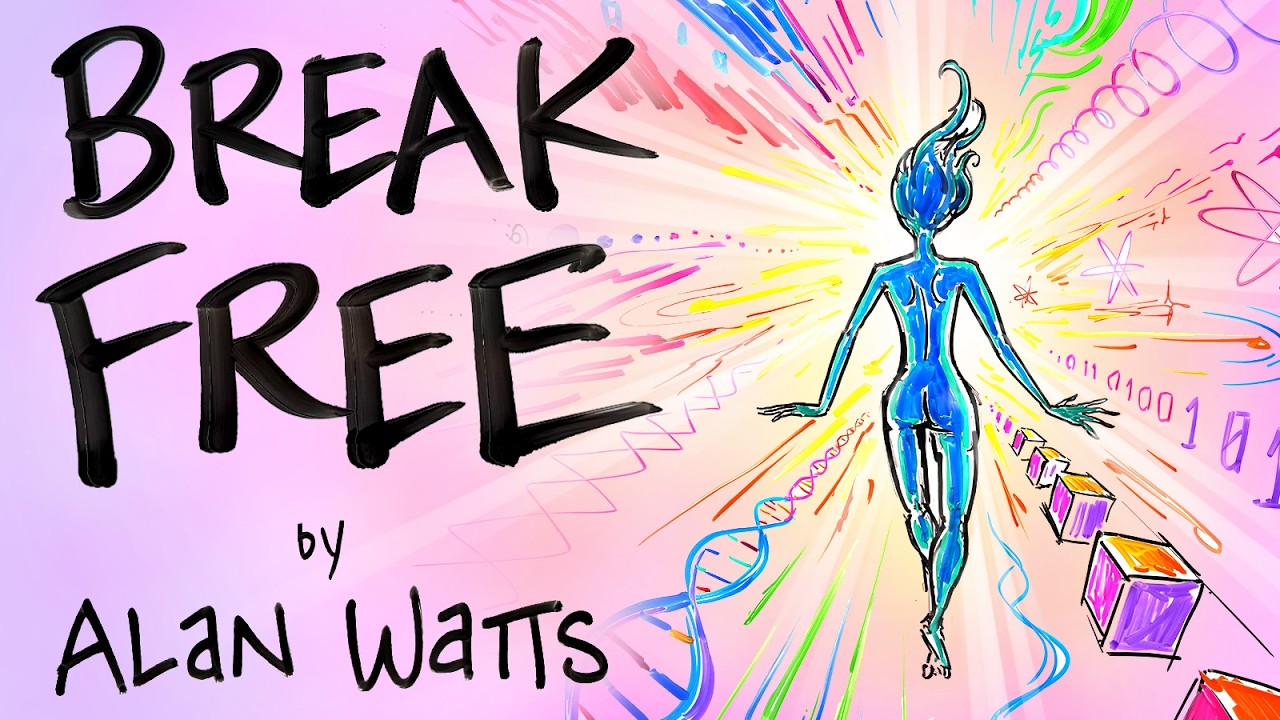
Alan Watts opens with a provocation so quiet it almost slips past: the belief that you exist only inside your skin is not a fact, not a scientific conclusion, and not even a particularly defensible position. It is a myth. And myths, as Watts insists, are not simply untruths but images in terms of which people try to make sense of the world. The stakes here are not abstract. The myth of separateness, he argues, is the engine behind a very specific kind of dread, the feeling that your wave is going to disappear and that will be awful. That fear, he contends, is a learned posture, not an honest reckoning with reality.
Watts draws the frame clearly early on: ‘You and I are all as much continuous with the physical universe as a wave is continuous with the ocean.’ The ocean waves, he says, and the universe peoples. What looks like a self-contained individual, bounded by skin and bone, is better understood as a locally concentrated expression of the same energy system that shines the sun and circulates the tides. Billions of years ago, he notes, what you now call yourself was a big bang. The lineage did not end. It elaborated.
Why the boundary between self and world was always arbitrary
The argument is not merely poetic. Watts grounds it in a straightforward observation from behavioral science: when a researcher tries to describe what a person does, they cannot confine themselves to what happens inside the skin. The behavior spills outward into environment, into relationship, into the behavior of others. If describing one person requires describing another, then in any practical sense the two are already one system. ‘What I am involves what you are,’ Watts puts it plainly. ‘I don’t know who I am unless I know who you are.’
He pushes the same logic inward. Most of what the body does, circulating blood, shaping bone, regulating digestion, proceeds without any conscious instruction. The hand moves when a person decides to move it, but ask how that decision is made and the answer dissolves. Did the person decide to decide? They did not. The line between voluntary and involuntary turns out to be drawn in sand. Breathing crosses it freely. So does every heartbeat. The ego, Watts concludes, is not the self in any full sense. It is ‘the focus of conscious attention,’ a radar designed to scan for trouble, and identifying entirely with the troubleshooter guarantees a perpetual state of anxiety.
What happens when the radar stops running the ship
The shift Watts describes is less a belief to be adopted than a perception to be recovered. When a person stops identifying exclusively with the ego and expands awareness to the whole organism, the first thing noticed, he says, is how harmonious it all is. The white blood cells fighting and consuming each other in the bloodstream are discord at one level and structural health at another. The same logic scales outward: conflicts that read as damage at a local level may be functional at a wider one. ‘What is discord at one level of your being is harmony at a higher level,’ he observes, and the recognition tends to arrive not as a conclusion but as a felt shift in how ordinary existence registers.
The destination Watts points toward is not euphoria but steadiness: the sense of arriving somewhere that was always home. To stop feeling like a stranger in the world, he argues, is not a spiritual achievement requiring unusual effort. It is what remains when a particular learned fiction is quietly set down.
The wave that already knows
A wave on the ocean, mid-curl, carrying the full weight of the water beneath it.
Watts spent decades returning to that image, and it never quite resolved into a slogan. The wave does not negotiate with the ocean about when to rise or fall. It does not decide whether to be water. It is already continuous with everything that made it possible, whether it knows that or not.