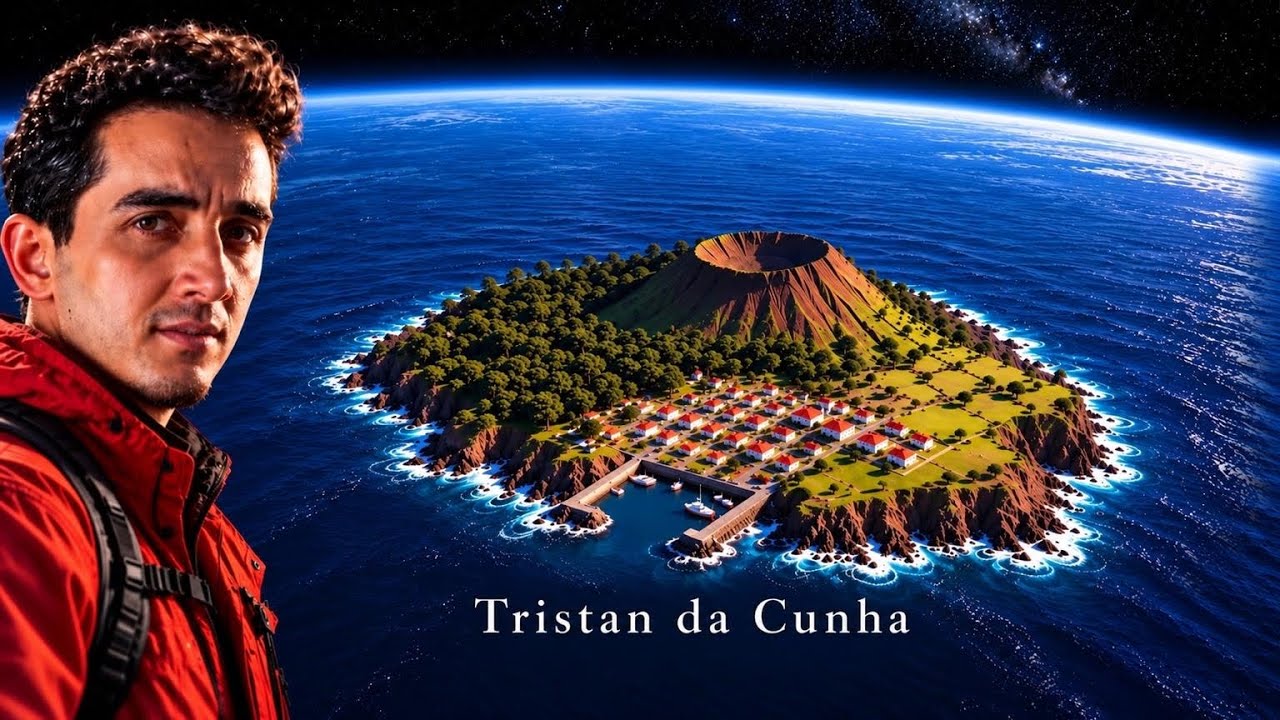
After 15 days crossing the Atlantic Ocean, the island of Tristan da Cunha finally appeared through the haze, a volcanic peak rising from a stretch of ocean so remote that the nearest settlement is thousands of miles away. For the 222 people who call it home, that distance is not a hardship to be solved. It is simply life, and it has been for generations. The journey to reach them begins weeks before landfall, aboard one of the handful of ships that make the trip, because there is no airport, no shortcut, and no other way in or out.
A town with one of almost everything
Edinburgh of the Seven Seas, the island’s only settlement, consists of 148 structures: 120 homes and 28 public buildings spread across 15 streets. At 8:30 in the morning, it is already busy. Islanders are heading to check on their animals, walking lanes edged by walls built from black volcanic stone, chunks of cooled lava formed during past eruptions. The quiet is not emptiness. It is the texture of a place where people have figured out how to live together without friction.
The settlement holds one school, one hospital, one post office, one supermarket, and one bar. The supermarket, run by the island’s government, subsidizes basic goods to keep prices manageable even though nearly everything must be shipped in. Resupply arrives roughly every three months. A 2.5-kilogram bag of flour costs around two pounds; a kilogram of sugar, 1.7. Clothing is harder to source. The supermarket receives only a minimum order, and islanders make what they have last for years.
The economy runs on a principle that would be unrecognizable most places on earth. Buying and selling land is banned. Every family farms an equally sized plot for free. Each person is allocated two sheep and a cow, and those limits hold firm, because overgrazing strips the vegetation that anchors the soil and triggers landslides. As 81-year-old Eric put it while working his potato field entirely by hand: ‘I think we got what we want.’
The island’s main export is a rock lobster found only in these waters, shipped to some of the world’s most exclusive restaurants. Beyond fishing and farming, islanders knit sweaters and socks to sell, tend livestock, and take on the maintenance roles that keep the settlement running. The entire island’s electricity comes from four diesel generators. Every light and every connection to the outside world depends on them.
What isolation actually looks like up close
Widespread internet access only reached Tristan da Cunha in 2025. There is still no cell phone network. When someone needs to raise an alarm, they strike an empty gas cylinder with a heavy hammer. The sound carries. It is the island’s emergency system.
The community’s only police officer, who doubles as the driver for a two-mile trip out to the farming fields, put the crime situation plainly: ‘It’s probably the safest place in the world, actually.’ Holding cells exist at the station, but convictions are rare. Doors on the island go unlocked at night.
The school, St. Mary’s, currently has 20 students. Different year groups share classrooms: years one and two together, years three and four together, and so on through secondary level. Many of the children are cousins or siblings. Education ends after high school. There is no college on the island, and no jobs that require one.
The island’s settlers came from England, Scotland, the Netherlands, Italy, the United States, and South Africa. Generations of intermarriage narrowed the gene pool, and today the entire community shares just eight last names. More than one in three islanders has asthma. When serious medical cases arise, patients are evacuated to Cape Town, a journey of at least seven days by sea. In 2023, the island’s administrator suffered a stroke. A ship took five days to arrive and another seven days would have been needed to reach hospital. He died two days into the voyage.
The lava that almost ended everything
Tristan da Cunha is the visible tip of a volcano that rises roughly 18,000 feet from the ocean floor. In 1961, it erupted. Lava poured toward the village and stopped only tens of meters short of the houses. The entire population fled by fishing boat to a nearby uninhabited island and was later picked up by a passing ship. They were taken first to Cape Town, then to Britain, where many of them saw cars for the first time. Three islanders died from illnesses their immune systems had never encountered, older residents unable to adapt to a cold English winter after a lifetime in isolation. The rest returned home as soon as the volcanic danger had passed. Roger Glass, a descendant of the island’s founding settlers, described the eruption in simple terms: ‘It just cracked out like that. The volcano took it and just destroyed every bit of it.’
The quiet threat no one has solved yet
Only eight babies have been born on the island in the past five years, and the population has dropped by around 20% recently. Permanent immigration is not permitted. The community that survived a volcanic eruption, enforced medical quarantine in Britain, and two centuries of Atlantic isolation now faces a slower and less dramatic threat: it may simply run out of people.
The Albatross Bar, the island’s only bar, is busy at most hours of the day.
The piles of empty bottles stacked outside it on a recent afternoon told their own quiet story about how people pass the time at the edge of the world.
 Wake up to Only Happy News!