
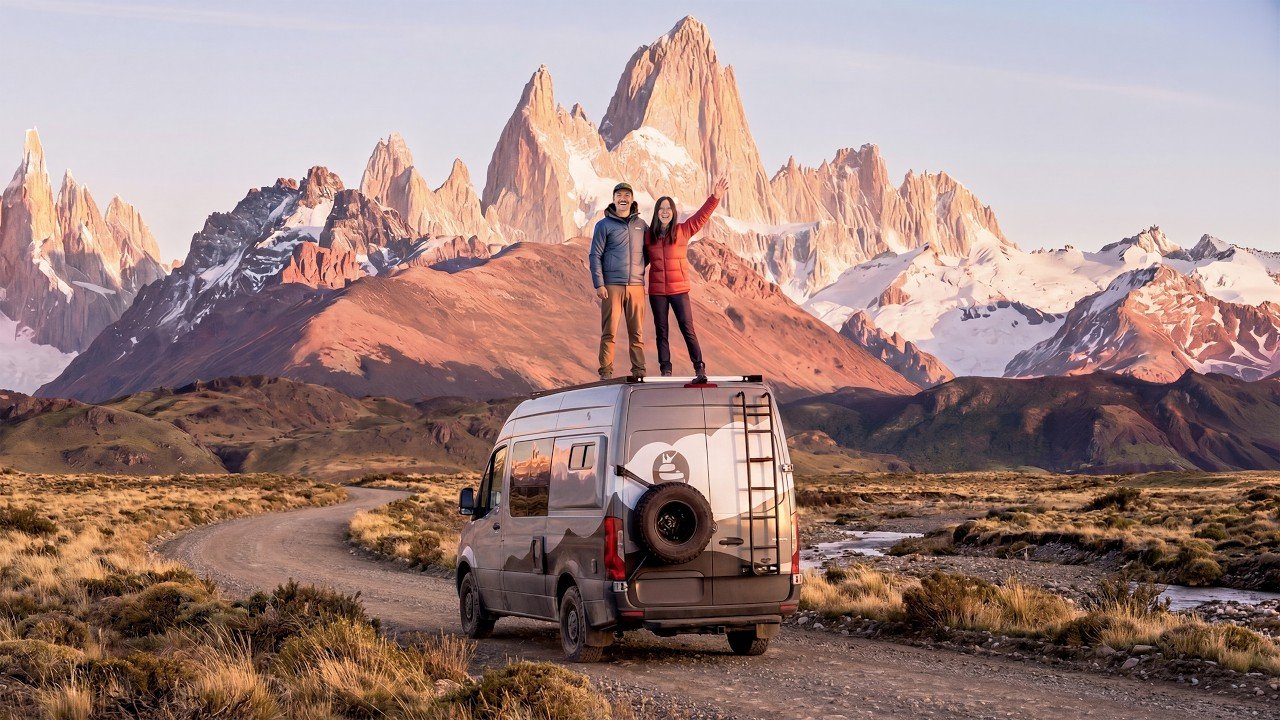
Five minutes from the outskirts of Mendoza, Kara and Nate crossed the two-thousandth mile of their van life traverse of Patagonia — a journey that began in the southern Argentine city of El Calafate and wound northward through some of the most remote and visually staggering terrain on the planet. Completed in eight days behind the wheel of a rented, extended-wheelbase Mercedes Sprinter van, the trip covered three distinct legs: El Calafate north to El Chaltén, then one thousand miles to San Martín de los Andes, and a final seven-hundred-mile push to Mendoza.
Route 40, Snow Closures, and a Vulture Strike
The route followed Argentina’s Ruta Nacional 40 — one of the longest roads in the world, running the full length of the country from south to north, with ninety percent of it paved. The stretch Kara and Nate encountered between El Chaltén and Bariloche included a notorious unpaved section, made significantly more difficult by a recent snowstorm that closed the road entirely and placed the pair two full days behind schedule. A local police officer at a Guardia post confirmed the road had reopened at nine in the morning, with caution advised. The gravel sections proved manageable, though a second unpaved stretch later in the journey featured potholes severe enough that parallel dirt tracks had been worn beside the road surface as a preferable alternative. Most dramatically, a vulture feeding on carrion in the road failed to clear the van in time, striking the windscreen and dislodging a plastic exterior panel — leaving the glass intact but the crew shaken.
Near Lago Cardiel, Kara and Nate stopped at a vast, strikingly blue desert lake with one of Argentina’s premier salmon fisheries — a population that exists, according to local legend, because a pilot transporting juvenile salmon was forced to dump his cargo into the nearest available lake after a storm made his aircraft too heavy to continue south.
Wildlife, Hot Springs, and the Seven Lakes Road
Wildlife encounters defined the journey in ways that no itinerary could have anticipated. Guanaco sightings numbered well over two hundred before Kara and Nate stopped counting, roughly one hour into a single driving day. An Andean condor — a species Charles Darwin first traced to these cliffs in 1834 after observing the white-stained nesting rocks from below — was spotted soaring on a thermal updraft near a roadside colony. A ñandú (the South American relative of the emu and ostrich), a fox, and large groups of wild horses rounded out what Kara described as a near-complete Patagonian ‘Big Five.’
Inside Parque Nacional Los Alerces, a morning hike revealed a three-hundred-year-old alerce tree — a species described as a southern cousin of the giant sequoia. The park’s oldest specimen, known as El Abuelo, is estimated to be between 3,500 and 5,000 years old, predating the Roman Empire. A warning sign at the trailhead cautioned hikers about aggressive pumas in the area; the park thoughtfully provided a bucket of walking sticks at the entrance.
At a geothermal site near the base of a volcano visible from their lakeside campsite, the pair applied therapeutic volcanic mud to their bodies before soaking in natural hot springs. A fellow visitor named Daniel, who had traveled from Buenos Aires specifically because the mineral-rich waters relieve his arthritis symptoms, was on his third visit within a single week. The attendants enforced a strict twenty-minute maximum soak, announcing departures by name over a microphone.
The celebrated Ruta de los Siete Lagos — the Seven Lakes Road — brought the journey into its final northern arc before arriving in Bariloche, a city founded by Swiss, German, and Italian immigrants in the early twentieth century and now home to more than fifty chocolate shops. Kara and Nate rode a cable car built in 1974 to a summit listed by National Geographic among the world’s top ten viewpoints, then dined at a rotating restaurant at the mountain’s peak before completing the Bariloche trifecta of chocolate, craft beer, and fondue.
Kara and Nate documented every overnight stop along the route using the free overlanding app iOverlander, successfully camping at a lakeside site on the Argentine-Chilean border of Lago Buenos Aires, on the shore of Lago Los Alerces, and at a dramatic cliff-top pullout above Bariloche — maintaining an unbroken streak of lake-adjacent campsites for the full duration of the trip. The journey stands as a practical field guide for a van route that, unlike New Zealand or Iceland, remains largely undocumented — precisely because Patagonia’s wonders are spread across vast distances rather than concentrated in a compact geography. That remoteness, Kara noted at journey’s end, is exactly what makes it extraordinary.