
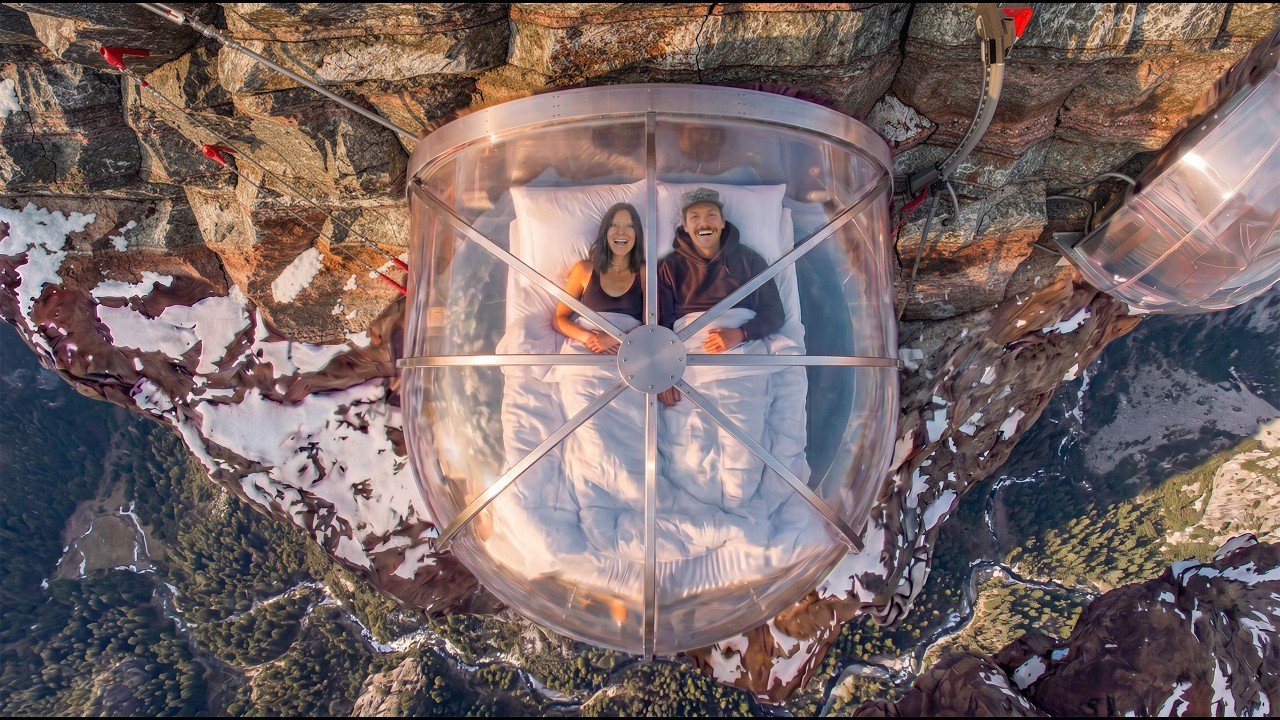
Fifty-seven hours after leaving Colorado, Kara and Nate finally clipped their carabiners to the side of a sheer cliff in Patagonia, Argentina, and stepped into the OVO capsule — a three-story glass and steel pod bolted to the rock face above a river valley, with Mount Fitz Roy looming on the horizon. The journey was meant to take 31 hours. It took nearly twice that.
A Passport Left on a Plane and 27 Extra Hours in Transit
The delay began at Bogota’s El Dorado Airport, where Nate reached into his bag and discovered his passport was missing — still aboard the plane he had just disembarked. A quick-acting airport employee called back to the aircraft before it departed and recovered the document. The incident added an estimated 27 hours to the transit, forcing Kara and Nate to rebook flights at multiple counters across the terminal. United Airlines rebooked both travelers at no additional cost and covered one night at an airport hotel. A secondary complication emerged in Buenos Aires, where a booking error had produced two tickets in Nate’s name and none for Kara. A gate agent resolved the issue after 30 minutes, placing both travelers in seats at the rear of the aircraft. The pair flew Denver to Houston, Houston to Bogota, Bogota to Buenos Aires, and finally Buenos Aires to El Calafate — four flights across two continents.
Climbing to the OVO Pod in Level-Five Patagonian Wind
From El Calafate, Kara and Nate collected a manual-transmission van — their home for the following three weeks — and drove a gravel mountain road at nightfall to reach their first overnight stop, a dome-style hotel in the foothills. The next morning, Nate ran a solo 10-mile training route toward the Mount Fitz Roy base camp along a private trail departing directly from the domes, testing gear ahead of the Patagonia 100-mile race scheduled 10 days later. Kara remained at the domes reading and waiting out wind gusts strong enough, Nate reported, to nearly lift a person from the trail.
That afternoon, a bus transported them to the base of the cliff, from which a 2-kilometer steep ascent on foot led to the OVO pod cluster. The pods are engineered from Plexiglas panels set in a steel frame and have been laboratory-tested to withstand winds of up to 300 kilometres per hour. The facility operates a five-tier wind classification system; guests are not permitted above Level 5. On the night Kara and Nate stayed, conditions reached Level 5 — the fourth such night in the property’s history, according to their guide. By morning, the guide confirmed that winds had peaked at 130 kilometres per hour.
The pod itself is arranged across three levels. The uppermost floor contains the sleeping area, fitted with heavy blankets and privacy curtains facing the adjacent via ferrata. The central living level includes a wall-mounted table, a diesel heating unit controlled by a bedside remote, and a walkie-talkie used to request supplies from staff. Below a trapdoor on the lowest level hangs a hammock suspended directly over the cliff face, offering an unobstructed view of the valley floor hundreds of feet below. The bathroom features a composting toilet and a 25-litre fresh water reservoir for the sink. Dinner was delivered in a guide’s backpack: four courses including minestrone soup, a corn and mushroom course, cheese-and-herb empanadas with chimichurri, and a chocolate brownie, accompanied by a bottle of Argentine red wine.
Cliff-suspended accommodation represents a small but growing category of extreme hospitality engineering. The concept was pioneered in Peru’s Sacred Valley, where a comparable glass capsule hotel requires guests to ascend a full via ferrata to reach their room — an approach Kara and Nate noted felt more adventurous, though they rated the Patagonian pod as significantly more refined in finish and dining experience. The OVO pods in Patagonia sit near El Chaltén, a village at the base of the Fitz Roy massif whose jagged silhouette directly inspired the logo of the outdoor apparel brand Patagonia.
Kara and Nate descended the cliff in morning rain, loaded the van, and pointed north toward Mendoza — a drive of more than 2,000 miles that will include Nate completing a 100-mile ultramarathon en route. ‘Now that we have officially survived,’ Nate said on the descent, ‘I think that makes the whole thing even more epic.’ The 57-hour journey, the lost passport, the Level-5 wind, and the four-course dinner swinging above a Patagonian river valley had, by every measure, been worth it.