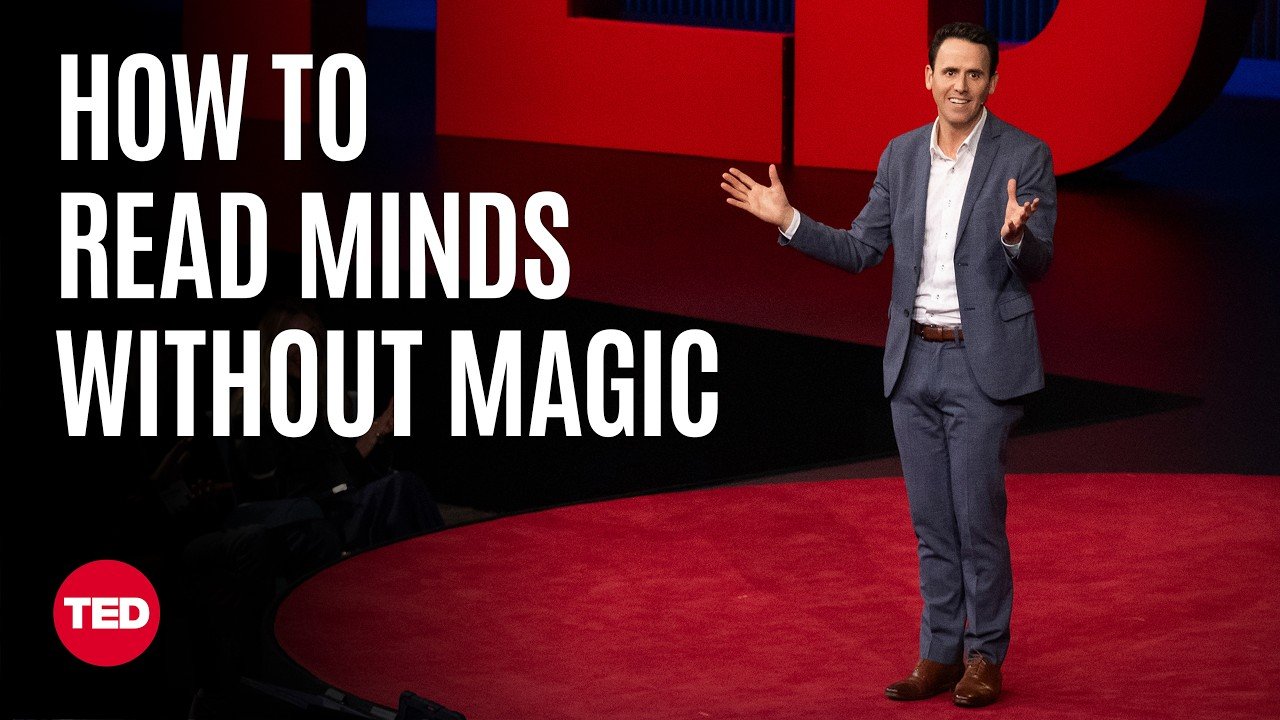
Oz Pearlman walked onto the TED stage billed as the world’s greatest mind reader, then immediately told the audience he cannot read minds. What he can do, he said, is read people, and after roughly three decades of reverse-engineering human behavior, the distinction matters more than most people realize. The gap between those two things turns out to be where every useful skill in his repertoire lives, and where the rest of us are leaving something on the table every single day.
The celebrity guessing act that was never really about the celebrity
Pearlman opened by asking the audience to close their eyes and picture someone famous they would want to have dinner with, dead or alive. Three volunteers were selected from the crowd: Ian, Nanjera, and Jeff Johnson. Working from body language and behavioral tells alone, Pearlman correctly identified that Jeff’s person was alive, that Ian’s was a dead man and specifically another man, and that Ian’s name had too many letters to be anything ordinary. When he told Ian to sit down if he was thinking of Alexander the Great, Ian’s expression gave the answer before his mouth did.
Nanjera’s reading was perhaps the most striking. Pearlman detected a last-second switch, pushed back, and when she admitted she had shifted from her first thought, he named the original: Trevor Noah. The crowd rewarded it with a standing ovation.
The finale brought a volunteer named Brett up from the audience after a mesh Frisbee, described by Pearlman as a 1.5-star Amazon purchase for 87 cents and ‘literally the worst Frisbee in the world,’ was thrown blind into the crowd. Brett, a stranger to everyone on stage, locked eyes with Jeff Johnson and announced that Jeff was having dinner with Barack Obama. Jeff turned the marker board around to confirm it.
The shampoo bottle trick that actually sticks
The performance was the hook. The lesson was the point. Pearlman walked the room through what he calls the single most common social failure he observes: forgetting a person’s name the moment they say it. His diagnosis is blunt. It is not a memory problem. Most people never actually heard the name to begin with, because the instant someone is speaking it, the listener is already composing a response.
His fix is built around three words borrowed from the back of a shampoo bottle: lather, rinse, repeat. Pearlman repurposes that sequence as listen, repeat, reply. Listen for real, making the mind blank for two full seconds. Repeat the name back twice, both to lock it in and to confirm the pronunciation. Then reply with something that creates a specific mental anchor: a compliment tied to the name, a spelling question, or a personal connection. He demonstrated it live using Nanjera’s name throughout the talk, noting the multiple repetitions were entirely deliberate.
As he put it plainly about the failure most people experience: ‘You didn’t forget the name. You never knew it.’
The underlying principle running beneath both the stage work and the memory lesson is the same. If you know how someone thinks, you know what they think. Pearlman has spent decades making that process feel like magic. He is adamant it is not.
The Frisbee that caught a secret
Somewhere in a TED conference room, a mesh Frisbee worth 87 cents sits with a one-of-a-kind story attached to it.
Pearlman had told the crowd that an unshakable belief something will work is self-fulfilling. Brett caught the Frisbee, walked to the front of the room, and proved it without having exchanged a single word with anyone on stage. The Frisbee traveled blind through the air, landed in the right hands, and the rest of the room watched a stranger read another stranger’s mind.
 Wake up to Only Happy News!