The seagull chick had been stuck in the harbor water, paddling with nowhere to go, when it found the ramp. Minutes after the second floating wetland platform was lowered into place along Bristol’s concrete embankment, the bird climbed up onto the structure and settled. The crew that had spent the day bolting modular frames together and pressing native plants into buoyant clay pellets watched in silence. That instant is what the entire effort had been building toward: not a nature reserve at the edge of the city, but nature arriving, uninvited and immediately, in the middle of it.
For most of human history, cities were built by removing water. Wetlands were drained, rivers were buried underground, and land was paved so people could live on it. Bristol’s River Froom still runs beneath the city today, sealed out of sight the same way Paris buried the Bievre and London buried the Fleet. The cost of that engineering has been compounding ever since, in flash flooding, in urban heat, in the near-total loss of freshwater habitat within city limits. The Wildfowl and Wetlands Trust, the UK wetland charity known as WWT, is now running a plan to reverse the logic entirely, turning Bristol into what they describe as the UK’s first wetland city. Over the next few years, 200 new projects will be scattered across Bristol, from small rain gardens replacing drain grates to full wetland anchors along the river.
What a floating wetland is actually made of
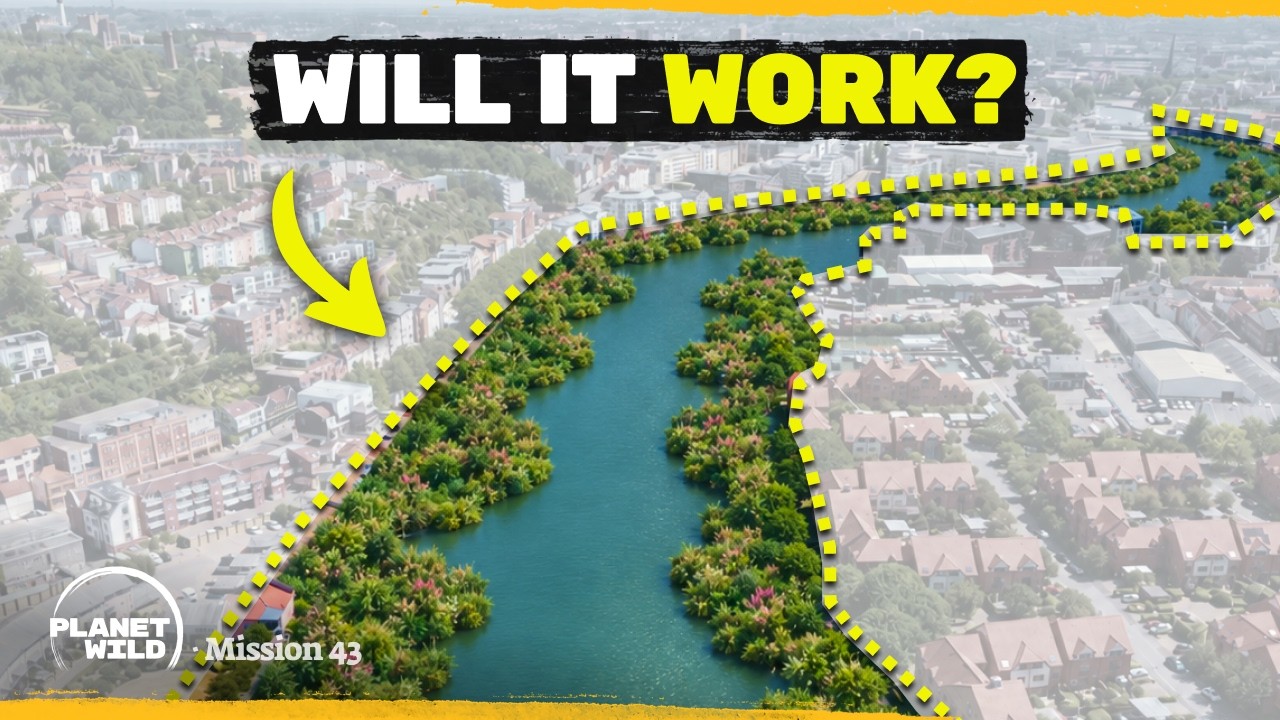
The floating platforms going into Bristol’s harbor are built from recycled drinking water pipes wrapped in coconut husk, held together as a fully modular frame that can be scaled to any size. Rather than soil, which would drift and disperse in moving water, the plant bed is filled with buoyant clay pellets. Planet Wild’s team, joined by Sam Bentley, planted more than 20 species of native wetland plants across the first two modules: a 100-square-metre platform and a smaller 16-square-metre platform, the latter deliberately fitted with miniature staircases after harbour workers noticed seagull chicks were becoming trapped against a corner of the wall.
Above the waterline, the dense planting creates foraging ground for pollinators and cover for nesting birds. Below it, roots push deep into the water, filtering pollutants, regulating temperature, and creating structure that fish and invertebrates can colonise. Julia from WWT described the effect of wetlands at any scale, from a backyard box to a harbour platform, as ‘really sort of magical’, adding that ‘everyone in the city benefits.’ There is potential to install up to 5,000 square metres of these floating platforms in Bristol alone.
The drain pipe version anyone can build at home
Not every contribution to the corridor requires a harbor crane. In a nearby garden, the team built a prototype for what WWT calls a miniature wetland in a box: two stacked containers attached directly to an ordinary domestic drain pipe. The top box catches rainwater from the gutter and functions as a small pond for aquatic plants. Once full, it overflows into the lower box, a bog layer for insects and amphibians. The build requires drilling one hole in the base of the top box, lining it with a permeable plant pot as a filter, adding gravel, a fabric membrane, and soil, then cutting the drain pipe to position everything under the outflow. The UK, the source notes, has 4,000 square kilometres of private garden space that could host exactly this kind of structure.
The ambition extends beyond Bristol. In Seoul, the Cheonggyecheon stream was buried under an elevated highway for decades before the city demolished the road in the early 2000s and restored the waterway; biodiversity along the corridor has since grown by over 600 percent. In Singapore, wild otter families now swim through the central business district on waterways healthy enough to support them. Each city solved the problem differently, finding corners and margins that existing infrastructure had left behind.
The swans that arrived before the installation was finished
The first platform had not yet been fully secured when a family of swans appeared at the embankment and began inspecting the new structure from the water.
The gray wall along that stretch of the harbor had been gray for centuries. The piece installed two years earlier as a pilot, just upstream, was already dense with nesting birds, insects, and fish visible beneath the surface. The newest platforms sit beside it now, their plants still young, their roots still reaching down.