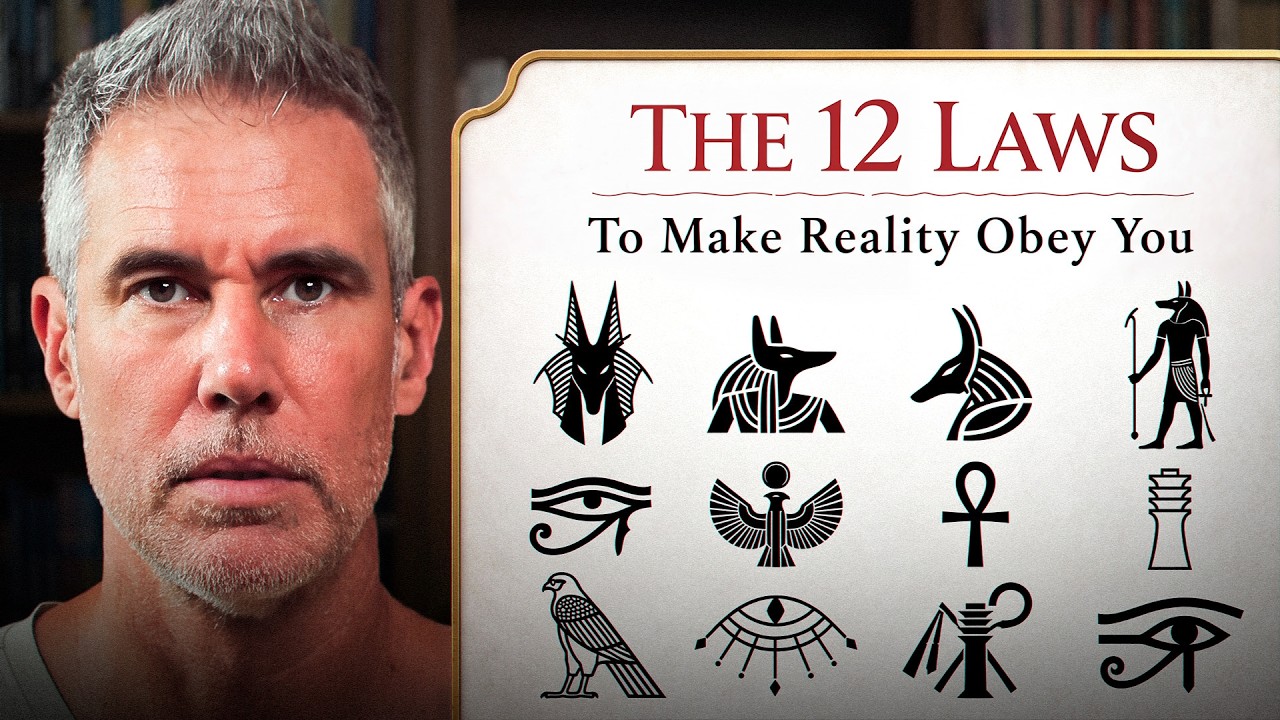
They were never taught in school, but spiritual and esoteric traditions have carried them for thousands of years: twelve principles, sometimes called the sacred laws of the universe, that describe how reality actually works. David Bayer, whose podcast has climbed into Apple’s top 100, sat down to walk through all twelve in a single session, promising that by the end, listeners would have both a new way to read what is happening in their lives and a practical starting point for shaping what comes next. He delivered.
The laws that set the foundation
Bayer opens with the law of divine oneness, the principle that connects everything else. Reality, in this framing, is a single superorganism. Each person is an individual expression of one consciousness, which means behavior toward others circles back to the self. Its simplest form, Bayer notes, is the golden rule.
From there, the law of vibration establishes that everything is energy. Drill down far enough into any solid object and what remains is frequency, a non-physical potential. Thoughts and emotions carry frequencies too, and Bayer points to David Hawkins, whom he describes as one of the great spiritual teachers of the 20th century, and Hawkins’ book ‘Power vs Force’, which arranges emotional states on a calibrated scale. Habitually inhabiting higher emotional states, Bayer argues, raises a person’s overall vibration and reshapes the circumstances they attract.
That leads directly into the law of attraction, widely popularized by ‘The Secret’ but rooted, Bayer emphasizes, in ancient esoteric teaching. Whatever frequency a person consistently operates from, they pull toward themselves circumstances that match it. Shift focus, shift perception, shift feeling, and the outer reality follows.
The law of correspondence tightens the logic: the external world is a mirror of the internal state. As Bayer frames it, drawing on a line from scripture, ‘be not conformed to this world but be transformed by the renewing of your mind.’ Patterns in business, relationships, and health, viewed honestly, can reveal what is actually running below the surface.
Where action, change, and responsibility enter the picture
Law five corrects a common misreading of the earlier principles. Bayer puts it plainly: ‘a lot of people who get into personal growth or law of attraction mistakenly think that they can just sit on their sofa eating cheesy poofs and watching Netflix and manifest a million dollars into their bank account, and that’s not the way that it works.’ The law of inspired action insists that humans are the vehicle through which ideas become real, and that vehicle moves through daily, intentional steps.
Laws six through eight form a triad around impermanence and accountability. The law of perpetual transmutation of energy holds that every problem comes to pass, not to stay, because energy never stops changing form. The law of cause and effect, also known as karma, traces every thought and action to its eventual consequence, removing the need to personally police every injustice in the world. The law of compensation adds that contributions return, often from an entirely different direction and usually as a multiple of what was given, making score-keeping with any one person unnecessary.
Laws nine through twelve broaden the lens. Relativity teaches that good and bad are products of perspective, illustrated by the parable of the wise farmer who meets every event with ‘who knows what’s good or bad.’ Polarity shows that opposites, love and hate, light and dark, hot and cold, are simply different degrees of the same spectrum. Rhythm confirms that life moves in seasons and that contraction, like any season, will turn. Gender, the final law, describes masculine and feminine not as biological categories but as complementary qualities woven through all of creation: structure alongside freedom, action alongside receptivity.
The question Bayer leaves open
At the close of the session, Bayer offers a single practical prompt: notice which of the twelve laws speaks to something you are experiencing right now.
That question, hanging in the air with no prescribed answer, is precisely where these laws stop being ideas and begin becoming a way of living.