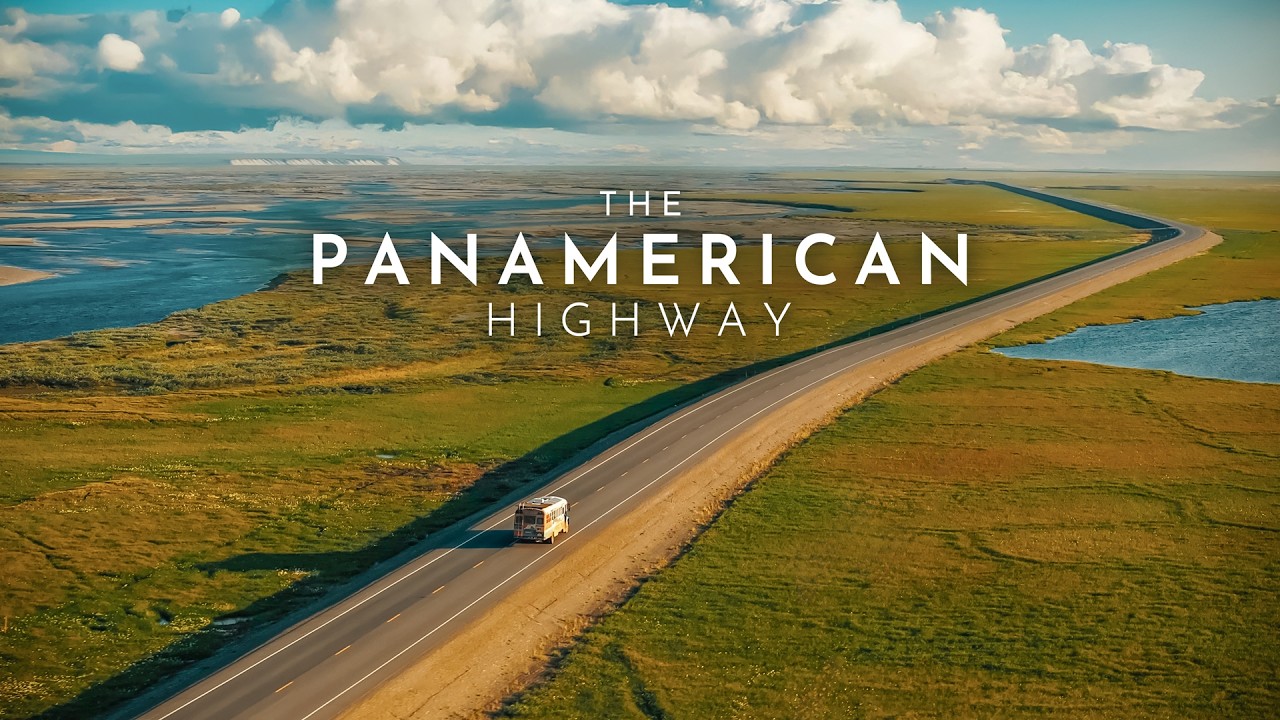
At 2 a.m. in Prudhoe Bay, Alaska, the sun never fully sets. It skirts the horizon in a perpetual twilight that feels like the edge of everything, because it very nearly is. For a pair of artists who spent five years converting a Jacksonville city bus into a rolling home and studio, standing where the Arctic Ocean laps the northernmost shore of North America is not a dramatic opener. It is the finish line of one story and the starting gun of a much longer one. The Pan-American Highway stretches from this frozen shoreline all the way to Ushuaia, Argentina, crossing two continents and every biome on Earth, and the people who call themselves Art We There Yet? are only just beginning.
The bus they call Bobby did not arrive here easily. In 2018, the couple bought her rough and rusted, convinced she would take three months to convert. It took a year of scraping, sanding, and hammering in the south Florida heat, with friends flying in from across the country and family showing up after work every evening. They hit the road in fall 2019 from the southernmost point of the United States, pointed toward Alaska. Then the pandemic closed the US-Canada border, and the plan dissolved. They spent two years in the lower 48 and a stretch in Baja Mexico, painting 18 community murals and running 11 songwriting workshops before the border reopened and they blazed north through Canada. They fell so deeply in love with the Alaskan winter that a planned five-month visit stretched into two years. Reaching Prudhoe Bay required driving the Dalton Highway, one of the most demanding roads in North America, in a 29,000-pound converted school bus.
What Prudhoe Bay actually looks like up close
Prudhoe Bay is not a place you simply drive to. Access to the oil fields requires a background check and a shuttle, because this industrial complex has produced over 18.5 billion barrels of oil since 1977 and access is tightly controlled for national security reasons. Once through, the infrastructure stretches to every horizon. Nearly 9,000 feet below the surface, a 250-million-year-old layer of porous sandstone holds oil and gas like a sponge, capped by impermeable shale that traps the hydrocarbons and creates the reservoirs the industry taps. The trans-Alaska pipeline carries that oil 800 miles south to the port of Valdez, and it runs alongside the Dalton the entire way, a constant and visible reminder of what powers the road.
Dead Horse, the industrial camp that serves the oil fields, is not a town. It exists only to support the workers who rotate through on multi-week shifts, shopping at the only general store for miles and receiving mail from its post office. In mid-July, caribou still graze the coastal plain before their migration 80 miles south to the Brooks Range, and migratory birds fatten their newest generation before the landscape transforms into what the artists called a frozen and windswept no man’s land. Inside one of the worker housing buildings, they joined a new friend, Priyanka, an author, activist, and public health professional also living the nomad life, for a surprisingly decadent dinner of red beans and smoked sausage. Priyanka put her own lesson plainly: ‘I tried to plan everything and then I realized that was also a mistake. You can’t try to plan.’
Where the road tries its best to end the trip early
The drive south off the North Slope introduced the first mechanical warnings fast. The engine temperature crept up on the flat Arctic tundra, and a concerning smell followed. Muskoxen appeared roadside, a rare enough sight that the moment briefly eclipsed the worry. There are only about 4,000 muskoxen in Alaska, and unlike the caribou they do not migrate. They simply stay and endure.
The Brooks Range brought harder trouble. Slick with mud after days of freezing rain and fog, the hills on the southern stretch of the Dalton are notorious. Moving over for a wide load, Bobby slid into a soft pullout and buried her wheels. A passing trucker stopped and hauled her back onto the road. The Dalton’s reputation for hostile commercial traffic turned out to be the opposite of their actual experience. Forty-three miles from Fairbanks, after completing the entire Dalton without a breakdown, the fan bearing finally failed. A mechanic on his way home for the night heard their location and drove out anyway, because, as the artists noted, there is an ethos that runs deep in Alaska to look out for each other. Bobby reached Fairbanks on the back of a tow truck in the middle of the night. The fan bearing and a mud-destroyed ABS sensor were the culprits. Parts arrived, repairs were made, and the 29,000-pound bus got a long-overdue bath.
A muddy fan belt on the Elliott Highway
On a hillside 43 miles from Fairbanks, Bobby sat silent with a seized fan, her rainbow paint buried under Dalton mud, her engine finally out of patience after 800 miles of Arctic road.
With Bobby fixed and pointed south, the journey resumes in earnest. The Pan-American Highway runs all the way to Ushuaia, and the first unexpected twist of many is already behind them. The Arctic Ocean is still visible in the rearview mirror of this story, exactly where it was when the sun refused to set at 2 a.m. and the whole impossible trip felt like it might actually be real.
 Wake up to Only Happy News!