The final night of Camp Crunch Labs opened with a confession and a bucket. Mark Rober stood in his backyard holding what he solemnly described as one of the most dangerous substances responsible for thousands of injuries every summer, dihydrogen monoxide, then tipped it toward two wide-eyed campers named Dira and Penny before revealing it was just water. That nerd joke set the tone for a finale built around five backyard water demonstrations that genuinely look like they broke physics, and a snowball fight made from the science inside a diaper.
When a balloon doesn’t pop the way anyone expects
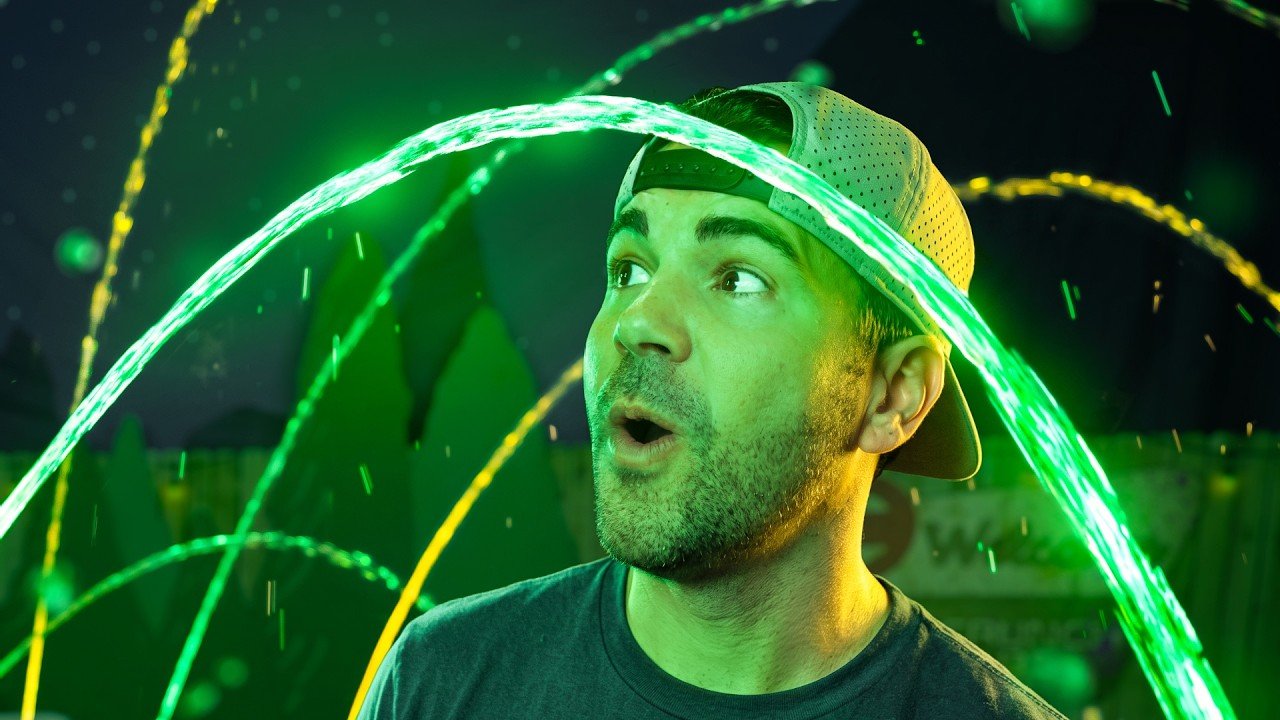
The first demonstration was a sharp blade pressed into a water-filled balloon. The campers predicted an explosion. Toy engineer Adam, brought in straight from a toy test with a group of kids, agreed it would explode. What came out instead was a single, glassy column of water so perfectly smooth it looked like a plastic rod. This is laminar flow, the state where water molecules stack into a single column and travel in calm, unified formation rather than the turbulent churn that comes out of a faucet. Crunch Labs had already built a scaled-up version of the effect inside a large steel canister, lit from within, and when the lights went down the stream looked exactly like a frozen plastic tube hanging in mid-air. Red lasers aimed into the beam bounced along its curve in what Rober called total internal reflection, a phenomenon that sent the light ricocheting from point to point like a Christmas disco.
Next came a pump-fed bucket and a beach ball. Rober dropped the ball into the upward flow and it locked in place, spinning and hovering. He identified it as a version of the Coanda effect, where flowing water follows the curve of the ball’s surface, generating spin while continuously pushing the ball back into the stream. He noted the same trick works at home with a garden hose and a ping pong ball, then proved the point by drinking directly from the stream and immediately regretting it. ‘That tastes really gross,’ he said. ‘I just swallowed like a thousand mosquito lines.’
The bucket that stayed dry at the top of a swing
The bucket-on-a-rope section produced the most water on the most people. Rober explained Newton’s first law: water moving upward in a swing wants to keep moving upward, and the bucket is simply in the way, so nothing spills at the apex. The slow-speed version disagreed with this theory and soaked Dira. Adam attempted a tray holding three cups, saved two, and lost one. Penny, after a careful reset and visible commitment, did noticeably better.
Science Bob, Rober’s neighbor, arrived in time for the finale. He filled a cup with water, appeared to prepare to pour it on his own head, then produced a cup that had been secretly lined with the same polymer found in diapers. The water had already solidified. Rober then scaled the trick up to a full bucket, converted the entire contents to a gel in seconds, and handed the result to the campers as ammunition. The polymer-gel snowball fight that followed left Science Bob, the fence, and most of the backyard thoroughly covered before Rober declared the summer officially closed.
A watermelon that needed a pressure washer
The campers eating pressure-washed watermelon off the patio
Rober strapped into a pressure washer, pointed it at a full watermelon, and the result landed mostly on the ground. The campers ate it anyway. Penny reached for the piece that had not touched the floor. Dira decided it probably tasted better this way.
The final night of Camp Crunch Labs ended exactly the way the first night promised: messy, specific, and genuinely educational in a way that made the science harder to forget than the water was to dry off.
 Wake up to Only Happy News!