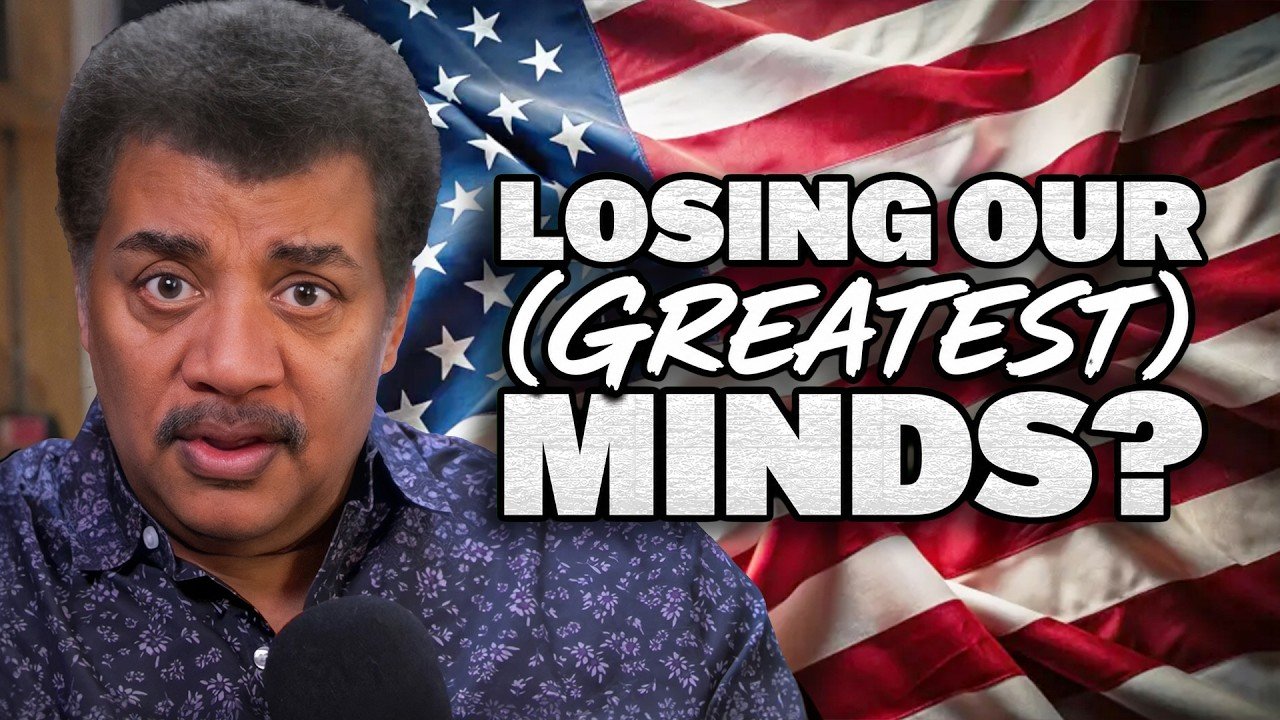
Neil deGrasse Tyson remembers standing in a graduate school corridor in the 1980s, looking around at his fellow astrophysics students and noticing that half of them were not born in the United States. He took it completely for granted. Of course they were here, he thought. This is America. What he did not fully reckon with then, and what he is reckoning with now, is what happens when that gravitational pull reverses. The United States is no longer simply losing foreign-born talent to other countries. It is losing its own.
When the labs start going quiet
Over the last two years, more than 15,000 scientists have left the ranks of the federal government. Grant funding from major government agencies has been reduced, meaning fewer researchers can sustain active labs, fewer graduate students can be supported, and fewer postdoctoral researchers, people who earned their PhDs and still have the energy and creativity to push a field forward, can find a place to work. ‘We’ve got a fully funded lab here,’ Tyson recounted European counterparts telling American scientists by phone. ‘I know your expertise and I know you’re running out of funding. Why don’t you bring your whole operation to us?’ The cherry-picking he watched America do to the rest of the world for half a century is now being done to America.
China’s trajectory tells the same story from the other direction. The first generation of Chinese graduate students came to the United States and stayed. The second generation trained here and returned home to build graduate programs in China. The third generation never came at all. They are being trained in China and staying in China. ‘This is a slide,’ Tyson said plainly. ‘It’s not a cliff. If you fell off a cliff, you would notice that.’
The MRI was never supposed to save lives
The deeper argument Tyson is making is about the nature of discovery itself. His own college physics professor, Ed Purcell, earned a Nobel Prize for research into nuclear magnetic resonance, the behavior of atomic nuclei under a strong magnetic field. Purcell was not interested in medicine. He was interested in atoms and molecules in space. Decades later, medical technologists realized his findings could produce detailed images of soft tissue inside the human body without cutting it open. The result was the MRI, which Tyson describes as ‘arguably the most potent machine in the arsenal of the medical community to diagnose the condition of your body.’ Nobody at the funding stage could have predicted that arc.
The same logic runs through GLP-1 weight loss medications, which emerged from curiosity-driven research into the venom of the Gila monster. It runs through the entire digital revolution, which rests on quantum physics that researchers in the 1920s pursued purely because they wondered what electrons and protons were actually doing. Corporate R&D budgets, constrained to deliver results inside a quarterly report, cannot replicate that kind of decades-long, direction-unknown exploration. The government has historically understood this, funding university labs precisely because the intellectual capital inside them has no equivalent anywhere.
NASA’s science budget, the fraction that pays for space telescopes, Mars exploration, and the James Webb, is separate from the cost of putting astronauts into orbit. Without it, Tyson argues, space becomes muscle-flexing rather than a noble enterprise. The science is what makes it matter.
A phone call from Germany
A colleague of Tyson’s, a working American scientist running a lab that is losing its funding, has reportedly received that call from Europe. The offer was real, the lab fully funded, and the invitation open.
Tyson closes not with despair but with a specific kind of American confidence grounded in two historical moments: Sputnik in October 1957 prompted the creation of NASA within a year, a moon orbit within eleven years, and a moon landing within twelve. The isolation of plutonium in 1940 led to a functional atomic weapon within five years, compressed by a national emergency into a timeline that would be unthinkable for a highway construction project today. His argument is that the United States has demonstrated, repeatedly, that it can rocket out of a hole once enough people agree they are in one. The concern is how deep the hole gets before that agreement arrives.
 Wake up to Only Happy News!