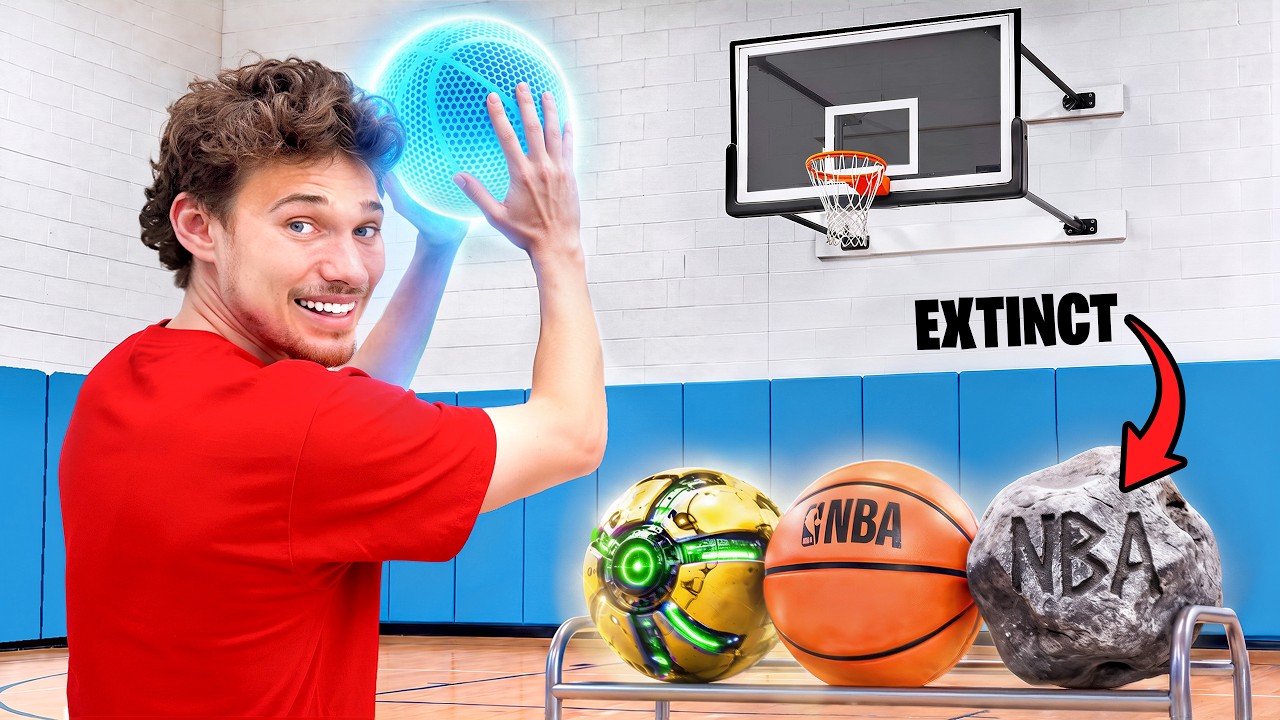
The Wilson Airless Gen 1 felt like sandpaper. That was the first honest verdict from Jesser, who opened 16 levels of increasingly ancient basketballs at a court where every single made shot sent the game one era further into the past. The stakes were a trophy and bragging rights. The obstacle was physics: leather that no longer grips, air that leaks mid-possession, and at the very end, a rock that predates the sport by several million years.
From a $10,000 collab ball to a deflating relic
The Wilson Airless Gen 1 started things off as a 1-of-20 Off-White collaboration priced at just over $10,000. Jesser put it plainly after finally cashing in his first make: ‘For actually hooping with it, I’m giving it a 1 out of 10.’ The ball’s deceptive weight meant players had to overshoot deliberately just to stop airmailing shots entirely. By Level 2, a mascot in slippery shoes was the defender, and a briefcase system added sabotages throughout: Jesser eventually drew Shaq shoes for one level and flippers for the final stretch.
The middle levels introduced real credentials. WNBA champion Ariel Atkins defended the size-6 Wilson Evo NXT at Level 5 and called it a shooter’s ball, adding that she would rate it above the NBA version. NBA champion Jordan Bell showed up for the Level 4 Wilson, the ball that launched in 2021 and drew immediate complaints from players about slickness. At Level 8 came the most hated ball in NBA history: the 2006 Spalding composite leather game ball, pulled from play after just three months. Ray Allen reportedly kept lotion on his hands because of it. Shaq compared it to a toy-store purchase. A 2006-born defender named Vidal Valencia scored on it repeatedly without dribbling, apparently unbothered.
When the balls started falling apart mid-game
Level 13 raised the stakes considerably. The 1964 Wilt Chamberlain signature ball arrived in its original box, visibly used, held together with tape, and losing air in real time. The defender was a 7-foot pro named Will Brooks. Play had to pause mid-level to pump the ball back up. It was, according to the transcript, 62 years old at that point. A 2-time Olympian named Chris Benard defended Level 12’s 1976 Olympic ball, a Spalding Top Flight 100 with almost no grooves and rubber lace instead of the standard panel design. A Harlem Globetrotter with two briefcases guarded the replica Globetrotters ball at Level 14, and the overinflated rubber sent every shot bouncing unpredictably off the rim.
Level 15 brought the oldest playable ball: a replica of the original basketball made by James Naismith in 1894, complete with laces like an American football. Back then, dribbling did not exist, so a two-dribble limit applied. Two defenders who had last played 25 years ago and ‘longer than that’ held the line. Jesser, already forced into left-hand-only shooting from a previous briefcase penalty, was now wearing flippers.
One deflating basketball, mid-possession
The 1964 Chamberlain ball holds a specific image: tape wrapped around the seams, air visibly escaping between possessions, and a 7-footer waiting patiently while someone pumped it back to a shootable pressure. Nobody paused the clock.
The final level replaced the basketball entirely with a prop meteor, required dodging dinosaur costumes within 10 seconds, and handed the win to whoever got past a caveman first. Jesser got there. He walked off with the trophy he said he was taking home from the very first possession, back when the ball was airless and cost $10,000 and felt like sandpaper the whole way through.
 Wake up to Only Happy News!