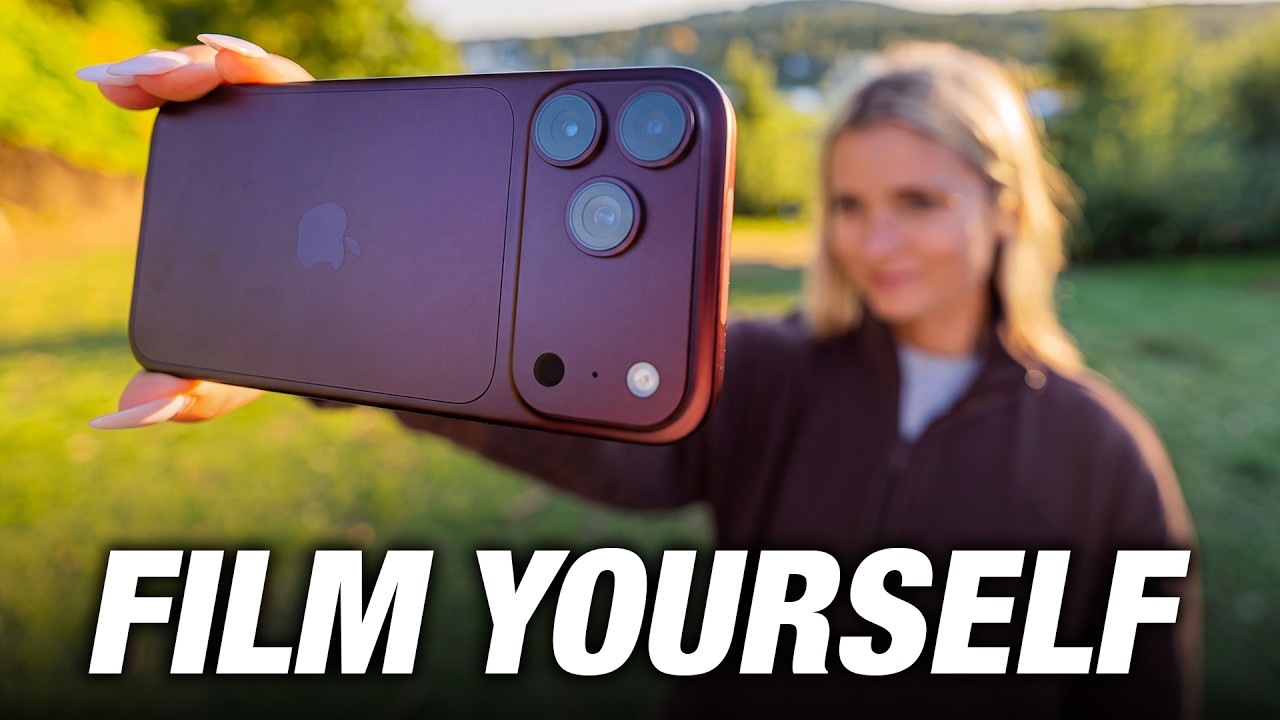
Connor stood in the middle of a busy public square, phone in hand, narrating directly to the rear camera while roughly 15 people milled around him wondering what he was doing. The uncomfortable reality of vlogging in public is that strangers stare, and most beginners never hit record because of it. What Connor from contentcreator.com wanted to prove, in a tutorial shot entirely on an iPhone, is that the gear question is already solved and the real work is everything else.
Four steps that actually get you filming
The first step is composition, and smartphones handle the heavy lifting through a built-in grid. On an iPhone, go into camera settings, scroll to composition, and toggle on grid. On Android, open camera settings and turn on composition guide. The rule of thirds that grid creates gives a clear target: eyes on or near the top third line. Connor demonstrated the gap between eyes sitting too low in the frame versus aligned with that line, and the difference reads immediately as the gap between amateur and intentional.
Stabilization is step one’s final piece. Connor’s recommendation for most beginners is a compact extendable mini tripod, something that doubles as a selfie stick for walking shots and disappears into a bag without drama. A large tripod works on a desk or ledge with adjustable legs, while a gimbal offers three-axis stabilization for moving shots but has largely been made redundant by modern optical image stabilization built into current smartphones. Connor ran a side-by-side of the same walking shot taken with a mini tripod versus a gimbal, and the difference was, in his words, ‘pretty hard to tell.’
A-roll is the talking layer, the moments where the creator speaks directly to the viewer and drives the story forward. The discipline Connor kept hammering from his time editing for influencers: film it while it is happening, not as a recap at the end of the day. Short takes, one thought at a time, with the mess-ups edited out later. B-roll is the visual evidence layer, the establishing shot of the coffee shop before you walk in, the close-up of the cup arriving. His second piece of recurring feedback to those same influencers was identical: capture more B-roll. If something might be part of the story, film it. Cutting a shot in the edit is trivial; wishing you had it is not fixable.
Audio and light beat expensive gear every time
Audio is step two, and Connor made the hierarchy plain: most people would rather watch a low-quality video with good audio than a polished video where the speaker is barely audible. A wireless microphone solves this at the source. One receiver clips to the shirt and transmits to a plug on the phone. Connor demonstrated the built-in iPhone microphone at a distance against a wireless unit and the gap was not subtle. He pointed toward Hollyland and DJI as trusted brands, specifically naming the Hollyland Lark A1 and A2 as options he has used personally.
Lighting follows the same logic of using what is already there. Outside, face the light source so it hits the front of the face rather than casting a shadow from behind. A quick check: hold up a palm. If the palm looks dark, the light is hitting the face correctly. If the palm is bright and lit, the body needs to rotate. Indoors, the counterintuitive move is to turn off ceiling lights entirely and film beside a window. Overhead lighting pushes harsh shadows under the eyes. A window, or a portable filmmaking light standing in for one, delivers frontal, soft illumination.
Camera settings close the loop. Shoot in 4K at 30 frames per second for A-roll with movement, and switch to 60 frames per second for B-roll to allow smooth slow motion in editing. On iPhone specifically, Connor recommends turning HDR off because HDR footage can appear washed out or overexposed once imported into editing software, and good lighting on location beats HDR with bad lighting every time. Cinematic mode also gets turned off for vlogs: the artificially blurred background can look fake, and when showing off a location, having the full environment in focus serves the viewer better.
The part Connor said almost no one talks about
Connor, surrounded by those 15 onlookers, kept filming anyway.
The gap between knowing the steps and actually pressing record comes down to public comfort, and Connor’s answer is direct: nobody is going home tonight thinking about the person they saw filming. Done is better than perfect, and the first ten vlogs will have problems. The lighting will be off. The audio will not be exactly right. None of that is fixed by revising indefinitely. It is fixed by posting, watching, and doing it again.
 Wake up to Only Happy News!