Stuart Campbell was standing inside the washroom of a private airplane, one camera, no room for a second, deciding which of the existing overhead lights to switch off rather than which movie lights to bring in. That instinct, strip back before you add, sits at the core of how the cinematography on Special Ops Lioness gets its unsettling sense of reality. For working DPs and curious viewers alike, the specifics of how a Taylor Sheridan production actually operates are almost never discussed in public, and Campbell’s willingness to walk through real behind-the-scenes moments changes that.
The widest lens on set needed Taylor Sheridan’s personal permission
Campbell shot the show on an Alexa 35, running Panavision Pana Speeds alongside zoom lenses stretching from 35 to 400mm. By his estimate, roughly 80 to 85 percent of the show lives on those zooms, a figure that surprises most people who assume long-lens television means prime lenses stacked in a case. The preference came directly from Sheridan, who cited Michael Mann and ‘The Insider’ as touchstones and made his position plain early. Campbell recalled the moment: ‘I remember him saying, if anybody wants to shoot wider than a 35, they need to get my permission.’ That single rule shaped every coverage decision that followed.
Wide lenses, Sheridan’s logic goes, are one of the things that pull audiences out. His standing instruction to the crew was that a camera goes only where a human body could plausibly be. A camera on a rooftop must be accompanied by a visible piece of the roof. Nothing floats. No hood-mounted driver’s-eye shots, because the instant a viewer clocks a camera position no passenger could occupy, the illusion collapses. Campbell connects this to something more physiological than intellectual: contrast, surprise, and imperfection keep a brain engaged, while relentless shallow-focus uniformity gets processed quietly as boredom.
A dust cloud that ate the monitors and a helicopter gun mounted on a dolly
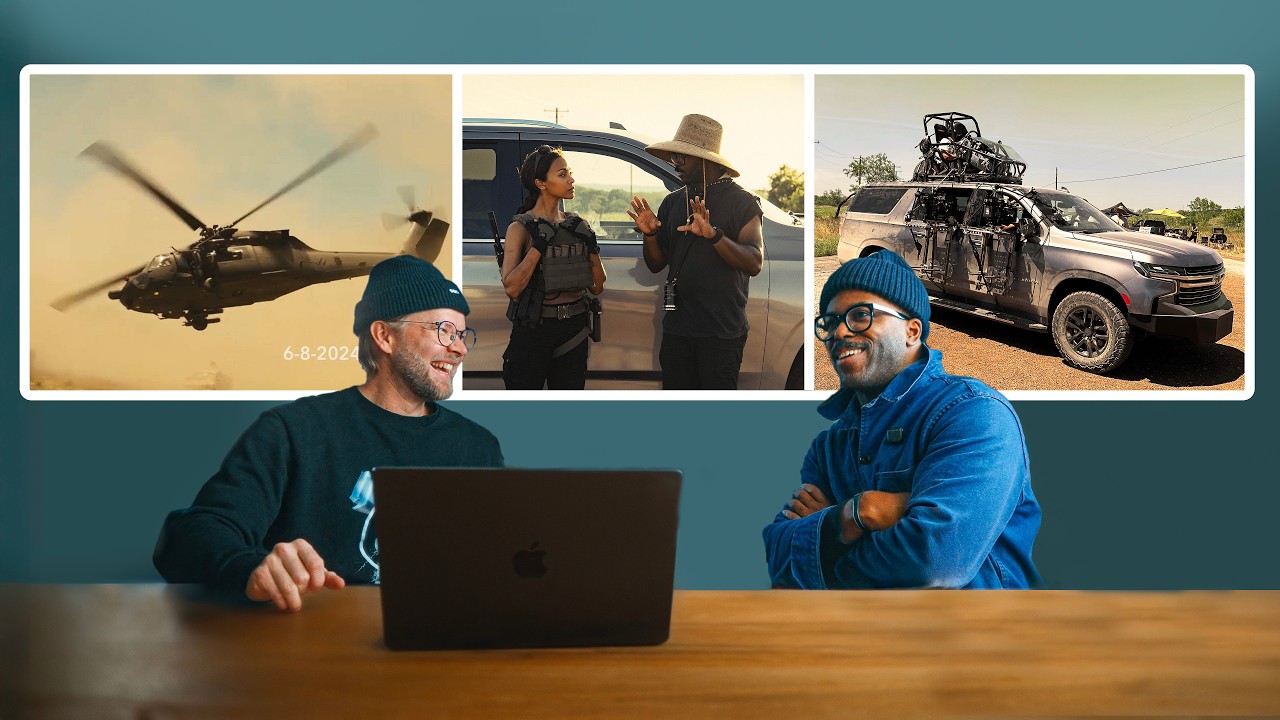
The behind-the-scenes material Campbell shared captures the gap between storyboard confidence and set-day reality. For a Humvee scene requiring complete visibility loss from blowing dust, the production ran fans through an open-windowed vehicle with camera operators kitted in goggles and dune suits, every opening sealed. Action was called, the dust fired up, and within moments the monitors went white. ‘I slide the van open,’ Campbell said, ‘and it’s just nothing. I can’t. It’s just a white cloud.’ The setup had to be adjusted before a usable take was possible.
The Blackhawk gun sequence presented a different geometry problem. The shot required seeing both the pilot and the weapon firing outside the window simultaneously, but on the actual helicopter those two elements simply do not line up. The grip team engineered a solution: they mounted the real gun on a dolly and physically walked it into the frame position needed, firing blanks on cue while the production added the rest in post. When the full explosion sequence for the final episode finally came together, with real detonations, low helicopter passes, and stunt performers in the field, Sheridan’s reaction on the cut was characteristically understated. Campbell remembered it exactly: ‘That didn’t suck.’
The Sony FX3 that survived a jackknife
For crash work, the production uses a small rigged camera rather than risking primary bodies. One FX3 went through a jackknife impact and came out intact. Campbell was unbothered by the quality gap in that specific context: ‘Nobody’s going to notice. Like, wait, the quality just dropped on this crash cam.’ The camera that absorbed the impact is now a piece of on-set lore.
Back in the airplane washroom, Campbell pinned strips of unbleached muslin to the black ceiling just above frame, not to create light but to give the camera something to lift later if needed. ‘Once there’s a little bit of information there, I know later if I need to bring it up, I can.’ The scene with Michael Kelly required a couple of exterior lights to hold consistency across a long take, but the shadow side stayed where it was. ‘I like how this looks,’ Campbell said. ‘I’m not going to add a light.’
That airplane washroom, one camera, existing overhead fixtures, a few switched off, sits exactly as Campbell left it on the day of the shoot.