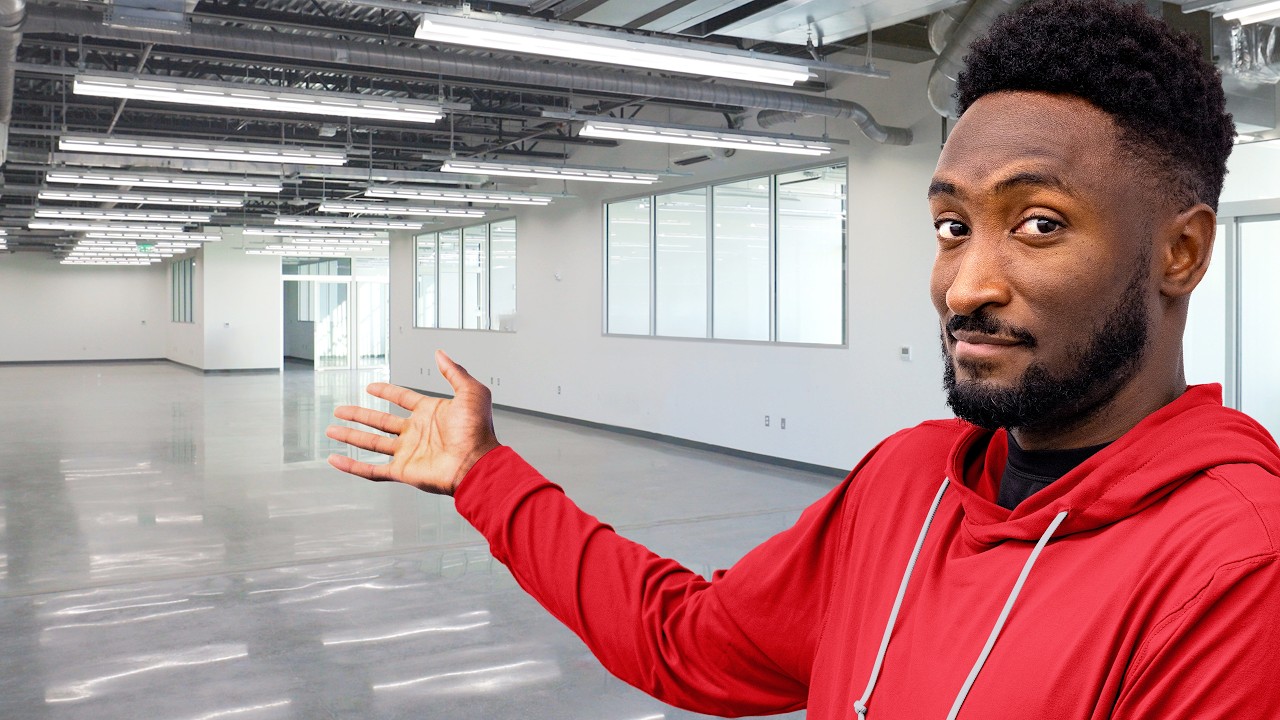
Marques Brownlee walked through the last room of his New Jersey studio and said something he had not said out loud before: this was the final tour. For anyone who has watched technology change over nearly two decades, that moment carries weight far beyond a room swap. It is a rare, unguarded look at what it actually takes to build something from nothing, and then build it again, and again, until the building itself becomes the bottleneck. The 7,000-square-foot space he was leaving held more history than its carpet tiles could carry, and those tiles alone have a story worth telling.
From a bedroom corner to a 15-person operation
The arc started in a corner of his parents’ bedroom, where Brownlee made tech tutorials with no job, no plan, and a new camera. The dorm room came next during one year of college, tight enough that squeezing in the production he called ‘the fastest Mac Mini in the world series’ required real ingenuity. Then an apartment where the bed sat on one side and the studio on the other, a single window serving as the key light, the sun dictating the schedule. That apartment, cramped as it was, had enough floor space to host the first-ever smartphone awards.
The move into what he calls the big box era came around 2016, after he spotted a billboard for an empty commercial space in a New Jersey building still under construction. He visited it with his mom. She gave him the green light to sign the lease, making him one of the building’s first tenants. The raw echo chamber needed foam on the ceiling and carpet tiles pressed down by hand, one by one, before it sounded like anywhere worth recording. He made the first dedicated top-down set there. He ran his first speed test at a then-dizzying 100 megabits per second upload.
Five years later, the team had outgrown it so completely that they were renting two additional satellite rooms down the hall, hauling gear past unrelated businesses whenever a top-down shot was needed. When the building’s owners finished a larger expansion space downstairs, they offered him first dibs. In 2020, during peak pandemic uncertainty, four people pulled up every carpet tile by hand, carried everything floor by floor, and built again inside a bigger empty box.
What 15 people and six years built inside one floor
The finished space held a logic that only accumulates through trial and error. The top-down room kept a single camera permanently mounted on a jib above a height-adjustable table, with a rack of aluminum plates wrapped in Dbrand skins standing in for marble, wood, and every other surface that has ever appeared in a product shot. ‘It’s not actually a marble table every time,’ Brownlee noted, with the matter-of-fact tone of someone who has watched that particular illusion fool millions of people for years.
Two set rooms, one with white walls and one with gray, allowed two separate builds to run simultaneously. The gear room, which began as a single desk drawer decades ago, had grown into a dedicated space organizing every Red camera body, mirrorless body, RF lens, EF lens, and PL lens the team owns. A camera robot named Colossus, controlled with a PlayStation 5 controller through motion control software, occupied its own room on a weighted base; Brownlee noted it has enough range to go out the window if someone programmed it wrong. The original robot, Mia, stayed too, kept as a reminder of where things started.
Ellis ran the audio room, the most acoustically treated space in the building, foam in every corner, bass traps, hanging curtain baffles. A separate podcast room, the smallest in the entire studio, produced the weekly Waveform recordings with a single light positioned at the center of the table to cover every host at once.
The carpet tiles that have been there for a decade
In the bullpen, the original carpet tiles from the first big box space upstairs are still down. Brownlee mentioned they are ‘not exactly aging gracefully anymore’ after roughly ten years, but every one of them made both moves and is still underfoot.
Somewhere in the building, there is also a casket. It has not been used in a video in some time. Brownlee acknowledged it is probably a mistake to still have it, but it is still there.
Four years ago, he quietly found a space he could own outright. He has been working on it in secret ever since. The carpet tiles will not be making a third trip.
 Wake up to Only Happy News!