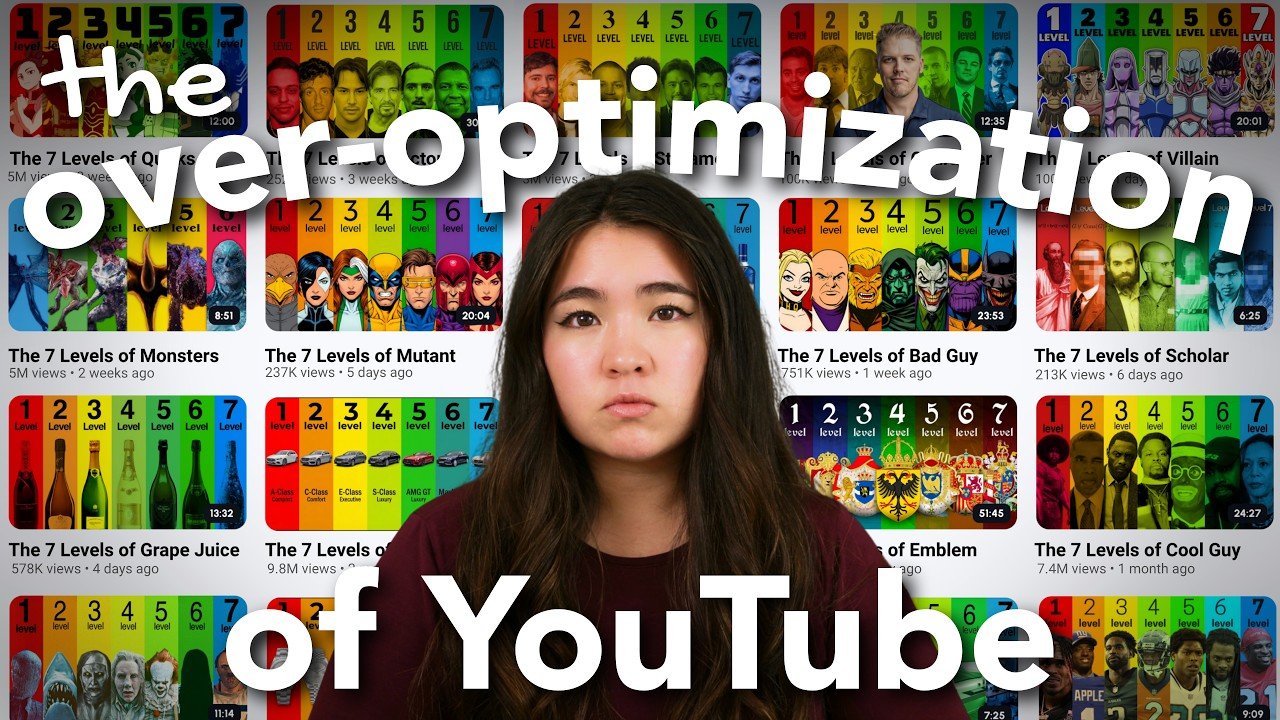
Aprilynne Alter sat down to brainstorm new video ideas for the rest of the year using the same analytical method that had served her well as a YouTube strategist, and something stopped her cold. Every idea she generated was technically new. None of these videos existed yet. And yet every single one felt like something she had already watched a dozen times before. That friction, between strategic soundness and creative déjà vu, is the tension sitting at the center of how YouTube actually works right now, and understanding it matters for anyone who watches, makes, or cares about online video. The mechanism behind it has a name: outlier theory.
The formula that quietly took over the platform
An outlier, in the YouTube sense, is a video that wildly overperforms a channel’s average. If a creator consistently earns 10,000 views per upload but one video earns 100,000, that video is an outlier, and it signals that something in its construction connected with a much broader audience. Jay Alto, a YouTube consultant whose clients have included major names in the creator economy, described the logic plainly: when a smaller channel outside the usual pattern suddenly has a video that explodes, there is clearly something to tap into.
Strategists like Alter spend their working hours identifying what that ‘something’ is: the topic angle, the title structure, the thumbnail format. Then they extract those ingredients and apply them to their own niche. It is not plagiarism. It is reverse-engineering a proven container and filling it with relevant content. And it works. Outlier theory stabilizes view counts, derisk uploads, and gives creators something validated to anchor their work to rather than taking a shot in the dark.
The problem Alter identified is what happens when everyone does this at once. When every strategic creator draws from the same pool of outliers, extracts the same structural patterns, and applies them to their own subject matter, the result is a platform that feels increasingly identical regardless of the topic. She put it plainly: ‘These videos have all done well, overperforming for their respective creators. From a purely views-based approach, these are all successful videos.’ The homogenization is a side effect of the tool working exactly as intended.
The local maximum problem and what it costs long-term
Alter reaches for a concept from machine learning to explain the deeper risk. An algorithm searching for the best outcome moves in whatever direction improves its result until it hits a peak where no immediate move seems to help. It stops, convinced it has found the answer. But that peak might only be a local maximum. A much higher hill could exist elsewhere, unreachable because getting there requires going downhill first.
Creators who exclusively build on proven outliers are, she argues, that algorithm. They find a hill that performs respectably and stay on it, because every unvalidated idea looks like going downhill. The first creator to execute a genuinely new concept captures the bulk of attention. Every follow-up version, however well made, earns only a fraction of the original because novelty is gone.
Her fix is not to abandon outlier theory but to invert its role. Start with something you genuinely want to share, then use outlier-based packaging to help that idea reach people, testing it against packaging ideas of your own. The outlier serves the idea rather than replacing it. And alongside that, she argues for protecting a small, consistent space in any upload schedule for pure experimentation: one unvalidated idea for every five or six proven ones if risk tolerance is low, but never zero.
The video she almost did not make
This essay-style piece was itself Alter’s own experiment: the first video essay she had ever made, with no proof of prior success and no outlier template behind it.
The upload that came from instinct rather than a spreadsheet arrived anyway, because she decided the data from a flop is still her data, still something she can use to build creative judgment no outlier can give her.
YouTube launched as a place to broadcast yourself: anyone, anywhere, building an audience on their own terms. That premise still holds, Alter believes, for the creators who learn to be both strategic and original, using every tool available without letting any of those tools replace their own voice.
 Wake up to Only Happy News!