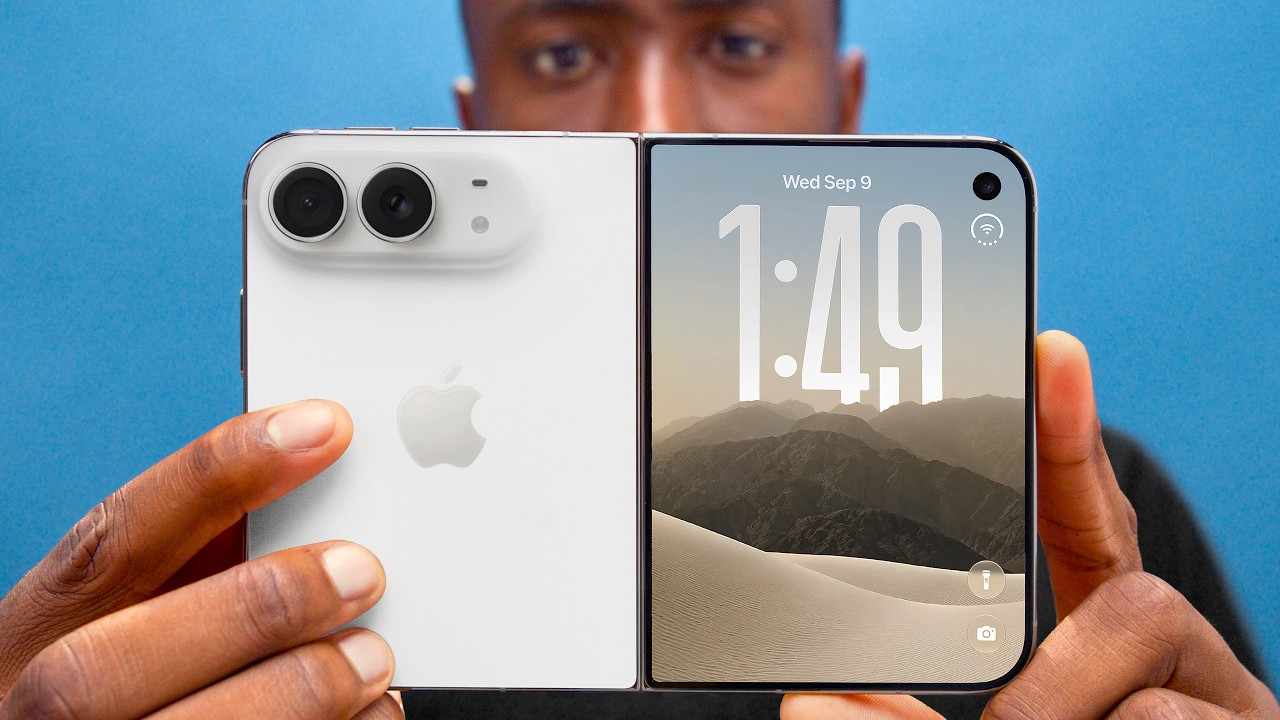
Marques Brownlee was holding the iPhone Duo for the first time in September 2026 when the animation stopped him cold. He slapped the phone shut, watched the outer screen light up instantly with zero delay, and said what a lot of people in that room were probably thinking: this thing just feels better than it has any right to. Apple had finally built a folding phone, and the question everyone wanted answered was not whether it existed but whether it was actually good.
For anyone who has watched the foldable market grind forward in fits and starts for the last several years, the arrival of a folding iPhone matters in ways that go beyond the hardware itself. Apple tends to legitimize a category simply by entering it, and with China buying more foldables than the rest of the world combined last year, the iPhone Duo is a product with real global stakes.
Brownlee had hands-on time with both the new Pro iPhones and the Duo on the day of Apple’s fall event, and his take was clear from the jump: the Pro line is a refinement story, while the Duo is something else entirely.
The Pro upgrades that need testing to mean anything
The iPhone 18 Pro and 18 Pro Max look essentially identical to their predecessors on the outside. The meaningful changes are internal, and most of them come with an asterisk until real-world testing confirms the claims. The new A20 Pro chip is built on a 2-nanometer process and carries 50% more memory bandwidth, which sounds impressive but translates to actual user experience only under specific conditions. Apple is claiming the 18 Pro will match the battery life of the 17 Pro Max, and that the 18 Pro Max will post the best battery life ever in an iPhone, despite storage capacities that do not look dramatically different on paper.
The variable aperture main camera is the hardware feature with the most immediate physical interest. Where Samsung’s Galaxy S9 offered two apertures eight years ago, f1.5 or f2.4, the 18 Pro gives users four stops they can cycle through manually, and if there is enough ambient light, you can actually watch the aperture blades open and close in real time. The sensor is also considerably larger than what Samsung was working with in those S9 days, which means the difference between wide open and stopped down could be more meaningful in practice.
The Dynamic Island is 25% smaller because the Face ID infrared camera has moved behind the display in the top-left corner. The pixel matrix up there is slightly different, but Brownlee confirmed it is invisible to the naked eye 99% of the time. The smaller cutout now allows three simultaneous Live Activities instead of two. Colors include burgundy, glacier blue, a more uniform silver, and a fully matte black that Brownlee flagged as the one calling his name. Starting price is $1,199 for the Pro and $1,299 for the Pro Max, each up $100 from last year.
Where the Duo quietly takes over the conversation
The iPhone Duo is a passport-shaped bookstyle foldable with a 5.4-inch outer display and a 7.6-inch inner display, both high refresh rate. The frame is titanium. The power button doubles as a Touch ID fingerprint reader. There is no Face ID. The dock on the outer screen sits on the right side rather than the bottom, and the UI is weighted toward right-hand reachability throughout. Opening the phone triggers a progressive fade animation that transitions content from the outer screen to the inner one with no perceptible lag.
The inner display has a nanotexture matte coating that does two things well: it cuts reflections to near zero in bright environments, and it visually minimizes the crease. Brownlee put the crease on par with the Oppo Find N6, calling it ‘basically the least crease I’ve ever seen on a folding phone.’ The hinge uses carbon fiber support plates, the ultra-thin glass layer is stiff, and between the coating and the engineering, the crease only becomes apparent when you are actively looking for it or running a finger across it.
The comparison Brownlee kept returning to was the Samsung Galaxy Z Fold 8. Functionally, the two phones are close: both carry dual cameras (a primary and an ultrawide), both have flagship chips, both are barely thicker than a USB-C port, both carry fingerprint readers on the power button. But after a couple of hours with the Duo, Brownlee landed on a sharp observation: ‘the iPhone kind of mogs the Samsung.’ The animations are cleaner, the open-to-close transition is faster, and the small quality-of-life details stack up in a way that the raw specs do not capture.
The downsides are real. The outer display is asymmetrical, rounded on the right and squared on the left. The dock is locked to four items with no apparent option to add a fifth. The under-display selfie camera on the inner screen is genuinely poor quality, a problem Samsung experimented with and abandoned for the same reason. There is no silicon-carbon battery, no ultra-fast charging, and no zoom camera. The Duo starts at $2,000, though Brownlee noted that landed lower than he had expected given the Apple premium and the general direction of flagship pricing.
It ships in October.
The dock with four items that would not budge
On the inner screen of the Duo, the dock holds exactly four apps. Brownlee tried adding a fifth and the phone simply would not allow it. No setting, no workaround surfaced in the time he had with the device.
The iPhone Duo arrives in October at $2,000, a price Brownlee described as lower than he had braced for, in a category that Apple has never entered before. Whether the animations and the crease coating and the IP68 water resistance hold up over months of daily use is the question the full review will have to answer.
 Wake up to Only Happy News!