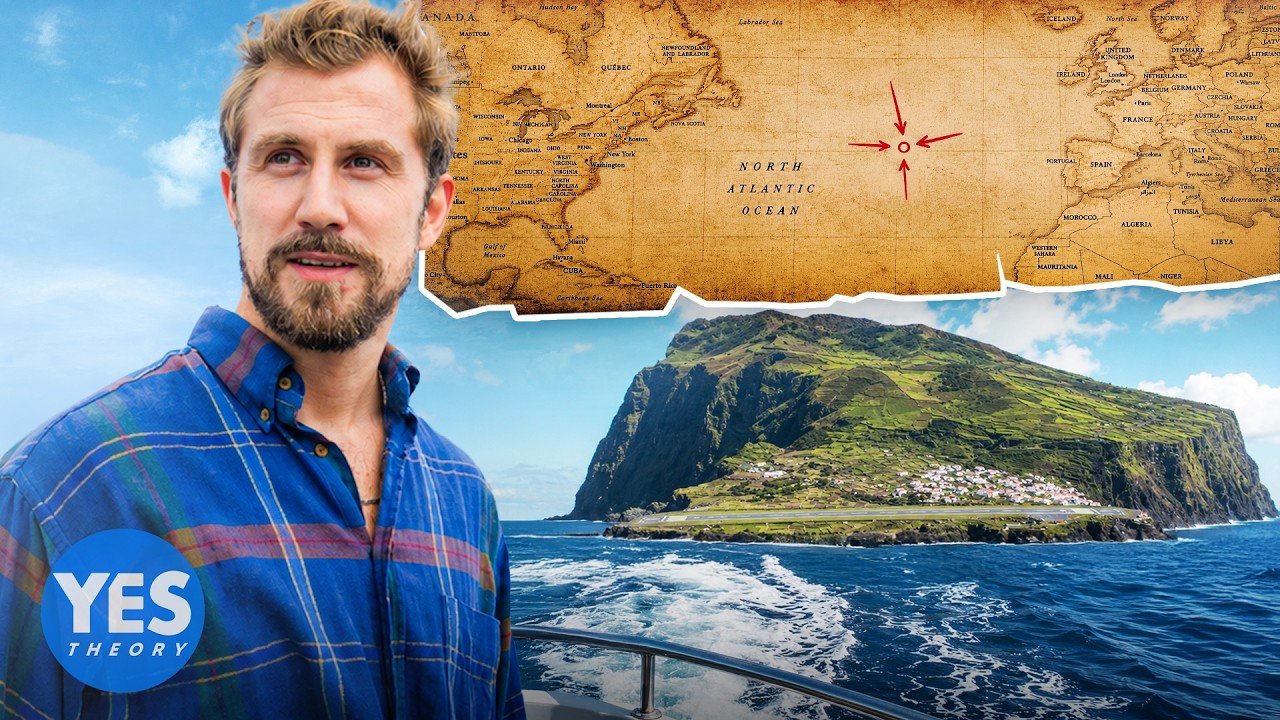
Corvo Island sits almost exactly halfway between Europe and North America in the middle of the Atlantic, a dormant volcanic speck with 400 residents, one road, one eatery, and an airport runway roughly the length of the island itself. For most of the world, the place does not even register: as one of the travelers put it on the connecting flight, ‘even Portuguese people don’t know it exists.’ Getting there is the first and most punishing part of the story, and what awaits on the other side turns out to be one of the more quietly human places left on the planet.
Two flights canceled and a pregnant stranger left behind
The trip began in Lisbon with three travelers, a film crew, and Katie, a subscriber who had won a competition run through the clothing brand Seek Discomfort and chosen this adventure as her prize. There was one complication nobody had planned for: Katie had recently found out she was pregnant. She said yes anyway. Then the logistics collapsed. The booking window between crew tickets and Katie’s ticket was long enough for the connecting flight to fill up, so they boarded separate planes toward the Azores. By the time the crew reached the layover airport, their onward flight to Corvo had been canceled outright. Katie was already in the air. She would land on a remote Atlantic island with 400 inhabitants, no working international mobile data, and no crew for at least a day.
The crew slept on airport benches in Lisbon, returned the next morning for attempt two, and then spent several hours in a holding lounge listening to a gate agent announce delays every thirty minutes. Weather at the Corvo airstrip, a narrow strip of tarmac that ends almost at the ocean, makes landing a technical exercise that the airline will simply cancel if conditions are not close to perfect. A fellow passenger waiting at the gate mentioned he had once been stranded seven days trying to reach a neighboring island. Another said six. The gate agent gave the crew a 50/50 chance of flying that day.
The boarding call finally came. The small turboprop descended through a thick ceiling of cloud, broke into grey Atlantic light at the last possible moment, and rolled to a stop at the far end of the strip. Katie was waiting at the arrivals area holding a handmade sign.
Fernando, the mayor, and a 96-year-old man who said ‘let’s go’
The only place open for food that first afternoon was the fire station bar, which served a plain burger with nothing on it. Stefan called it ‘the saddest burger I’ve ever had,’ which given the circumstances felt about right. From there, the group split to complete a set of challenges: find the mayor, find a stranger to host a home-cooked meal, and find Jose Anacleto, reported to be 96 years old and the oldest person living on Corvo.
Katie found the mayor within five minutes at a community boat race where roughly a quarter of the island’s population had gathered to watch handmade recycled-material watercraft take on the harbor. The mayor, who is also a fireman, invited the group to visit him at the mayor’s office the next morning.
The home-cooked meal challenge led to Fernando, a local fisherman and self-described chef who agreed to cook dinner on one condition: if they caught a fish together, he would cook it. They did not catch a fish. Fernando invited them anyway, spent several hours cooking, and welcomed them into his home the following evening with an elaborate spread of shrimp and local dishes, then produced an accordion and played late into the night. Fernando also drove the group up the island’s steep central hill to Caldera, the collapsed crater of an ancient volcano that formed Corvo roughly half a million years ago. The crater opened below them through tearing wind and cloud, and one of the travelers described it as ‘my best experience of my life.’
The mayor’s office provided the final piece. He knew exactly where Jose Anacleto lived and walked the group there personally. Jose agreed to come back to Caldera with them, a place he had not visited in fifteen years. He did not hesitate. ‘Let’s go,’ he said, and climbed into the car.
At the rim, looking down into the same crater, Jose said through a translator: ‘The world is a pretty good place, and I think it’s easy to forget that. Be kind, and good things will come back to you.’
A donkey named Maria and the only farm on the island
Fernando’s farm sits somewhere in the lower stretch of the island and is home to what he described as the only donkeys on Corvo. He brought the group there on the first afternoon, seemingly because he had enjoyed the conversation and wanted to extend it. Katie, who had spent time teaching English to complete beginners, was able to piece together Fernando’s stories well enough to learn that 80 percent of the island’s electricity comes from renewable energy. Her crewmates could barely ask to pet a cow.
Corvo runs on exactly that kind of quiet self-sufficiency. The island was rumored to have once been used by the Portuguese crown as a place of exile. Now its 400 residents, fewer every year according to the mayor, live without rush in a place the mayor described simply as somewhere ‘you can live like you lived in your country 100 years ago.’
The evening at Fernando’s ended with a group hug, an impromptu song, and Fernando on accordion. He had played trumpet for twenty years earlier in his life and traveled to the United States. None of that came out until the second bottle was open.
The sign Katie was holding at the airstrip
Katie’s handmade arrivals sign was still on the table at the fire station bar when the burgers arrived. Nobody mentioned it again after that.
Corvo is still out there, roughly equidistant between two continents, with its 400 people and its single runway pointed into the Atlantic. The next flight in is probably delayed.
 Wake up to Only Happy News!